The WATERUN Toolbox

Funded by the
European Union
The WATERUN Toolbox was developed as a dissemination activity of the WATERUN project, funded by the European Union under the Horizon Europe research and innovation programme (Grant Agreement No. 101060922, project duration: June 2022 – May 2026). Views and opinions expressed are however those of the author(s) only and do not necessarily reflect those of the European Union or the granting authority. Neither the European Union nor the granting authority can be held responsible for them.
This work has received funding from the Swiss State Secretariat for Education, Research and Innovation (SERI).
The WATERUN Toolbox contains key results and gathered information of the project. This Perspective has been designed to make project results and key learnings accessible as a toolkit for practitioners, urban water managers, policymakers and potential users or replicators of the solutions demonstrated under WATERUN when developing and implementing urban water runoff management plans based on the Water-Sensitive Urban Design concept.
Concept and editing: Johanna von Toggenburg (seecon)
Technical implementation: Leonellha Barreto Dillon (seecon), Simon Joncourt (seecon), and Luis Roberti Pérez (cewas)
Disclaimer
The WATERUN Perspective reflects only the authors' views and not those of the European Community or Project Coordinator. This work may rely on data sources external to the members of the WATERUN project Consortium. Members of the Consortium do not accept liability for loss or damage suffered by any third party as a result of errors or inaccuracies in such data. The information in this document is provided "as is" and no guarantee is given that the information is fit for any particular purpose. The user thereof uses the information at its sole risk and neither the European Community nor any member of the WATERUN Consortium is liable for any use that may be made of the information.
About the WATERUN Project
 WATERUN aims to develop an innovative methodology to contribute to the implementation of urban water runoff (UWR) management plans in cities based on the Water-Sensitive Urban Design (WSUD) concept. This methodology provides preventive and mitigation solutions and best management practices adopting a holistic perspective — from source identification to remediation strategies — for diffuse water pollution control in urban catchments.
The target is to transform urban water runoff management through the development of identification, planning and risk-based tools and new working procedures (guidance), counting on the early involvement of the main urban water management and governance actors through a co-creation process to ensure wider and faster adoption.
Three case studies — the city of Santiago de Compostela (Spain), the city of Aarhus (Denmark) and the city of Amman (Jordan) — have been selected according to different climate conditions, land use and level of implementation of measures for diffuse pollution, in order to validate the tools in different scenarios. Key stakeholders including RTOs, industry, public authorities, urban planners and citizens participate in a continuous co-creation process from a multidisciplinary approach, ensuring that decisions for urban water runoff management are made with complete comprehension of environmental, social and economic dimensions.
The international consortium consists of 14 partners, coordinated by AIMEN, and collaborates over a 48-month period with a total budget of €4.35 million.
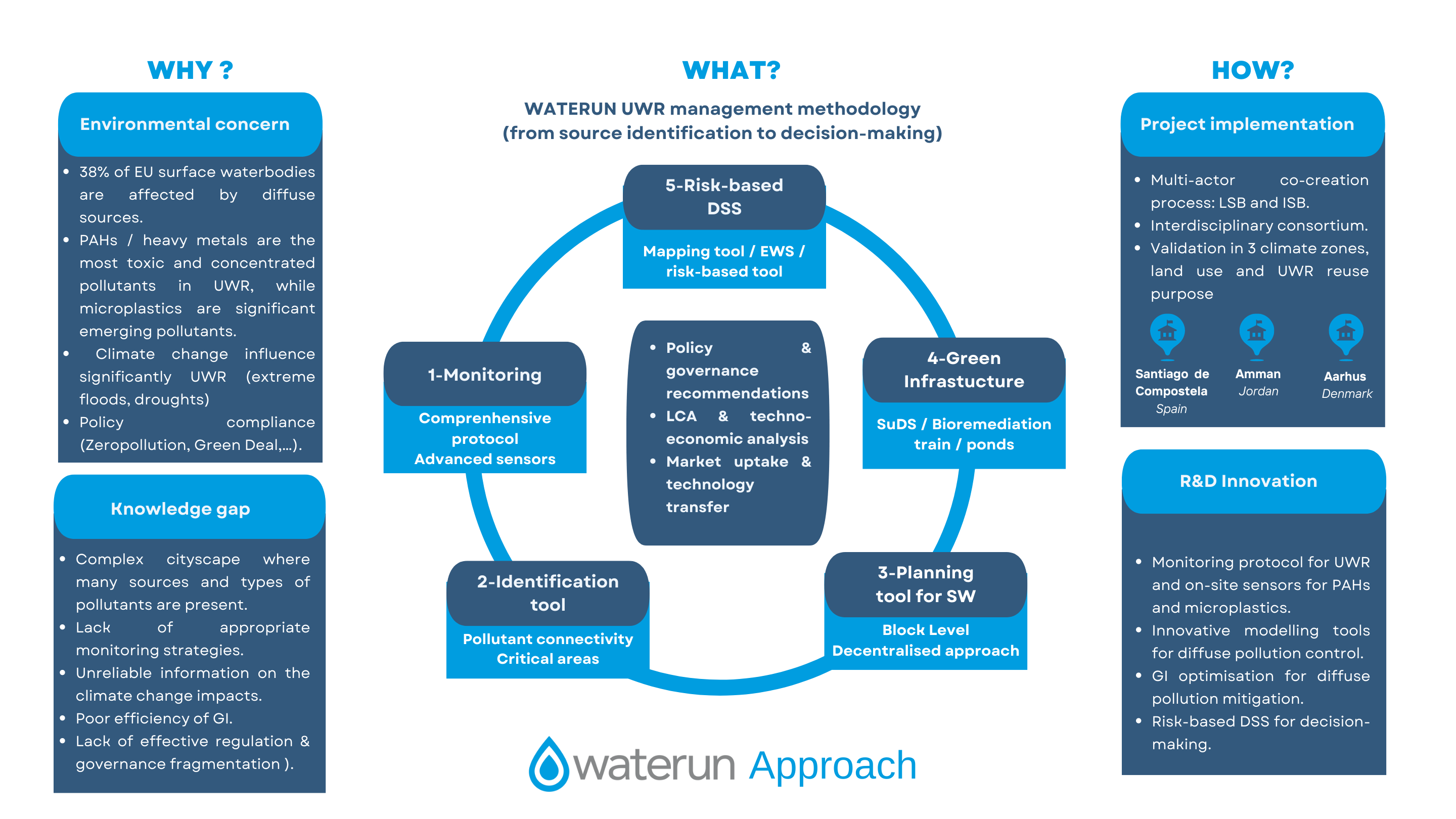
The WATERUN Project at a glance. Source: WATERUN Consortium 2022
WATERUN Objectives
The specific objectives of WATERUN were:
- 1. Establish a co-creation process involving key stakeholders (water utilities, public authorities, water regulators, water engineering companies, the research community and citizens) to ensure multidisciplinary participation in the decision-making process for UWR management based on the WSUD approach.
- 2. Develop advanced monitoring strategies for diffuse pollution control, including portable and low-cost sensors for on-site detection of PAHs and microplastics, supported by comprehensive field campaigns across the three case studies.
- 3. Develop and validate modelling tools for UWR management, including an identification tool for critical sources of urban diffuse pollution, a planning tool for stormwater management based on a decentralised approach, and a risk-based decision support system for UWR management and reuse.
- 4. Design, implement and validate Green Infrastructure (GI) based on Sustainable Drainage Systems (SuDS) and Nature-Based Solutions (NBS) for diffuse pollution mitigation in the Santiago de Compostela and Aarhus case studies.
- 5. Develop a risk management tool and guidance for decision-making, including an Early Warning System for safe UWR reuse and a ready-made output facilitating the elaboration of UWR management plans for cities.
- 6. Ensure the exploitation, dissemination and communication of WATERUN results, including technology transfer and training activities, to maximise the uptake of project outputs by practitioners, policymakers and industry.
WATERUN Workplan
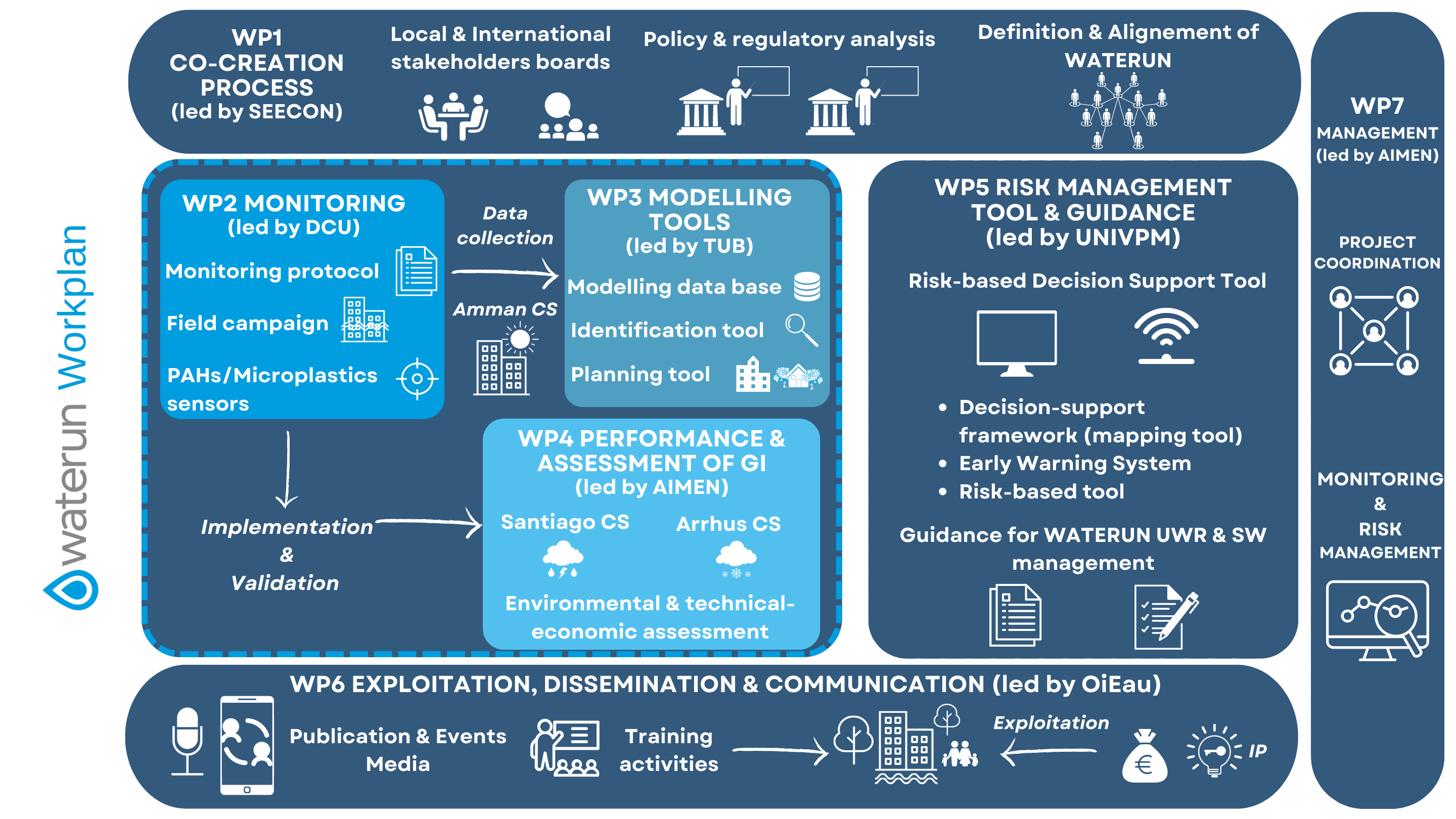
The WATERUN Workplan at a glance. Source: WATERUN Consortium 2022
A work plan consisting of 7 Work Packages (WP), with research, development, demonstration, dissemination and coordination activities, was designed and followed by the project consortium to achieve the proposed objectives within a total budget of €4.35 million and a timespan of 48 months.
WP1 “Co-creation and Methodology”, led by SEECON, was designed to establish and implement a co-creation process for efficient and multidisciplinary participation in the decision-making process and to define the WATERUN methodology. It included stakeholder mapping along the UWR management cycle, the preparation of a stakeholder participation strategy, and the definition of the working framework to assure proper information flow among all working teams.
WP2 “Advanced Monitoring”, led by DCU, focused on advanced monitoring strategies for diffuse pollution control. It included the definition of a monitoring protocol for UWR control, field campaigns across the three case studies, and the development of portable and low-cost sensors for on-site measurement of PAHs and microplastics.
WP3 “Modelling Tools”, led by TUB, aimed to develop and implement modelling tools for UWR management. This included the development of modelling databases, a diffuse pollution identification tool based on connectivity assessment, a multi-scale modelling approach to rank the severity of critical source areas, and a planning tool to estimate the maximum capacity of Green Infrastructure for reducing UWR.
WP4 “Performance and Assessment of Green Infrastructure”, led by AIMEN, aimed to design, implement and validate Green Infrastructure in the Santiago de Compostela case study and to optimise existing GI in the Aarhus case study. It included GI design and construction, operation and validation using the monitoring protocol from WP2, performance analysis, and environmental and technical-economic assessment using Life Cycle Assessment methodology.
WP5 “Risk Management and Decision Support”, led by UNIVPM, consisted of developing a risk management tool and guidance for decision-making. It included a risk-based decision support system based on environmental and health-risk assessment, an Early Warning System for safe UWR reuse and management, a risk-based tool for Water-Sensitive Urban Design, and guidance for the methodological implementation of WATERUN UWR management plans.
WP6 “Exploitation, Dissemination and Communication”, led by OiEau, covered the management and exploitation of intellectual property, dissemination and communication activities to maximise the reach of project results, and technology transfer and training activities to assure knowledge transfer from Research and Technology Organisations to companies involved in the project.
WP7 “Management and Coordination”, led by AIMEN, ensured effective project coordination as the single contact point with the European Commission, monitoring and risk management of the project through deliverables and milestones, and strategic management including consortium orientations and adjustments of the development trajectory.
Funding Acknowledgement
WATERUN has been made possible thanks to the financial support of:
The European Commission: The EC is the executive body of the European Union, and supports and fosters research through its Framework Programmes for Research and Technology Development. WATERUN (2022-2026) has received funding from the European Union’s under Horizon Europe programme under the Grant agreement n° 101060922.
Project Coordinator
WATERUN was coordinated by:
| AIMEN Technological Centre AIMEN is a Spanish non-profit multi-sector innovation and technology centre based in Galicia, with 58 years of experience in R&D&I and technological services in key areas such as materials, advanced manufacturing, digitization and sustainability. AIMEN served as the overall project coordinator, led WP4 related to the performance and assessment of Green Infrastructure across the case studies, and was responsible for the definition of monitoring protocols. AIMEN also led WP7, ensuring effective project management and coordination. Website: www.aimen.es/ |  |
Project Partners
With the participation of:
| UDC - Universidade da Coruña UDC is a Spanish public university established in 1989, located in A Coruña, Galicia, with expertise in environmental science and water quality research. UDC was responsible for the monitoring of runoff pollution in the Santiago de Compostela case study. Website: www.udc.es/ |  |
| DCU - Dublin City Universiy DCU s a public research university based in Dublin, Ireland, with expertise in sensor development, analytical chemistry and environmental monitoring. DCU was responsible for the development of advanced sensors for on-site analysis of Polycyclic Aromatic Hydrocarbons (PAHs) and microplastics in WP2. Website: www.dcu.ie/ |  |
| TUB - Technische Universität Berlin TUB is a public research university based in Berlin, Germany, with expertise in urban water management, hydrology and environmental modelling. TUB led WP3 and focused on the development of the diffuse pollution identification tool and GI location inventory. Website: www.tu.berlin/en/ |  |
| UFZ - Helmholtz Centre for Environmental Research UFZ is a German research centre based in Leipzig, devoted exclusively to environmental research spanning both basic and applied science, with expertise in water resources, urban systems and environmental remediation. UFZ was responsible for the development of the planning tool for Blue-Green Infrastructure for the reduction of urban diffuse pollution within WP3. Website: www.ufz.de/ |  |
| UNIVPM - Università Politecnica delle Marche UNIVPM is a public university based in Ancona, Italy, with expertise in environmental engineering, water quality assessment and risk management. UNIVPM was responsible for WP5 concerning the development of the risk management tool. Website: wweelab.simau.univpm.it/ |  |
| Aarhus Universitet Aarhus University is a public research university based in Aarhus, Denmark, with expertise in aquatic biology, ecophysiology and the use of wetlands and Green Infrastructure for water pollution control. Aarhus Universitet was responsible for the operation, performance analysis and upgrade of existing Green Infrastructure in the Aarhus case study, including long-term monitoring of water quality, assessment of pollutant removal (nutrients, heavy metals, PAHs and microplastics), and evaluation of GI design, capacity and maintenance within WP4. Website: www.au.dk/ |  |
| TILIA TILIA is a German owner-managed consultancy based in Berlin, specialised in supporting municipalities, utilities and companies in achieving climate protection and sustainability transformations since 2009. TILIA was responsible for the technical-economic assessment within WP4. Website: www.tilia.info/ |  |
| Viaqua Viaqua is a Spanish environmental services company based in Galicia, operating under the Veolia brand, specialised in the management of the complete urban water cycle. Viaqua was responsible for the construction and maintenance of Blue-Green Infrastructures in the Santiago de Compostela case study within WP4. Website: www.viaqua.gal | 
|
| OiEau - Office International de l'Eau OiEau is a French non-profit organisation established in 1991 and recognised as a public utility, dedicated to improving water management in France, Europe and worldwide. OiEau led WP6, dealing with exploitation, dissemination and communication of project results. Website: www.oieau.org |  |
| WAREG - European Water Regulators WAREG is a European association of public authorities responsible for the economic regulation of drinking water and wastewater services across EU member states. WAREG was responsible for the Policy Brief within WP1. Website: www.wareg.org |  |
| UJ - University of Jordan http://www.ju.edu.jo/Home.aspx is a public university based in Amman, Jordan, with expertise in environmental engineering, water resources management and urban sustainability. UJ was responsible for the Amman case study and contributed to all related work packages. Website: www.ju.edu.jo/Home.aspx |  |
| Aarhus Vand Aarhus Vand is a leading Danish public water utility based in Aarhus, responsible for drinking water supply and wastewater treatment for the city and surrounding areas. Aarhus Vand was responsible for the Aarhus case study and contributed to all related work packages. Website: www.aarhusvand.dk/ |  |
| Seecon seecon is a Swiss-based organisation founded in 1998, specialised in sustainable development, environmental management and capacity building across Europe, Asia, Africa and Latin America. SEECON led the co-creation process (WP1) and contributed to the dissemination of WATERUN results (WP6). Website: seecon.ch/ | 
|