

Compiled by: Johanna von Toggenburg
Reviewed by: Dr. Darla N. Nickel, Berliner Wasserbetriebe
Choosing measures is not the end of the process. The directive requires that you assess them before implementation, to check they are likely to work, and after, to confirm that they do.
The IUWMP is a circular process, where the monitoring data you collect after the first implementation becomes the situation analysis for your next IUWMP cycle. It must be revised at least every six years. A well-designed assessment programme does not just satisfy this cycle's reporting requirement. It also makes the next plan easier to write and more defensible to regulators.
4.1 Before you build: ex-ante assessment
Before committing to a measure programme, your assessment should address at least three questions.
Will it achieve the objectives? The measures selected in Stage 3 need to be evaluated collectively, not just individually. A portfolio of well-chosen measures at the surface level may still fall short of the system-level 2% overflow target if the network is operating close to capacity. Understanding the aggregate effect requires some form of hydraulic or water quality modelling at catchment scale. If you do not have a model, use a simpler mass-balance approach: estimate the load reduction from each measure, sum them, and compare against your Stage 2 targets. Test against future climate scenarios, not just current conditions (EUROPEAN PARLIAMENT & COUNCIL OF THE EU 2024; WILLEMS et al. 2012).
Have preventive measures been prioritised? The Assessment should consider whether preventive measures have been prioritised before mitigation, i.e. whether the plan ensures that clean water is kept out of the sewer system. A source control measure that stops pollution from entering the network is almost always cheaper than treating it further downstream. If your measure package is dominated by end-of-pipe solutions, revisit Stage 3.
Does it reduce risk to acceptable levels? Beyond load reduction percentages, the test is whether the remaining risk to the environment and to human health is acceptable. This requires a risk-based framing. You could ask whether what is being discharged is safe? This matters most near drinking water abstraction, bathing waters, and ecologically sensitive areas (WFD 2000; EUROPEAN PARLIAMENT & COUNCIL OF THE EU 2008; EUROPEAN PARLIAMENT & COUNCIL OF THE EU 2006). If your assessment reveals that residual discharges still exceed Environmental Quality Standards at a critical location, you need to either strengthen the measures or flag the gap for the next plan cycle.
WATERUN Tool 3 Must-B provides inputs for aggregated results & Tool 4 Risk-based DSS residual risk check.
4.2 Monitoring after implementation
Field monitoring of implemented measures is where many plans fall short, either because monitoring is not designed from the start, or because what gets monitored does not match what the plan was trying to achieve. Practice across various national research frameworks converges on a tiered approach (DEFRA et al. 2025; VSA 2025; US EPA 1995; MTECT 2021).
Three layers of monitoring are typically applied:
- Checking if the measure was built as planned, applied to every measure, typically through asset records and site inspections (WOODS BALLARD et al. 2015)
- Performance against planned objectives, to check if the load reductions and overflow frequencies are achieved, assessed at catchment scale using indicators and hydraulic models, recalibrated periodically with measurements at representative outfalls (DEFRA et al. 2025; REGIERUNGSRAT BASEL-STADT 2012).
- Impact on receiving waters aligned with WFD monitoring programmes to avoid duplication, with Article 21 obligations on representative CSO monitoring feeding directly into this layer (WFD 2000; EUROPEAN PARLIAMENT & COUNCIL OF THE EU 2024; ENVIRONMENT AGENCY 2017).
Wherever possible, build on monitoring data your utility already collects, so the data collected also satisfies reporting obligations under Article 22 (MTECT 2021; US EPA 1995).
4.3 Make your data review-ready
Collect data in a form that can be compared across years and aggregated into trend analyses. For each monitoring location, maintain a consistent record of:
- the parameters measured,
- the sampling method and frequency,
- the rainfall event characteristics (intensity, duration, antecedent dry period),
- the associated flow data.
Without this metadata, raw concentration numbers are difficult to interpret and impossible to compare between sites or years. Store data in an accessible, structured format. When the six-year review comes, you will need to assemble trend analyses across your entire system. If the data is scattered, that process alone can consume months.
4.4 The six-year review cycle
The Directive requires updates at least every six years (EUROPEAN PARLIAMENT & COUNCIL OF THE EU 2024). Beyond the calendar, significant events like major floods, network modifications, catchment changes should trigger a review.
Build the monitoring programme with the next revision in mind. At each review, ask:
- have the measures delivered the load reductions we predicted in Section 4.1?
- Has the receiving water quality improved?
- Have new pressures emerged since the last plan?
- Where the answers reveal gaps, cycle back to the relevant Stage - refine the system understanding (Stage 1), adjust the objectives (Stage 2), or modify the measure package (Stage 3).
Stage 4 Checkpoint. Before closing the plan, confirm you have:
- an ex-ante assessment showing the measure package can meet the Stage 2 objectives under current and future conditions,
- a monitoring programme matched to your objectives, with named parameters, frequencies, and responsibilities,
- a data management system that supports trend analysis across review cycles,
- a clear trigger for the next plan update.
----> You can go back to Stage 3 of the IUWMP Journey <----
This IUWMP Journey stage is part of seecon's practical interpretation of Annex V of Directive (EU) 2024/3019 within the WATERUN project. It is not official EU guidance. The EU Commission implementing acts on methodologies are due by 2 January 2028 (Art. 5(6)). See the Stage 0 for details on how the four stages were developed.
Guidelines for Statutory Drainage and Wastewater Management Plans (DWMPs)
Directive 2000/60/EC (Water Framework Directive)
Directive 2006/7/EC on Bathing Water Quality
Directive 2008/105/EC on Environmental Quality Standards
The use of long-term on-line turbidity measurements for the calculation of urban stormwater pollutant concentrations, loads, pollutographs and intra-event fluxes
Deliverable D5.6. Guidance Document on WATERUN Tools for IUWMP Support
This document is not currently publicly available.
WATERUN CONSORTIUM (2025): Deliverable D5.6. Guidance Document on WATERUN Tools for IUWMP Support. WATERUN Project, EU Horizon Europe Grant Agreement No. 101060922. Lead Beneficiary: UFZ.Climate change impact assessment on urban rainfall extremes and urban drainage: Methods and shortcomings
Guidelines for Statutory Drainage and Wastewater Management Plans (DWMPs)
UK statutory guidance for water and sewerage companies under section 94 of the Water Industry Act 1991. DWMPs are 25-year strategic plans produced on a 5-year cycle, structured around Strategic and Tactical Planning Units (sub-catchment and wastewater treatment works level). They require climate projections, CSO frequency analysis, WFD linkage and adaptive planning under uncertainty — making them the nearest real-world equivalent to an IUWMP.
DEFRA; ENVIRONMENT AGENCY; OFWAT; WELSH GOVERNMENT & NATURAL RESOURCES WALES (2025): Guidelines for Statutory Drainage and Wastewater Management Plans (DWMPs). London: gov.uk-Environment-Water Management. URL [Accessed: 30.04.2026]The SuDS Manual
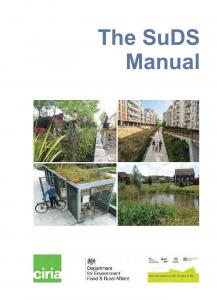
The SuDS Manual is a comprehensive technical guide on Sustainable Drainage Systems (SuDS), developed by CIRIA to support the planning, design, construction and maintenance of sustainable urban drainage solutions. It promotes approaches that reduce flood risk, improve water quality, enhance biodiversity and create more attractive urban environments through integrated surface water management. The manual also provides practical guidance on topics such as green roofs, permeable pavements, wetlands, rainwater harvesting, maintenance, community engagement and climate resilience.
WOODS BALLARD, B.; WILSON, S.; UDALE-CLARKE, H.; ILLMAN, S.; SCOTT, T.; ASHLEY, R.; and KELLAGHER, R. (2015): The SuDS Manual. London: Construction Industry Research and Information Association (CIRIA) Report C753 URL [Accessed: 15.04.2026] PDF