Mugu and Humla are among the least developed of the 75 districts of Nepal and have a sanitation coverage of 10 % only. This study assessed the sanitation situation of the area gives recommendations to for software and hardware approaches in order to reach an overall sanitation coverage.
TILLET, W. (2008): Appropriate Approaches to Hygiene and Environmental Sanitation in Remote Communities of Mugu and Humla Districts, Western Nepal. Action Contre la Faim (ACF) URL [Accessed: 02.08.2010]Library
This booklet is a chapter from “A Community Guide to Environmental Health”. It offers basic information and learning activities to help communities understand and prevent sanitation-related health problems. The booklet includes instructions for building several kinds of latrines, as well as ecological sanitation solutions.
HESPERIAN FOUNDATION (2004): Sanitation & Cleanliness for a Healthy Environment. The Hesperian Foundation in Collaboration with the United Nations Development Programme (UNDP) URL [Accessed: 01.08.2010]This video from the UNICEF shows how to wash hands. It is a good example of an educational video, especially for children.
The cartoons shown on this webpage help raising awareness for the need of a sound institutional framework in a humoristic way.
Asian Development Bank (ADB) website, non revenue water on the search section: non-revenue water components, related concepts and definitions, „caretaker approach“ etc.
News feature describing the advantages of recycling nutrients from urine in struvite form.
ETTER, B. (2008): Nepal: Pee proudly for healthy vegetables. IRC Source News. [Accessed: 29.07.2010] PDFThis site of the NETSSAF tutorial contains various documents related to the process of demand creation used in participatory planning related to sustainable sanitation. These documents can support you in your planning process and act as examples and case studies.
Livestock manures represent a valuable resource, which can produce clean renewable energy and valuable fertilizer. In many part os the world, livestock production is increasing. However, the amount of gas produced by small scale biogas plants is very limited. This paper researches how small-scale biogas plants can be adapted for use in cold regions in developing countries.
SOMMER, S.G. NORDDAHL, B. (2008): Optimising simple biogas digesters for use in cold regions of developing countries. Odense: University of Southern Denmark URL [Accessed: 29.07.2010]MSP Resource Portal
Summary, basic principles and many definitions of water balance and the focus areas to reduce non-revenue water.
NGUYEN, C.T. (2005): Non-Revenue water Assessment. Hanoi: South East Asian Water Utilities Network (SEAWUN). [Accessed: 29.07.2010] PDF- Poster with an overview on the struvite production process in Nepal, process inputs and outputs.
This report provides an overview of various agricultural irrigation methods. The variations of each general method (surface irrigation, drip/micro irrigation, sprinkler irrigation, and sub-irrigation) are described. The capabilities, limitations, institutional considerations, and economic factors of the methods and their variations are explained. These explanations will facilitate the proper selection of irrigation method for respective circumstances, depending upon crop, climate, economics, water quality, support infrastructure, energy availability, and numerous other factors.
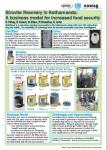
BURT, C. M. (2000): Selection of irrigation methods for agriculture. Environmental and Water Research Institute. Virginia: ASCE Publications URL [Accessed: 29.07.2010]Poster illustrating the potential of operating struvite recovery as a business for independent fertiliser production.
EAWAG (2009): Struvite recovery in Kathmandu: A business model for increased food security. Swiss Federal Institute of Aquatic Science and Technology (EAWAG). [Accessed: 29.07.2010] PDFPreliminary research on the pilot scale struvite reactor developed and operated in the Kathmandu Valley.
ETTER, B. (2009): Struvite - Recovery from urine at community scale in Nepal. Duebendorf: Swiss Federal Institute of Aquatic Science and Technology (Eawag). [Acccessed: 29.07.2010] PDFPress release on the motivation for struvite recovery in a developing country setting.
EAWAG (2009): World Toilet Day: Creating Value from Urine. Press Release. Duebendorf: Swiss Federal Institute of Aquatic Science and Technology (EAWAG). [Accessed: 29.07.2010] PDFThis site of the NETSSAF tutorial contains various documents related to the process of describing the settlement conditions in your project area. These documents can support you in your planning process and act as examples and case studies. This website contains the following documents a) A check-list of water and sanitation services conditions b) A check-list of the demographic and cultural, economic and financial, institutional and health aspects c) A check-list of the climatic and soil characteristic d) Further Readings about assessment of current status e) Guidelines for carrying out an assessment of current status f) Review of the existing participatory sanitation planning g )Materials to prepare your team for community field work and community mapping.