
HIJOSA-VALSERO, M.
; MATAMOROS, V.
; MARTÍN-VILLACORTA, J.
; BÉCARES, E.
; BAYONA, J.M.
(2010):
Assessment of full-scale natural systems for the removal of PPCPs from wastewater in small communities.
In: Water Research :
Volume 44
, 1429-1439.
Library
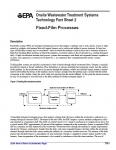
Technical factsheet on aerobic fixed-film processes (trickling filters and rotating biological contactors). Applications, main design assumptions, performance and maintenance are discussed.
U.S.EPA (2002): Onsite Wastewater Treatment Systems Manual Technology Fact Sheet 5. Fixed-Film Processes. In: U.S.EPA (1980): Onsite Wastewater Treatment Systems Manual. 008.
This presentation offers a broader view on Improved Wastewater Fertigated Short Rotation Coppice (wfSRC).
KHAHIL, N., ARIAS, C. and HÄNEL, M. (2023): TTZ - Improved Wastewater Fertigated Short Rotation Coppice (wfSRC). Training Program on Sustainable Natural and Advance Technologies and Business Partnerships for Water & Wastewater Treatment, Monitoring and Safe Water Reuse in India . PDF
Report with the description of the final implementation of the risk-based DSS in the CS of Santiago and Aarhus, including the algorithms for QMRA and QCRA analysis and the display of results in the GIS-based mapping tool for different reuse scenarios.
WATERUN CONSORTIUM (2026): Deliverable D5.3. Decision-support framework and mapping tool for water quality and risk analysis provision. WATERUN Project, EU Horizon Europe Grant Agreement No. 101060922. Document not yet publicly available.
Since 2005, ESCAP, together with Waste Concern and local partners, tested and further refined the decentralized community based composting approach in Matale, Sri Lanka and in Quy Nhon, Viet Nam. This leaflet describes a project for further replicating this approach in the Asia Pacific Region.
UNESCAP (2009): Pro-Poor Solid Waste Management for Secondary Cities and Small Towns of Asia and the Pacific. Bangkok: United Nations Economic and Social Commission for Asia and the Pacific
This pdf contains questions as an exercise for the STEP University Module 4. The questions cover the topic: Drinking water supply.
JENSSEN, P.D. (2012): Questions Module 4: Drinking Water Supply. PDF
Waste is generally defined as any material that is no longer needed or no longer useful to the owner. Wastes can be solid, liquid or gaseous, however, our focus is on solid wastes. Japan and the European Union have embarked on a different approach to reduce the materials that require landfilling. They use various conversion technologies such as composting and thermal treatment. What about the rest of the world? Open dumps – controlled or uncontrolled continue to receive solid waste every day. They constitute the most serious threat to global environmental quality. China, south Asia, Africa and South America are regions where open dumps continue to prevail. In Nigeria today, the open dumps are neither even organised nor controlled. People can just dump anything anywhere.
ABUBAKAR, M.B. (2006): Municipal Solid Waste Management: Options for Developing Countries. Kaduna: EEMS Limited
CARTER, R. and ROSS, I.
(2016):
Beyond ‘functionality’ of handpump-supplied rural water services in developing countries.
In: WATERLINES:
Volume 35
Issue 1
URL
This report contains the results of the workshop on developing a framework for the preparation of the CSPs conducted by GTZ with the CSP consultants for the cities. The objectives of the workshop were discussing the key issues in the status reports, identifying data gaps, discussing the issues in ensuring ownership at ULB/State level and developing a framework for the CSP outputs/recommendations.
GTZ (2010): Report of the Workshop on Developing a Framework for the preparation of the City Sanitation Plans. 29th September 2010 in New Delhi. Eschborn: Deutsche Gesellschaft für Technische Zusammenarbeit (GTZ)
Optimization of municipal solid waste (MSW) collection and transportation through source separation becomes one of the major concerns in the MSW management system design, due to the fact that the existing MSW management systems suffer by the high collection and transportation cost. Generally, in a city different waste sources scatter throughout the city in heterogeneous way that increase waste collection and transportation cost in the waste management system. Therefore, a shortest waste collection and transportation strategy can effectively reduce waste collection and transportation cost. In this paper, we propose an optimal MSW collection and transportation scheme that focus on the problem of minimizing the length of each waste collection and transportation route. We first formulize the MSW collection and transportation problem into a mixed integer program. Moreover, we propose a heuristic solution for the waste collection and transportation problem that can provide an optimal way for waste collection and transportation. Extensive simulations and real testbed results show that the proposed solution can significantly improve the MSW performance. Results show that the proposed scheme is able to reduce more than 30% of the total waste collection path length.
DAS, S. and BHATTACHARYYA, B. (2015): Optimization of municipal solid waste collection and transportation routes. In: Waste Management: Volume 43 , 9-18.
A field study to evaluate the use and performance of Biosand filters at the Artibonite Valley of Haiti. They found it as an attractive option for supplying safe water in rural areas of poorly developed countries with producing water in safe range in 97% of the cases
DUKE, W. BAKER, D. (2005): The Use and Performance of the Biosand Filter in the Artibonite Valley of Haiti: A Field Study of 107 Households. Victoria: University of Victoria URL
This paper gives a description of the process required to coordinate the human resources in a project.
MISHRA, S. (2007): Human Resource Management in a Project. In: PM World Today: Volume 9
http://data.unhcr.org/imtoolkit/chapters/view/emergency-needs-assessments/lang:eng
The “Emergency Information Management Toolkit, for response within the first two to four months of a refugee emergency” is the result of the latest efforts of the UNHCR in strengthening the organisation’s capacity through information and data management. The Toolkit is structured to present UNHCR information and data management advice and tools meant to inform a coordinated humanitarian response during the first two to four months of a refugee emergency, but the guidance provided is relevant and useful in a broader range of operational settings.