
A video with Dr. Mercedez Vazques, describing the Portable Monitoring System developed in the framework of WATERUN.
OiEau - International Office for Water (2025): https://www.youtube.com/watch?v=IUQX-w2aUe0 [Accessed: 15.04.2026]Library
Shiny web application of the CleanCityCover tool parameterised for four sub-areas in Aarhus.
Technical University Berlin (n.d.): https://boneyj.shinyapps.io/app2/ [Accessed: 15.04.2026]
The current (2025) Swiss national framework for municipal drainage planning, replacing the 2010 Musterpflichtenheft. Every Swiss municipality must maintain a Genereller Entwässerungsplan (GEP) and update it on an 8–10-year cycle. The Leitfaden covers situation analysis, sub-project scoping, data management and an action plan — validating the sub-catchment approach and source-control logic used throughout the IUWMP.
VSA (2025): Leitfaden GEP 2025 – Generelle Entwässerungsplanung. Glattbrugg: Verband Schweizer Abwasser- und Gewässerschutzfachleute (VSA). URL [Accessed: 15.04.2026] PDFShiny web application of the CleanCityCover tool parameterised for four sub-areas in Santiago de Compostela.
Technical University Berlin (n.d.): https://boneyj.shinyapps.io/app_Santiago/ [Accessed: 15.04.2026]
BUGALLO, L.
(2013):
Cathedral and rear of the Manor House of Raxoi, Santiago de Compostela, Galicia (Spain).
In: Wikimedia Commons. Available at:
URL
[Accessed: 15.04.2026]
WERNER, B.
(2009):
Ruins of the temple of Hercules in Amman (Jordan).
In: Wikimedia Commons. Available at :
URL
[Accessed: 15.04.2026]
BØDSKOV, L.
(20025):
Stitched panorama foto from top of the Århus rådhus over bugten and harbor (Denmark).
In: Wikimedia Commons. Available at:
URL
[Accessed: 15.04.2026]
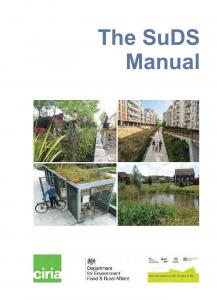
The SuDS Manual is a comprehensive technical guide on Sustainable Drainage Systems (SuDS), developed by CIRIA to support the planning, design, construction and maintenance of sustainable urban drainage solutions. It promotes approaches that reduce flood risk, improve water quality, enhance biodiversity and create more attractive urban environments through integrated surface water management. The manual also provides practical guidance on topics such as green roofs, permeable pavements, wetlands, rainwater harvesting, maintenance, community engagement and climate resilience.
WOODS BALLARD, B.; WILSON, S.; UDALE-CLARKE, H.; ILLMAN, S.; SCOTT, T.; ASHLEY, R.; and KELLAGHER, R. (2015): The SuDS Manual. London: Construction Industry Research and Information Association (CIRIA) Report C753 URL [Accessed: 15.04.2026] PDFThis is the official webpage of WATERUN, an EU-funded Horizon Europe research project focused on sustainable urban water runoff management. It develops innovative methodologies based on Water-Sensitive Urban Design (WSUD), offering cities both preventive and mitigation solutions for urban water challenges.
WATERUN.EU (2022): https://www.waterun.eu/ [Accessed: 15.04.2026]
This document is a research deliverable from the EU-funded STOPUP project focused on managing urban stormwater quality through a risk-based approach, developing tailored water quality management plans for several European case study cities. STOPUP emphasises identifying and mitigating pollution risks at source. The deliverable provides practical frameworks for assessing and controlling contaminants in urban runoff before they reach receiving water bodies.
STOPUP CONSORTIUM (2025): Deliverable 4.5 – Urban Runoff Water Quality Management Plans (URUQ-MAP) for Each Case Study. STOPUP Project, EU Horizon Europe Grant Agreement No. 101060428. Brussels: European Commission. URL [Accessed: 15.04.2026] PDF
JIA, H.; WANG, Z.; ZHEN, X.; CLAR, M.; and YU, S.L.
(2017):
China’s Sponge City Construction: A discussion on technical approaches.
In: Frontiers of Environmental Science and Engineering 11(4), 18.
URL
[Accessed: 15.04.2026]
This is the official webpage of the UFZ Stadtbüro, a service unit of the Helmholtz Centre for Environmental Research (UFZ) in Germany. It offers science-based consulting for cities and municipalities on climate-resilient urban development, with a focus on blue-green infrastructure such as urban greenery and water management solutions.
UFZ.DE (2025): https://www.ufz.de/stadt-buero/ [Accessed: 10.04.2026]This is the official Zenodo repository for UrbanWaterBlocks (v0.1), an open-source Python toolkit developed by the Helmholtz Centre for Environmental Research (UFZ). It automates decentralized urban water management at the block scale, offering tools to generate urban blocks from street networks, compute spatial and demographic attributes, and assess decentralized stormwater potential through Low-Impact Development sizing.
ZENODO.ORG (2026): https://zenodo.org/records/17396242 [Accessed: 10.04.2026]This is the official repository of pysewer, an open-source Python tool developed by the Water-Sensitive Infrastructure Planning (WASP) group at the Helmholtz Centre for Environmental Research (UFZ). It provides a framework for automatically generating cost-efficient sewer network layouts with minimal data requirements, targeting sanitary engineers, infrastructure planners, and researchers involved in preliminary planning and analysis.
GIT.UFZ.DE (2023): https://git.ufz.de/despot/pysewer [Accessed: 10.04.2026]
KHURELBAATAR, G., RODRIGUEZ, S. P. R, AUBRON, T., RAHMAN, K. Z., KHALIL, N., VAN AFFERDEN, M., BREULMANN, M., FRISEN, J., MÜLLER, R. A.
(2024):
Preliminary planning and optimization tool for wastewater infrastructure for regions with low data availability.
In: Water 16(5): 694:
URL
[Accessed: 15.04.2024]
PDF