A review of strategies for encouraging hand washing with soap in developing countries.
CURTIS, V. ; DANQUAH, L. ; AUNGER, R. (2009): Planned, motivated and habitual hygiene behavior: an eleven country review. In: Health Education Research, March 13: URL [Accessed: 06.05.2019]Library
An academic review of industrial water reuse between mining industries in Australia. Barriers and triggers to cooperation are discussed.
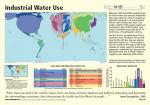
BEERS, D. van ; CORDER, G. ; BOSSILKOV, A. ; BERKEL, R. van (2007): Industrial Symbiosis in the Australian Minerals Industry. In: Journal of Industrial Ecology : Volume 11 , 55-72. URL [Accessed: 06.05.2019]This document illustrates the water use in industry around the world.
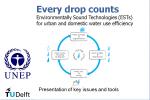
SASI GROUP (2006): Industrial Water Use. Sheffield: SASI Group URL [Accessed: 06.05.2019]Presentation with 60 slides on key issues in water saving at household level, containing backgrounds of decision making (policies and criteria) and a number of environmentally sound technologies storage, supply, use, reuse & recycling.
UNEP ; TU DELFT (2008): Every Drop Counts. PowerPoint Presentation. Osaka & Delft: United Nations Environment Programme (UNEP) and TU DELFT URL [Accessed: 06.05.2019]This webpage describes several quick and easy hints that can help you save water in your kitchen, laundry, bathroom, and garden.
SA WATER (2009): Save water inside your home. Adelaide: SA Water URL [Accessed: 06.05.2019]This website from the Australian government provides information regarding greywater reuse systems, reuse possibilities, and treatment systems at the household level.
COMMONWEALTH OF AUSTRALIA (2005): Wastewater Re-Use. Canberra Act: Department of Climate Change and Energy Efficiency URL [Accessed: 06.05.2019]This paper gives an overview about the water use in Industry of the past years and makes a projection of future uses. Furthermore, the paper gives advices how to save water in the future.
GROBICKI, A. (n.y): The Future of Water Use in Industry. Global Ministerial Forum on Research for Health. Geneva: World Health Organization URL [Accessed: 06.05.2019]Example - This site by the city of Longmont describes prohibitions for storm drain discharges directly to the river without treatment.
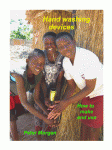
The information in this simple booklet has been accumulated over many years by the writer The school is perhaps the very best place with a special focus on promoting the importance of hand washing and teaching the simplest methods of making hand washers at schools.
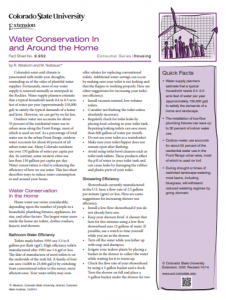
MORGAN, P. (2011): Hand Washing Devices. How to Make and Use. Zimbabwe: Aquamor Pvt Ltd. URL [Accessed: 06.05.2019]This paper gives an overview of the water use on household level in Colorado. Furthermore, the document contains some water saving advices.
WASKOM, R. NEIBAUER, M. (2014): Water Conservation In and Around the Home. Colorado: Colorado State University. Fact Sheet No. 9.952. Consumer Series/Housing URL [Accessed: 06.05.2019]This brief explores the role of water tariffs and subsidies as key instrument to achieve the objective of providing safe and affordable drinking water to residents of growing urban areas in developing countries.
BLANC, D. le (2007): Providing Water to the Urban Poor in Developing Countries: The Role of Tariffs and Subsidies. In: Sustainable Development Innovation Brief: Volume 4 URL [Accessed: 03.05.2019]The website of UN DESA (UN Department of Economic and Social Affaires) contains a section dedicated to water issues, including publications about water tariffs and subsidies in the provision of water services in developing countries.
This paper presents a case for removing metropolitan permanent water restrictions by 2012 in Australian cities. To achieve this goal, a water industry reform will need to be pursued on a number of fronts.
ALLEN CONSULTING (2007): Saying Goodbye to Permanent Water Restrictions in Australia's Cities. Key Priorities for Achieving Water Security. ALLEN CONSULTING URL [Accessed: 03.05.2019]This paper focuses on the role of prices in the water sector and how they can be used to promote equity, efficiency, and sustainability.
ROGERS, P. ; SILVA, R. de ; BATHIA, R. (2001): Water is an Economic Good: How to use Prices to Promote Equity, Efficiency, and Sustainability. In: Water Policy : Volume 4 , 1–17. URL [Accessed: 03.05.2019]This paper provides an excellent overview on financing and cost recovery for the water supply and sanitation services sector in rural and low-income urban areas of developing countries. The document contains also case studies and mini reviews of best publications on financing and cost recovery.
CARDONE, R. FONSECA, C. (2003): Financing and Cost Recovery. Delft (The Netherlands): IRC (International Water and Sanitation Centre). Thematic Overview Paper 7. URL [Accessed: 03.05.2019]