
SELA, G.
(n.y):
https://www.smart-fertilizer.com/articles/drip-irrigation
"Online image".
Smart Fertilizer Management
[Accessed: 08.05.2019]
Library
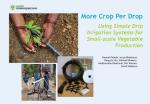
Simple low-cost drip irrigation is practical and affordable for smallholder farmers. It has been successfully used in India and is becoming more popular in other southeast Asia and sub-Saharan Africa. It can reduce both water and labor use by as much as 20-50%. Yield of vegetables also can be increased by at least 10%. Our farm trials in Cambodia showed yield increases of 20-50% compared to traditional hand watering. Low pressure irrigation is also a key component of the African Market Garden concept jointly developed in west Africa with ICRISAT. This 10-chapter drip irrigation manual provides basic, step-by-step procedures for installing simple drip irrigation systems for different crops, climates, and soils.
PALADA, M. BHATTARAI, S. WU, D. ROBERTS, M. BHATTARAI, M. KIMSAN, R. MIDMORE, D. (2011): More Crop Per Drop. Using Simple Drip Irrigation Systems for Small-scale Vegetable Production. Shanhua, Tainan: AVRDC - The World Vegetable Center URL [Accessed: 08.05.2019]
Volume III of the Guidelines for the Safe Use of Wastewater, Excreta and Greywater deals with wastewater and excreta use in aquaculture and describes the present state of knowledge regarding the impact of wastewater-fed aquaculture on the health of producers, product consumers and local communities. It assesses the associated health risks and provides an integrated preventive management framework.
WHO (2006): Guidelines for the safe use of wastewater excreta and greywater. Volume III. Wastewater and Excreta Use in Aquaculture. Geneva: World Health Organisation URL [Accessed: 08.05.2019]
This is the report of a Study Group that considered food safety issues associated with farmed finfish and crustaceans. The principal conclusion was that an integrated approach — involving close collaboration between the aquaculture, agriculture, food safety, health and education sectors — is needed to identify and control hazards associated with products from aquaculture.
FAO ; NACA ; WHO (1999): Food Safety Issues Associated with Products from Aquaculture. (= WHO Technical Report Series , 883 ). Washington: World Health Organization (WHO) URL [Accessed: 08.05.2019]
https://www.ifad.org/en/web/operations/country/id/eritrea
[Accessed: 08.05.2019]
Water is precious in Eritrea, where farmers have to cope with droughts and crop failures. With support from the government and an IFAD-funded project, farmers and herders are expanding spate irrigation, an ancient form of water management. By harnessing floodwaters and collecting run-off, farmers can provide enough water for the crop season. Now some farmers can obtain yields that are six times what they used to be.
ENCISO, J. PORTER, D. BORDOVSKY, J. FIPPS, G.
(2010):
Maintaining Subsurface Drip Irrigation Systems.
College Station:
The Irrigation Technology Center
URL
[Accessed: 08.05.2019]
Study on the use of greywater for agricultural irrigation in the South African context with special focus on comparing the irrigation of plants with nutrient solution, greywater and tap water.
SALUKAZANA, L. JACKSON, S. RODDA, N. SMITH, M. GOUNDEN, T. MACLEOD, N. BUCKLEY, C. (n.y): Re-use of Greywater for Agricultural Irrigation. Kwazulu-Natal: University of Kwazulu-Natal URL [Accessed: 08.05.2019]
This literature review provides a first overview of the possibilities, potentials and limits of duckweed aquaculture and its combined use in wastewater treatment and animal feed production in low and middle-income countries. It is somewhat limited as critical literature on duckweed field use is scarce and difficult to obtain (e.g. unpublished internal documents).
IQBAL, S. (1999): Duckweed Aquaculture. Potentials, Possibilities and Limitations for Combined Wastewater Treatment and Animal Feed Production in Developing Countries. Duebendorf: Swiss Federal Institute of Aquatic Science and Technology (Eawag) URL [Accessed: 08.05.2019]
Whereas spate irrigation is the ultimate adaptation to climate variability, this document prepared for IFAD is an overview of likely impact of climate change and practical possibilities for livelihood improvement.
STEENBERGEN, F. van VERHEIJEN, O. AARST, S. van HAILE, M.H. (n.y): Spate Irrigation, Livelihood Improvement and Adaptation to Climate Variability and Change. URL [Accessed: 08.05.2019]
This paper reviews minimum design recommendations and a case study of remediation efforts on an existing commercial field.
ROGERS, D.H. LAMM, F.R. CLARK, G.A. (2004): Subsurface Drip Irrigation (SDI) System Remediation - A Case Study. St. Joseph: American Society of Agricultural and Biological Engineers URL [Accessed: 08.05.2019]
Keeping soil salinity low in the root zone is crucial to growers of salt-sensitive crops. This study investigated patterns of soil salinity under surface and subsurface drip irrigation. High soil salinity occurred midway between drip laterals for both irrigation methods and above the drip tape for subsurface drip irrigation. Rainfall leached the salts from the zones of high salinity for both irrigation methods.
HANSON, B.R. ; BENDIXEN, W.E. (1995): Drip Irrigation Controls Soil Salinity Under Row Crops. In: California Agriculture: URL [Accessed: 08.05.2019]
Short description on a container gardening system for dry areas based on walls with built-in growth boxes made of hollow concrete blocks and developed by a Swedish horticulturist in Botswana.
WINBLAD, U. SIMPSON-HERBERT, M. (2004): Box 5.4 Vertical gardens in Gaberone, Botswana. In: WINBLAD, U. ; SIMPSON-HERBERT, M. ; (2004): Ecological Sanitation - revised and enlarged edition. (pdf presentation). Sweden: 83. URL [Accessed: 08.05.2019]
Growing vegetables in containers can improve diets and raise incomes for urban residents in the Philippines.
AVRDC (2011): Small Spaces, Big Returns. Shanhua, Tainan: AVRDC - The World Vegetable Center URL [Accessed: 08.05.2019]
DOYLE, W.
; PEARCE, J. M.
(2009):
Utilization of Virtual Globes for Open Source Industrial Symbiosis.
In: Open Environmental Journal :
Volume 3
, 88-96.
URL
[Accessed: 07.05.2019]
CARDENAS-LAILHACAR, B.
(2006):
Sensor-Based Automation of Irrigation of Bermudagrass.
(= Master Thesis
).
Gainesville:
University of Florida
URL
[Accessed: 07.05.2019]
A field study was conducted on sunflower by using different irrigation techniques, such as basin, furrow and raingun sprinkler systems at Post-Graduate Agricultural Research Station (PARS), University of Agriculture, Faisalabad during 1998-2002. The comparison of irrigation efficiencies, nitrate leaching and the yield of sunflower was noted.
RANA, M.A. ARSHAD, M. MASUD, J. (2006): Effect of Basin, Furrow and Raingun Sprinkler Irrigation Systems on Irrigation Efficiencies, Nitrate-Nitrogen Leaching and Yield of Sunflower. Islamabad: Pakistan Journal of Water Resources URL [Accessed: 07.05.2019]
This is a very detailed document about surface irrigation simulation, evaluation and design. The aim of the manuscript is to improve the water irrigation management, which is an important step to guarantee security and stability in food supplies. You will be able to find the PDF presentation downloading the ZIP archive and opening the Surface Irrigation Design file.
WALKER, W.R. (2003): SIRMOD III - Surface Irrigation Simulation Evaluation and Design. Guide and Technical Documentation. "PDF Presentation". Logan, Utah (USA): Utah State University (USU). URL [Accessed: 07.05.2019]
MELTON, P.
(2012):
Occupant Engagement–Where Design Meets Performance.
In: Environmental Building Rules:
Volume 20
, 11.
URL
[Accessed: 07.05.2019]
This study presents a scheme for the development of a Geographic Information Systems (GIS) based decision support system (DSS) for real time water demand estimation in distributaries.
RAO, N.H. ; BROWNEE, S.M. ; SARMA, P.B.S. (2004): GIS-Based Decision Support System for Real Time Water Demand Estimation in Canal Irrigation Systems. In: Current Science: Volume 87 , 628-636. URL [Accessed: 07.05.2019]
This field guide has been developed to accommodate the ever-increasing demand for more detailed and scientifically backed information on how to use urine in agricultural production. It is intended primarily for practitioners and experts in the water, sanitation, planning, and agriculture sectors, as well as local and national government officials from the various sectors, NGO and individuals interested and working in the field of agriculture and sustainable sanitation in the Philippines and the wider Southeast Asian region.
GENSCH, R. MISO, A. ITSCHON, G. (2011): Urine as Liquid Fertilizer in Agricultural Production in the Philippines. Cagayan de Oro: Sustainable Sanitation Center Xavier University (XU), the Philippine Sustainable Sanitation Knowledge Node, the Philippine Ecosan Network, and the Sustainable Sanitation Alliance (SuSanA) URL [Accessed: 07.05.2019]