This factsheet provides information on the link between sanitation and agriculture as well as related implications on health, economy and environment. It shows examples of treating and using treated excreta and wastewater in a productive way and describes the potential for urban agriculture and resource recovery in rural areas. Institutional and legal aspects, business opportunities and how to manage associated health risks are also discussed
GENSCH, R. DAGERSKOG, L. WINKLER, M. VEENHUIZEN, R. van DRECHSEL, P. (2011): Productive Sanitation and the Link to Food Security. Sustainable Sanitation Alliance (SuSanA) URL [Accessed: 09.05.2019]Library
This presentation gives information on hydropower technology and contains some facts and figures on worldwide hydro power projects. It also shows some basis operations equations for hydropower, including some environmental, social and economic aspects to take into consideration in the construction phase of hydropower projects.
MIT (2005): Hydro Power – A Case Study. Cambridge, Massachusetts: Massachusetts Institute of Technology (MIT) Laboratory for Energy and the Environment URL [Accessed: 09.05.2019]The guide is intended to provide engineers, ecologists and planners with up-to-date information and direction on landscape-based stormwater management planning and low impact development stormwater management practices such as rainwater harvesting, green roofs, bioretention, permeable pavement, soakaways and swales. The information contained in the guide will help practitioners adopt landscape-based stormwater management approaches, and will help select, design, construct and monitor more sustainable stormwater management practices.
TRCA ; CVC (2010): Low Impact Development Stormwater Management Planning and Design Guide. Downsview and Mississauga: Toronto and Region Conservation Authority (TRCA) and Toronto and Region Conservation Authority (CVC) URL [Accessed: 09.05.2019]The ROSA project has been working on promoting resource oriented sanitation systems that focus on implementation of simple, cost effective and affordable sanitation units and carrying out research on these pilot units. This booklet attempts to provide practical information about the activities carried out by Arba Minch town ROSA project including information on the implementation and testing of greywater towers.
ROSA (2006): Arba Minch town ROSA project. Project Booklet. Resource Oriented Sanitation concepts for peri-urban areas in Africa. Ethiopia: Arba Minch University URL [Accessed: 09.05.2019]This manual about stormwater management includes the three main topics “Hydrology and Stormwater Runoff”, “Site Planning and Nonstructural Approaches” and “Structural Best Management Practices”.
DEP ; CZM (1997): Stormwater Management. Volume Two: Stormwater Technical Handbook. Boston: MA Department of Environmental Protection (DEP) and MA Office of Coastal Zone Management (CZM) URL [Accessed: 09.05.2019]This book is a historical account of the use of waterwheels in Newfoundland, Canada. It provides descriptions as well as technical drawings of the many types of waterwheels that were used in this region.
ROBERTSON, A. (2005): Water Power Sawmills in New Foundland. St John’s: Alexander Robertson URL [Accessed: 09.05.2019]This factsheet provides a view on worldwide figures on hydropower such as total capacity, costs and potential and barriers to expand hydropower capacity in Asia, Africa and South America.
LAKO, P. (2010): Hydropower. (= Energy Technology Systems Analysis Programme, Technology Brief E06 ). Paris: International Energy Agency URL [Accessed: 09.05.2019]This guide brings together all the aspects related to developing of small hydropower ranging from business, engineering, financial, legal and administration. The document is presented in a step-by-step approach and is very helpful tool for practitioners and potential local developers of small hydropower scheme.
ESHA (2004): Guide on How to Develop a Small Hydropower Plant. Brussels, Belgium: European Small Hydropower Association (ESHA) URL [Accessed: 09.05.2019]This document is a broad research study of the environmental effects of Tucuruı ́ Dam in Brazilian Amazonia.
FEARNSIDE, P. (2001): Environmental Impacts of Brazil’s Tucurui Dam: Unlearned Lessons for Hydroelectric Development in Amazonia. In: Environmental Management : Volume 27 , 377–396. URL [Accessed: 09.05.2019]The Atlantis underground tank system is a modular sub surface system that can be constructed to hold any volume required. The sub surface location of the tank frees up space for landscaping or driveway use while also ensuring optimal conditions for retaining water is always maintained. Macro and micro pollutants are completely kept out of the system through an Atlantis Filtration Unit. It is used for infiltration, detention and to store roof top harvested rainwater.
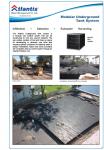
ATLANTIS (n.y): Modular Underground Tanks System. Sidney: Atlantis URL [Accessed: 09.05.2019]This document presents the general overview of small hydropower development and how it can contribute to meet the electricity needs of the national grid as well as the isolated rural areas. It presents a case study from Nepal that shows how a country that relied on external assistance for its hydropower development has now developed its local capability and utilised the internal resources available to develop it hydropower resources, especially the small hydro projects.
BASNYAT, D. (2006): Fundamentals of Small Hydro Power Technologies. Nairobi. Kenya: African Development Bank FINESSE training course on Renewable Energy and Energy Efficiency for Poverty Reduction URL [Accessed: 09.05.2019]This book describes how to construct Arborloo toilets and how it can be upgraded to VIPs at a later stage.
MORGAN, P. EcoSanRes (2009): Ecological Toilets. (pdf presentation). Stockholm: Stockholm Environment Institute URL [Accessed: 09.05.2019]These guidelines are intended to help municipalities, local authorities, consulting engineers, and developers in the planning and design of stormwater management systems in Alberta. They outline the objectives of stormwater management and the available methodologies and concepts for the planning, design, and operation of stormwater drainage systems. In addition to the water quantity aspects of stormwater management, the publication also describes some of the techniques that can be applied for quality management of stormwater.
ALBERTA ENVIRONMENT (1999): Stormwater Management Guidelines for the Province of Alberta. Edmonton: Alberta Environmental Protection URL [Accessed: 09.05.2019]This is one of a series of fact sheets on potential income generating activities.
WHIRISKEY, J. and MC CARTHY, P. (2006): Small-Scale Hydroelectricity. Galway: Teagasc, Mellows Development Centre URL [Accessed: 09.05.2019]Paper on container gardening in Cagayan de Oro (Philippines) as a way of growing vegetables in urban areas.
DEVEZA, K. HOLMER, R. (2002): Container Gardening – A Way of Growing Vegetables in the City. Paper presented at the Urban Vegetable Gardening Seminar. Cagayan de Oro City, Philippines: Sundayag Sa Amihanang Mindanao Trade Expo URL [Accessed: 08.05.2019]The survey focuses on the determinants of success and failure and identifies knowledge gaps that influenced either adoption or disadoption by beneficiaries. A cost-effectiveness analysis is also undertaken to compare drip kits with traditional bucket irrigation. Finally, the study draws some conclusions and lessons that can be extrapolated beyond Zimbabwe to ensure that interventions aimed at smallholder-irrigated gardens have more sustainable impacts.
BELDER, P. ROHRBACH, D. TWOMLOW, S. SENZANJE, A. (2007): Can Drip Irrigation Improve the Livelihoods of Smallholders? Lessons Learned from Zimbabwe. Bulawayo: International Crops Research Institute for the Semi-Arid Tropics (ICRISAT) URL [Accessed: 08.05.2019]This case study focuses on the water management of the Dodota spate irrigation system, the first large scale spate irrigation system in Ethiopia. This system in the Oromia state has been recently designed and constructed to establish food-self sufficiency in an area chronically affected by food deficits and supported by food aid for over 25 years. The following main research question guided this study: How is water management taking place in the new Dodota spate irrigation system and what are the impacts and effects for irrigation, soil conservation practices, and production?
HAM, J.P. van den (2008): Dodota Spate Irrigation System Ethiopia. A case study of Spate Irrigation Management and Livelihood options . Wageningen: Wageningen University URL [Accessed: 08.05.2019]A document about drip irrigation system including components, design advices, management of the system and additional resources.
SHOCK, C. (2006): Drip Irrigation: An Introduction. Corvallis: Oregon State University URL [Accessed: 08.05.2019]