These guidelines aim to impart knowledge about water loss reduction to decision-makers and stakeholders at the national level and to the management team, planning and design department and operating staff at local water utilities in developing and transition countries. The guidelines are accompanied by capacity development materials as well as the implementation of pilot projects in order to transfer know-how and implement state-of-the art pressure management (PM) technology in practice.
GIZ (2011): Guidelines for Water Loss Reduction. A Focus on Pressure Management. Eschborn: Deutsche Gesellschaft für Internationale Zusammenarbeit (GIZ) GmbH URL [Accessed: 13.05.2019]Library
This document presents 7 myths commonly believed about water supply in rural areas.
RWSN (2010): Myths of the Rural Water Supply Sector. St. Gallen: The Rural Water Supply Network (RWSN) URL [Accessed: 13.05.2019]The report investigates access to and use of drinking water in greater detail than is possible in the regular JMP progress reports, and includes increased disaggregation of water service levels and analyses of trends across countries and regions. It focuses on the three key challenges of equity, safety and sustainability.
UNICEF ; WHO (2011): Drinking Water: Equity, Safety and Sustainability. New York and Geneva: United Nations Children's Fund (UNICEF) and World Health Organization (WHO) URL [Accessed: 13.05.2019]Typically, the large urban areas represent concentrated demands, both due to large populations and large per capita use and waste. Most urban areas have depleted, polluted or destroyed their local sources of water like rivers, lakes and tanks and in many cases even groundwater. This case study presentsdecentralised approach where powers are devolved to local institutions and where co-ordination among the state, private sector and civil society are ensured for evolving water supply options
SANDRP (1999): Assessment of Water Supply Options for Urban India. Large Dams Have No Case. New Delhi: South Asia Network on Dams, Rivers and People (SANDRP) URL [Accessed: 13.05.2019]The “How it Works” section of the company FLUSHMATE explains the flush system of its low-flush toilets.
A document on water supply evaluation methods.
HICKEY, H.E. (2008): Water Supply Systems and Evaluation Methods. Volume II: Water Supply Evaluation Methods. Emmitsburg: U.S. Fire Administration URL [Accessed: 13.05.2019]This book provides a general introduction to a wide range of technologies. Among the topics covered are: planning and management of small water supplies, community water supplies in Central and Eastern European countries, water quality and quantity, integrated water resources management, artificial recharge, rainwater harvesting, spring water tapping, groundwater withdrawal, water lifting, surface water intake, water treatment, aeration, coagulation and flocculation, sedimentation, multi-stage filtration, desalination technology, disinfection, household level water treatment, technologies for arsenic and iron removal from ground water, and emergency and disaster water supply. Chapter 21: Water Distribution
SMET, J. ; WIJK, C. van (2002): Small Community Water Supplies: Technology, People and Partnership: Water Distribution - Chapter 21. The Hague: International Water and Sanitation Centre (IRC) URL [Accessed: 13.05.2019]Fossa alterna with a urine diversion component (optional). Image from Flickr
This study aims at finding out if the Peepoo meets the expectations and perceptions of end users, if it is biodegradable and also if it is economically viable in terms of generating organic manure for sale.
JAC (2009): Impact Assessment Report on the Peepoo bags, Silanga Village, Kibera, Nairobi-Kenya. Nairobi: Jean Africa Consultants (JAC) URL [Accessed: 12.05.2019]Factsheet including information related to microbial die-off rates and health risks.
U.S. EPA (1999): Water Efficiency Technology Fact Sheet - Composting Toilets. Washington D.C. (USA): United States Environmental Protection Agency (US EPA), Office of Water. EPA 832-F-99-066 URL [Accessed: 12.05.2019]This GIZ publication explains the design, use and operational requirements of composting toilets. Ample examples for composting toilets from around the world are included in the publication to show that these types of toilets have a wide range of applications under a variety of circumstances (for wealthy or poor people; for cold, hot, wet or dry climates; for urban or rural settings). The appendix contains a listing of suppliers.
BERGER, W. (2011): Technology Review of Composting Toilets. Eschborn: Deutsche Gesellschaft für Internationale Zusammenarbeit (GIZ) URL [Accessed: 12.05.2019]This case study is about a demonstration project in the headquarters of GTZ in Eschborn, Germany. The project consists of 50 urine-diversion flush toilets, 23 waterless urinals and 10 m³ urine storage tank.
WINKER, M. SADOUN, A. (2011): Urine and brownwater separation at the GTZ main office building, Eschborn, Germany. (= SuSanA - Case Studies ). Eschborn: Sustainable Sanitation Alliance (SuSanA) URL [Accessed: 12.05.2019]End-product from 16 public mixed latrine style composting toilets (CTs) at 12 sites between 50 and 2100 m.a.s.l. in Western North America was tested in order to evaluate the effect of composting variables on compost quality and hygiene.
HILL, G. B. ; BALDWIN, S. A. ; VINNERAAS, B. (2013): Composting Toilets a Misnomer: Excessive Ammonia from Urine Inhibits Microbial Activity yet Is Insufficient in Sanitizing the End-Product. In: Journal of Environmental Management: Volume 119 , 29-35. URL [Accessed: 12.05.2019]From 2000 to 2006, the cross-cutting project Novaquatis explored the potential of urine source separation – also known as NoMix technology. Novaquatis comprises nine work packages, largely organized around the various stages of a nutrient cycle (e.g. user acceptation, sanitary technologies, storage and transport, urine treatment and fertiliser production, micropollutants in urine, urine-based fertilisers). The final report contains the results of all working packages as well as a practical guide for interested NoMix user.
LARSEN, T. A. LIENERT, J. (2007): Novaquatis final report. NoMix – A new approach to urban water management. Duebendorf: Swiss Federal Institute for Environmental Science (EAWAG) URL [Accessed: 12.05.2019]Critical article by environmental activist and Stockholm Water Price Laureate Sunita Narain, on why it is mindless to waste so much clean water to flush away excreta.
NARAIN, S. (2002): The Flush Toilet is Ecologically Mindless. In: Down to Earth: Volume 19 URL [Accessed: 12.05.2019]This case study investigates whether toilet bags are a feasible sanitation alternative for poor urban settlements including the socio-cultural acceptance.
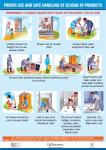
GTZ (2009): Results of a medium-scale trial of single-use, self-sanitising toilet bags in poor urban settlements in Bangladesh. Eschborn: German Agency for Technical Cooperation (GTZ) GmbH URL [Accessed: 12.05.2019]This poster illustrates how to use Ecosan toilets and handle faecal compost in a safe way.
NETWAS (n.y): Proper Use and Safe Handling of Ecosan By-Products. Kampala: Network for Water and Sanitation (NETWAS) URL [Accessed: 11.05.2019]This article provides detailed information on terra preta, the historical background and the latest ideas and theories of creating a synthetic terra preta.
BALLIETT, A. (2007): Terra Preta. Magic Soil of the Lost Amazon. In: Acres U.S.A. The Voice of Eco-Agriculture: Volume 37 , 16-18. URL [Accessed: 11.05.2019]