This document includes course contents on advanced treatment plants including suspended and dissolved solid removal, phosphate removal, dissolved organic compounds removal with different techniques.
SUBRAMANIAN, M.S. (n.y): Advanced Waste Water Treatment . Module 1.5. In: NPTEL: URL [Accessed: 22.05.2019]Library
This website provides an introduction of membrane processes including microfiltration nanofiltration, and ultrafiltration.
This document gives an overview on the role of chlorination in disinfecting drinking water. It includes information on chlorine and waterborne disease, disinfection by-products, and compares chlorine to alternative disinfection methods such as ozone and ultraviolet radiation.
C4 (2003): Drinking Water Chlorination. A Review of Disinfection Issues and Practices. Chlorine Chemistry Council (C3) and Canadian Chlorine Coordinating Committee (C4) URL [Accessed: 22.05.2019]This document summarises main advancements performed within European projects in the field of membrane technologies for water treatment
EC (2010): Membrane Technologies for Water Applications. Highlights from a selection of European research projects. Brussels: European Commission (EC) URL [Accessed: 22.05.2019]This case study outlines the activities of an engineering consulting firm that has been contracted to submit a preliminary design for a new water treatment plant for a rural community in Nova Scotia, Canada.
WALSH, M.E. GAGNON, G.A. (2006): Evaluating Membrane Processes for Drinking Water Treatment Design. Halifax, Canada: Association of Environmental Engineering & Science Professors URL [Accessed: 22.05.2019]These equipment packages have been devised by the Oxfam Public Health Engineering Team and others to help provide a reliable water supply, primarily for emergency situations such as in refugee camps and disaster-relief operations. The equipment is designed to be readily available, easily transported, simple to use, rapidly assembled, and fully self-contained, to provide an adequate water supply at moderate cost.
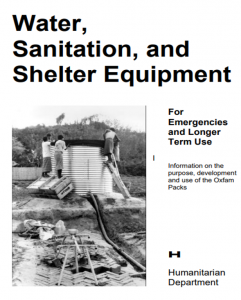
OXFAM (2000): Water, Sanitation, and Shelter Equipment. For Emergencies and Longer Term Use. Oxford: OXFAM URL [Accessed: 21.05.2019]This document presents the results of a pilot study aiming at removing water micropollutants at the Lausanne (Switzerland) wastewater treatment plant.
MARGOT, J. ; MAGNET, A. ; THONNEY, D. ; CHEVRE, N. ; ALENCASTRO, F. de ; ROSSI, L. (2011): Traitement des Micropolluants dans les Eaux Uses-Rapport Final sur les Essais Pilotes a la STEP de Vidy (Lausanne). In: Ed. Ville de Lausanne : URL [Accessed: 21.05.2019]Factsheet on the principles, construction, operation and maintenance of arsenic removal via complexation for drinking water treatment at household level.
CAWST (2009): Arsenic Removal. Complexation. (= Household Water Treatment and Safe Storage Fact Sheet - Academic ). Centre for Affordable Water and Sanitation Technology (CAWST) URL [Accessed: 21.05.2019]A three-page factsheet containing introduction, operation procedure, treatment efficiency, operating criteria and other information related to settling.
CAWST (2009): Settling. (= Household Water Treatment and Safe Storage Fact Sheets ). Calgary: Centre for Affordable Water and Sanitation Technology (CAWST) URL [Accessed: 21.05.2019]This is the webpage of a producer of mobile compact water purification and desalination units from Switzerland.
This review article focuses on the treatment of textile wastewaters by means of different AOPs.
ADEL, A. K. ; AZNI, I. ; KATAYON, S. ; CHUAH, T.G. (2004): Treatment of Textile Wastewater by Advanced Oxidation Processes – A Review. In: Global Nest: the International Journal – General Information: Volume 6 , 222-230. URL [Accessed: 21.05.2019]This short manual describes purpose, development and use of standard water and sanitation equipment packages of OXFAM, as well as individual packages for water storage, water pumping, borehole drilling, but also excreta disposal and shelter equipment. These measures can serve urgent but also longer term needs.
OXFAM (2000): Water, Sanitation, and Shelter Equipment. For Emergencies and Longer Term. Oxford: Humanitarian Department Oxfam URL [Accessed: 21.05.2019]This publication discusses the effects of pH, temperature, flow rate, contaminant nature, activated carbon type etc. on adsorption.
DESILVA, F. (2000): Activated Carbon Filtration. In: Water Quality Products Magazine : URL [Accessed: 21.05.2019]This case study of 400 households in camps for displaced people in Monrovia, Liberia, highlights that POU water treatment with a flocculant-disinfectant plus improved water storage reduced diarrhoea incidence by 90%.
DOOCY, S. BURNHAM, G. (2006): Point-of-use Water Treatment and Diarrhoea Reduction in the Emergency Context: an Effectiveness Trial in Liberia. Baltimore: Johns Hopkins University Center for Refugee and Disaster Response URL [Accessed: 21.05.2019]This site has a wealth of resources for water, sanitation and hygiene (WASH) practitioners collected by the International Federation of Red Cross and Red Crescent Societies (IFRC) with a focus on emergency situations.
Product specification of activated carbon from Coconut Shell Based Products in India.