
PURAIR
(n.y):
Wood based Powder Activated Carbon.
Hebei (China):
Purair Carbon Filter Company
URL
[Accessed: 22.05.2019]
Library
This study evaluated changes in drinking water quality resulting from an intervention that provided large closed water storage tanks (2,500-gallons) to individual homes lacking a piped water supply.
GRAHAM, J.P. ; VANDERSLICE, J. (2007): The Effectiveness of Large Household Water Storage Tanks for Protecting the Quality of Drinking Water. In: Journal of Water and Health: , 307-313. URL [Accessed: 22.05.2019]
This document includes course contents on advanced treatment plants including suspended and dissolved solid removal, phosphate removal, dissolved organic compounds removal with different techniques.
SUBRAMANIAN, M.S. (n.y): Advanced Waste Water Treatment . Module 1.5. In: NPTEL: URL [Accessed: 22.05.2019]
https://www.koshland-science-museum.org/water/html/en/Treatment/Membrane-Processes.html
[Accessed: 22.05.2019]
This website provides an introduction of membrane processes including microfiltration nanofiltration, and ultrafiltration.
This document gives an overview on the role of chlorination in disinfecting drinking water. It includes information on chlorine and waterborne disease, disinfection by-products, and compares chlorine to alternative disinfection methods such as ozone and ultraviolet radiation.
C4 (2003): Drinking Water Chlorination. A Review of Disinfection Issues and Practices. Chlorine Chemistry Council (C3) and Canadian Chlorine Coordinating Committee (C4) URL [Accessed: 22.05.2019]
AEPPLI, J.
; DYER-SMITH, P.
(1996):
Ozonation and Granular Activated Carbon Filtration the Solution to Many Problems.
In: Proceedings of the First Australiasian Conference of the International Ozone Association:
URL
[Accessed: 21.05.2019]

This document outlines the social and economical relevance of photocatalysis, provides background information on the technology, and highlights further challenges to be addressed.
MULLER, N. ; NOWACK, B. ; OY, S. ; SAARI, J. (2010): Photocatalysis for Water Treatment. In: ObservatoryNANO Briefings: URL [Accessed: 21.05.2019]
The most common technologies for arsenic removal utilise conventional processes like oxidation, co-precipitation, adsorption, ion exchange and membrane techniques. The paper gives a short review of all these technologies, which are used in Bangladesh and India.
AHMED, M. F. (2001): An Overview of Arsenic Removal Technologies in Bangladesh and India. In: BANGLADESH UNIVERSITY OF ENGINEERING AND TECHNOLOGY ; UNITED NATIONS UNIVERSITY (2001): Technologies for Arsenic Removal from Drinking Water. Dhaka: 251-269. URL [Accessed: 21.05.2019]
This presentation given in a course at the New Jersey Institute of Technology gives a theoretical and technical overview of adsorption on granular activated carbon.
ARMENANTE, P.M. (n.y): Adsorption with Granular Activated Carbon (GAC) . URL [Accessed: 21.05.2019]
CHALINDER, A.
(1994):
Water and Sanitation in Emergencies. Good Practice .
(= Review 1
).
London:
Overseas Development Institute
URL
[Accessed: 21.05.2019]
LEA, M.
(2010):
Bioremediation of Turbid Surface Water Using Seed Extract from Moringa Oleifera Lam. (Drumstick) Tree.
URL
[Accessed: 21.05.2019]
This publication describes the combination of ozone and ultrasounds for the disinfection and discoloration of domestic wastewater treatment plant effluents for reuse purposes.
SELCUK, H. ; NADDEO, V. ; BELGIONO, V. (2007): Advanced Treatment by Ozonation and Sonolysis for Domestic Wastewater Reuse. In: Proceedings of the 10th International Conference on Environmental Science and Technology: URL [Accessed: 21.05.2019]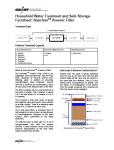
Factsheet on the principles, construction, operation and maintenance of kanchan filters (for arsenic and pathogen removal) for drinking water treatment at household level.
CAWST (2009): Kanchan Filter. Fact Sheet - Academic. (= Household Water Treatment and Safe Storage Fact Sheet - Academic ). Centre for Affordable Water and Sanitation Technology (CAWST) URL [Accessed: 21.05.2019]
REED, B. SHAW, R.
(1999):
Emergency Water Supply.
Leicestershire (UK):
Water, Engineering and Development Centre (WEDC), Loughborough University. Technical Brief No. 44
URL
[Accessed: 21.05.2019]
These equipment packages have been devised by the Oxfam Public Health Engineering Team and others to help provide a reliable water supply, primarily for emergency situations such as in refugee camps and disaster-relief operations. The equipment is designed to be readily available, easily transported, simple to use, rapidly assembled, and fully self-contained, to provide an adequate water supply at moderate cost.
OXFAM (2000): Water, Sanitation, and Shelter Equipment. For Emergencies and Longer Term Use. Oxford: OXFAM URL [Accessed: 21.05.2019]
KOMMINENI, S.
; ZOECKLER, J.
; STOCKING, A.
; LIANG, S.
; FLORES, A.
; KAVANAUGH, M.
(2008):
Advanced Oxidation Processes.
In: National Water Research Institute:
URL
[Accessed: 21.05.2019]
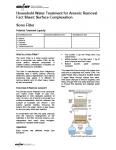
Factsheet on the principles, construction, operation and maintenance of arsenic removal via complexation for drinking water treatment at household level.
CAWST (2009): Arsenic Removal. Complexation. (= Household Water Treatment and Safe Storage Fact Sheet - Academic ). Centre for Affordable Water and Sanitation Technology (CAWST) URL [Accessed: 21.05.2019]
A three-page factsheet containing introduction, operation procedure, treatment efficiency, operating criteria and other information related to settling.
CAWST (2009): Settling. (= Household Water Treatment and Safe Storage Fact Sheets ). Calgary: Centre for Affordable Water and Sanitation Technology (CAWST) URL [Accessed: 21.05.2019]
This document presents the results of a pilot study aiming at removing water micropollutants at the Lausanne (Switzerland) wastewater treatment plant.
MARGOT, J. ; MAGNET, A. ; THONNEY, D. ; CHEVRE, N. ; ALENCASTRO, F. de ; ROSSI, L. (2011): Traitement des Micropolluants dans les Eaux Uses-Rapport Final sur les Essais Pilotes a la STEP de Vidy (Lausanne). In: Ed. Ville de Lausanne : URL [Accessed: 21.05.2019]
COMNINELLIS, C.
; KAPALKA, A.
; MALATO, S.
; PARSON, S.A.
; POULIOS, L.
; MANTZAVINOS, D.
(2008):
Perspective Advanced Oxidation Processes for Water Treatment: Advanced and Trends for R&D.
In: Journal of Chemical Technology and Biotechnology:
Volume 83
, 769-776.
URL
[Accessed: 21.05.2019]