This publication contains laboratory and field studies to characterise the UV- tube performance at flow rate of 5L/m. It presents the UV tube as a promising technology for treating household drinking water at the point of use.
BROWNELL, S.A. ; CHAKRABARTI, A.R. ; KASER, F.M. ; CONNELLY, L.G. ; PELETZ, R.L. ; REYGADAS, F. ; LANG, M.J. ; KAMMEN, D.M. ; NELSON, K.L. (2008): Assessment of a low-cost, point-of-use, ultraviolet water disinfection technology. In: Journal of Water and Health: Volume 6 , 53-65.Library
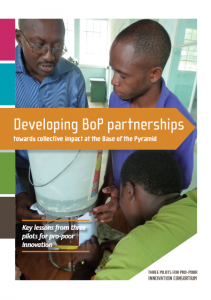
This publication is based on insights gathered through the programme ‘Three Pilots for Pro-Poor Innovation’ (3P4PPI). Associated business partners are SNV, Mueller B.V., The Fruit Republic and Fresh Studio to develop and implement innovations in Kenya, Vietnam, Ethiopia, Rwanda and Bangladesh. These insights illustrated in this publication will help the private and the public sector scale inclusive innovations and achieve results for the BoP.
VAN DER KLEIN, W. SPRENGER, T. COLLÉE, L. BROUWER, H. VAN TUBERGEN, K. BULTS, R. (2013): Developing BoP partnerships towards collective impact at the Base of the Pyramid. Utrecht: BoP Innovation CenterThis paper describes the different physicochemical properties of soils, and their organic and inorganic constituents that allow for degradation of pollutants present in wastewater.
JOSHI, S. ; JOSHI, S. ; KUBER, B. (2002): Physicochemical and biological processes of wastewater irrigation and land treatment. First Workshop on Reuse of Treated Wastewater and Sludge for Agriculture in South Asia. In: Proceedings of International Work Plan of GWP – SASTAC on Reuse of City Effluents :Training session plan on undergroung Rain Water Harvesting System
ODENTHAL, M. (2023): Training Session Plan - Underground Rain Water Harvesting System. Training Program on Sustainable Natural and Advance Technologies and Business Partnerships for Water & Wastewater Treatment, Monitoring and Safe Water Reuse in India . PDFA case study in a rural Muslim community to investigate cultural factors affecting the choice of sanitation solutions. The study underlines the importance of incorporating cultural preferences in the planning of improved sanitation, particularly when designing low-cost ecological systems.
NAWAB, B. NYBORG, I. ESSER, K. JENSSEN, P. (n.y): Cultural Preferences in Designing Ecological Sanitation Systems in North West Frontier Province, Pakistan.Taking as an example the Eritrean city of Asmara, this paper presents the findings of a study that used a newly developed model to calculate waste flows and waste management costs, and to simulate various alternative scenarios.
ROTHENBERGER, S. (2007): Does Decentralized Composting Make Economic Sense? . Duebendorf: EAWAGThis is part one of the research study of Ohio State University on the impact of vermicompost on tea production and plant growth where the research study found out that aerating vermicompost tea during brewing results in significant growth responses, even at the concentration tested.
ARANCON, N.Q. EDWARDS, C.A. DICK, R. DICK, L. (2007): Vermicompost Tea Production and Plant Growth Impacts. Ohio State UniversityThe Sphere Handbook, Humanitarian Charter and Minimum Standards in Humanitarian Response, is one of the most widely known and internationally recognized sets of common principles and universal minimum standards in life-saving areas of humanitarian response.
Humanitarian information source on global crises and disasters. It is a specialised digital service of the UN Office for the Coordination of Humanitarian Affairs (OCHA). It provides reliable and timely information for humanitarian workers to make timely decisions to plan an effective response.
This study has evaluated eleven precipitated phosphates as sources of phosphorus (P) or plant growth by comparing their effectiveness with that of monocalcium phosphate (MCP), a source of water-soluble P that is generally considered to be fully plant available. The precipitated phosphates comprised Struvites recovered from wastewater discharges (mainly magnesium ammonium phosphate), laboratory synthesised Struvites, a synthetic iron phosphate and a recovered calcium phosphate. The grass dry-matter yields and P offtakes given by the synthetic and recovered Struvites were not significantly different statistically either between themselves or to MCP applied at the same rate. On this basis these Struvites could be used to recycle P to similar soils and the effect of the P on crop yield should be similar to that of MCP.
JOHNSTON, A.E. ; RICHARDS, I.R. (2004): Effectiveness of Different Precipitated Phosphates as Phosphorus Sources for Plants. In: Phosphorus Research Bulletin : Volume 15 , 52-59.In 1991, the first subsurface flow constructed wetland for treatment of domestic wastewater was built in Norway. Today, this method is rapidly becoming a popular method for wastewater treatment in rural Norway. This is due to excellent performance even during winter and low maintenance. The systems can be constructed regardless of site conditions.
JENSSEN, P.D. ; MAEHLUM, T. ; KROGSTAD, T. ; VRALE, L. (2005): High Performance Constructed Wetlands for Cold Climates. In: Journal of Environmental Science and Health: Volume 40 , 1343-1353.