PDF presentation on the technical and non-technical aspects of sanitation systems in developing countries.
EAWAG/SANDEC (2008): Sanitation Systems and Technologies. Presentation. (= Sandec Training Tool 1.0, Module 4 ). Duebendorf: Swiss Federal Institute of Aquatic Science (Eawag), Department of Water and Sanitation in Developing Countries (Sandec)Library
Report describing the development, configuration and complete structure of the Early Warning System, including outcomes of the performed simulations in the case studies of Santiago and Aarhus.
THE WATERUN CONSORTIUM (2022): Deliverable D5.4: Implementation of EWS for a safe UWR reuse and management. In: WATERUN Project, EU Horizon Europe Grant Agreement No. 101060922. Document not yet publicly available :This brochure describes composting and the “Community-based Waste Management and Composting Pilot Program,” implemented in urban slum and suburban areas of Bangladesh by Waste Concern, with support from Government of Bangladesh and UNICEF.
WASTE CONCERN Community based Composting. Dhaka: Waste ConcernThis document is part of a set of three resource documents included in the Integrity Management toolbox for Water service Providers (WsPs):
- Facilitator’s Guide
- Description of WsP Integrity risks
- Description of WsP Integrity Instruments (this document)
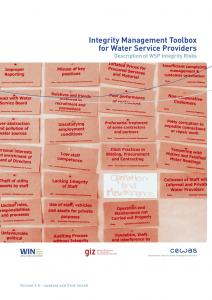
This description of WsP Integrity risks provides detailed descriptions of the most common integrity risks for WsPs, including examples of “red flags” (warning signs indicating potential lack of integrity in a WsP) and concrete examples from different public sources for each risk. the integrity risks are organised in six categories, which are oriented along the departments / work areas commonly found in WsPs:
- Customer relations
- Operations and maintenance
- Financial management
- Procurement and contract management
- Governance, management and controls
- Human resources management and employment
Most of the integrity risks at the level of WsPs are generic and comparable across the globe. A handful of country-specific risks do, however, exist. Most of these country-specific risks are likely to be found in the risk area “Governance, management and controls” and
are for example linked to the political and regulatory framework, the governance of WsPs, or the roles and responsibilities of other water sector institutions.
Master thesis on biophysical and operational aspects of anaerobic bio-digesters in rural Honduras. Bio-digester processes, the operational practices for plastic balloon bio-digesters and a typology of successful bio-digester operation are developed.
GREEN, S. (2005): Emerging Biodigester Technology in Honduras: Biophysical Processes and Operation. (= Master Thesis ). Montana: University of MontanaThis document provides practical tools for appropriate sanitation implementation. It contains guidelines for sanitation and technical option sheets.
HUBA-MANG, E. PANZERBIETER, T. (2006): Sanitation is more than Life - Sustainable Sanitation Options for Sri Lanka. (= Guidelines and Technical Option Sheets , 3 ). Singapore: World Toilet Organization (WTO)This video provides an overview of biosand filter and its promotion in developing countries.
After the preparation of the City Sanitation Plan (CSP) of Kochi, India, GIZ has initiated this intervention among others. The development of Slums has emerged as one of the key intervention to be addressed to bring about overall improvement in the sanitation profile of the city.
GIZ (2012): Preparation of Pollution Discharge Register at Rameshwaram-Kalvathy Canal. Eschborn: Gesellschaft fuer Internationale Zusammenarbeit (GIZ)