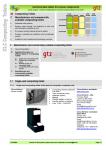
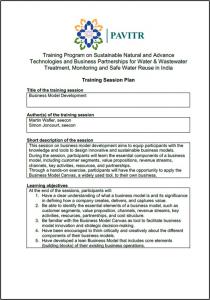
Session plan on Business Partnership Models
WAFLER, M. and JONCOURT, S. (2023): Training Session Plan. Training Program on Sustainable Natural and Advance Technologies and Business Partnerships for Water & Wastewater Treatment, Monitoring and Safe Water Reuse in India. PDFLibrary
Un archivo de presentación en *.pdf donde se mencionan todos los aspectos relacionados con Ecosan y además se presentan ejemplos de aplicación.
WERNER, C. KIMMICH, S. KLINGEL, F. MANG, H. (2003): Ecosan- Enfoques de Circuito Cerrado en el Manejo de Aguas Residuales y Saneamiento. Eschborn: Deutsche GesellschaftfürTechnischeZusammenarbeitLanguage: Spanish
A case study of a rural village in the Indian state Tamil Nadu focusing on alternative sources of water because of depleting groundwater and pollution of the nearby rivers.
OLSEN, D. CAMPBELL, C. (2009): Engineers Without Borders. Rainwater Harvesting Case Study. Ontario, Canada: Waterloo Faculty of EngineeringThis PowerPoint presentation (in pdf format) gives an overview on different ecosan hardware including urine-diversion twin-pit pour-flush toilets; double-vault urine-diversion dehydration toilets; single-vault urine-diversion dehydration toilets; composting toilets; toilet-linked biogas systems; decentralized wastewater treatment systems; constructed wetlands; vermin-composting; rainwater harvesting.
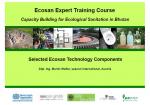
WAFLER (2006): Selected Ecosan Technology Components. (= Ecosan Expert Training Course “Capacity Building for Ecological Sanitation in Bhutan ). Vienna: seecon international gmbhThis document introduces us to the objectives and guidelines of water reuse. In describes all possible reuse application of water, technical issues in planning water reuse systems, legal and institutional issues, funding of water reuse systems, public involvement programs, guidelines in the U.S. and other countries.
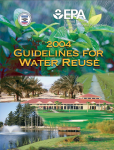
U.S. EPA (2004): Guidelines for Water Reuse. Washington, DC: Environmental Protection Agency (EPA)Child stunting and anemia are intractable public health problems in developing countries and have profound short- and long-term consequences. The Sanitation Hygiene Infant Nutrition Efficacy (SHINE) trial is motivated by the premise that environmental enteric dysfunction (EED) is a major underlying cause of both stunting and anemia, that chronic inflammation is the central characteristic of EED mediating these adverse effects, and that EED is primarily caused by high fecal ingestion due to living in conditions of poor water, sanitation, and hygiene (WASH).
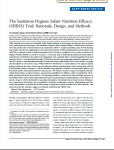
HUMPHREY, J.H. (2015): The Sanitation Hygiene Infant Nutrition Efficacy (SHINE) Trial. Rationale, Design, and Methods. (= Clinical Infectious Diseases , 685 / 61 ). URLThis paper introduces three typical biogas systems which regard anaerobic fermentation of human and animal “wastes” as a key technology, and which link sanitation and biogas production with agricultural use of digested effluents.
XIANGJUN, Y. ; WANG, H. (2003): Integrated systems on biogas production, non-polluted agricultural production and sanitation in rural China. In: Proceedings of the 2nd international symposium, F. 7th-11th April, Luebeck, Germany: , 601-606.