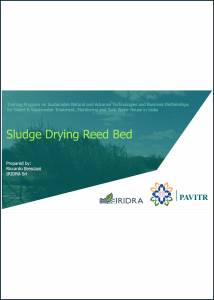
This presentation offers a broader view on Sludge Drying Reed Bed (SDRB)
BRESCIANI, R. (2023): IRIDRA: Sludge Drying Reed Bed (SDRB). Training Program on Sustainable Natural and Advance Technologies and Business Partnerships for Water & Wastewater Treatment, Monitoring and Safe Water Reuse in India . PDFLibrary
This Jordanian standard defines mandatory conditions for the application of treated biosolids/sludge from wastewater treatment intended in agricultural land.
Jordan Standards and Metrology Organization (2016): Jordanian Standards 1145:2016. Sludge. Uses of biosolid and disposal.Official web page of the Ecological Sanitation Research Programme (EcoSanRes). The EcoSanRes Programme aims to develop and promote sustainable sanitation in the developing world through capacity development and knowledge management as a contribution to equity, health, poverty alleviation, and improved environmental quality. It contains numerous helpful publications, and also allows you to gain access to the EcoSanRes discussion forum, currently the most active discussion forum on ecological sanitation.
This book explores social entrepreneurship vis-à-vis participation of marginalised communities.
Based on in-depth case studies that highlight the efforts of selected third sector organisations, this book brings to light the emergence of social entrepreneurship in India. The cases focus on the roles of locally established methods and community participation in carrying out sustainable social transformation.
Social Entrepreneurship: Working Towards Greater Inclusiveness contributes to both practice and theory in social entrepreneurship. It also sets out modalities for future work in the field, examining the various processes adopted by social enterprises in their functioning and delivering of services to address the concerns of exclusion.
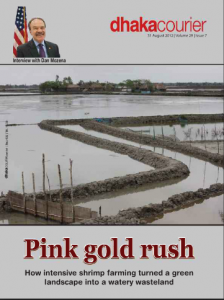
KRISHNA, R. and KUMMITHA, R. Institute for the Advanced Study of Sustainability, United Nations University (2016): Social Entrepreneurship: Working toward greater Inclusiveness. Tokyo : SAGE PublicationsExcellent example of a feature story on the effects of unsustainable shrimp farming on water and what should be done about it. The article won the Developing Asia Journalism Award (DAJA) in 2012.
Dhakar Courier (2012): Pink Gold Rush: How intensive Shrimp Farming turned a green Landscape into a watery Wasteland. Bangladesh: Cosmos Group URLThis PDF-presentation was presented a workshop in Ouagadougou entitled South-South cooperation in the field of Biomass energy: Challenge and opportunities. It illustrates how biogas technology was introduced along with cooking stoves and emphasizes technical and organisational lessons learnt.
SANOGO, O. (2008): Dissemination of improved stoves and biogas experiences in Burkina Faso. Institute de Recherche en Sciences Appliquées et Technologie (IRSAT) and Centre National de la Recherche Scientifique et Technologique (CNRST)Factsheet with technology description and relevant information ona manufactured commercial guinea worm cloth filter and its implementation in Ghana.
GWEP (2008): Guinea Worm Cloth Filter. (= Household Water Treatment and Safe Storage (HWTS) Product and Implementation Fact Sheet ). Tamale: Guinea Worm Eradication Program (GWEP)This study attempts to review the global capacity building efforts in the Water, Sanitation and Hygiene (WASH) sector by identifying the major capacity building organizations, understanding their focus and activities, comparing their efforts, and assessing potential gaps in capacity building services.
NGAI, T.K.K. MILLS, O. FRENCH, G. OLIVEIRA, R. LEPORE, C. MATTENS, M. SIBANDA, T. SWEET, M. GRAVES, A. (2013): A Global Review of Capacity Building Organizations in Water Sanitation, and Hygiene for Developing Countries. (= conference paper 36th WEDC International Conference, Kenya 2013). Loughborough: Water, Engineering and Development Center (WEDC)As part of the process to systematise and enhance the quality of monitoring and evaluation processes, this simple monitoring and evaluation guide has been developed. This guide includes practical guidance on how to do monitoring and evaluation: including developing simple monitoring and evaluation tools giving practical examples, a set of formats to facilitate the evaluation process and basic monitoring and evaluation terminology to ensure coherence and consistency.
IFRC (2007): Monitoring and Evaluation in a nutshell. INTERNATIONAL FEDERATION OF RED CROSS AND RED CRESCENT SOCIETIES (IFRC). [Accessed: 13.05.2010]Three different multistage constructed wetland plants for wineries wastewater treatment, located in central Italy, have been monitored and designed by the IRIDRA Ltd engineering firm. This paper presents the principal design specifications, a description of the plant operations and the analyses of influent and effluent characteristics (pH, COD, BOD5, TN, TP, TSS).
MASI, F. CONTE, G. MARTINUZZI, N. PUCCI, B. (2002): Winery High Organic Content Wastewaters Treated by Constructed Wetlands in Mediterranean Climate. (= Proceedings of 8th International Conference Wetland Systems for Water Pollution Control, 274-282 ). London: International Water Association (IWA) and University of Dar es Salaam URL