This paper provides highlights of a utilization-focused evaluation of a collaborative Pan-Arctic Inuit Wellness TV Series that was broadcasted live in Alaska and Canada in May 2009.
JOHNSON, R. et al. (2012): Pan-Arctic TV Series on Inuit wellness: a northern model of communication for social change?. In: International Journal of Circumpolar Health: Volume 70 , 235-244. URL [Accessed: 02.08.2018] PDFLibrary
This review summarizes the current contamination status of different environment media, including sewage, surface water, sludge, sediments, soil, and wild animals, in China by PPCPs. The human body burden and adverse effects derived from PPCPs are also evaluated.
LIU, JL. and WONG, M.H. (2013): Pharmaceuticals and Personal Care Products (PPCP): A Review on environmental Contamination in China. In: Environment International: Volume 59 , 208-224. URL [Accessed: 02.08.2018]GWPP`s mission is to be a knowledge resource and hub on water pathogens which will guide the goals for sanitation and achieving safe water around the world using the power of new information technology and tools. The glossary contains relevant terms: see here http://www.waterpathogens.org/glossary
Se describen contextos especficos en México, las tecnologias relacionadas a la energía, agua, vegetación y vivienda y casos de implementación en comunidades rurales.
CERVANTES. E., SEGURA, I. VAZQUEZ, S., GARCIA, L. y FALCÓN, A. (2017): Tecnologías apropiadas para el acceso sostenible al agua en el medio rural marginado. Morelos (México): Instituto Mexicano de Tecnología del Agua (IMTA) URL [Accessed: 01.08.2018] PDFThe Circumpolar Health Research Network (CHRN) was formed in 2012 with the coming together of two international circumpolar health organizations — the International Network for Circumpolar Health Research (INCHR) and the International Association of Circumpolar Health Publishers (IACHP).
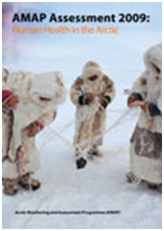
This assessment report details the results of the 2009 AMAP assessment of Human Health in the Arctic. It builds upon the previous AMAP human health assessments that were presented in 19981 and 2022.
The Arctic Monitoring and Assessment Programme (AMAP) is a group working under the Arctic Council.
The research underpinning this work took place in the context of two rural water and sanitation projects carried out in the Eastern Region of Ghana. The focus of study was on the way engineers can make water and sanitation projects more sustainable. In particular, emphasis was placed on the broad range of non-technical factors engineers need to incorporate into the design of water and sanitation systems and the processes they need to follow in order to achieve this, looking specifically at the implications of community participation for design process, project management and health and safety management.
The perception of social sanitation norms (PSSNs) around unacceptability of open defecation has been a key aspect of recent sanitation interventions. However, underlying mechanisms through which "reconstructed" PSSNs affect sanitation outcomes have been a black box. This explorative cross-sectional study examines direct and indirect links between PSSNs and sanitation safety using data from structured interviews and observations in 368 households in rural South Ethiopia.
NOVOTNY, J. et al. (2017): The Role of Perceived Social Norms in Rural Sanitation: An Explorative Study from Infrastructure-Restricted Settings of South Ethiopia. In: International Journal of Environmental Research and Public Health: Volume 14 URL [Accessed: 25.07.2018] PDF