
Library
En este estudio se hace una revisión sistemática, así como un meta análisis de los efectos que tiene el hervir el agua sobre la diarrea e infecciones producto de patógenos presentes en el agua que se consume en países de ingreso bajo y medio.
COHEN, A. and COLFORD, J. (2017): Effects of Boiling Drinking Water on Diarrhoea and Pathogen-Specific Infections in Low- and Middle-Income Countries: A Systematic Review and Meta-Analysis. In: The American Journal of Tropical Medicine and Hygiene: Volume 97 Issue 5, pp.1362-1377. URL [Accessed: 05.08.2018] PDFEn este artículo en inglés se estudia la caracterización del proceso de inactivación bacterial con el uso del tratamiento de desinfección solar del agua potable que está dentro de botellas plásticas transparentes, consiguiendo como resultado que siempre y cuando haya mucha luz solar disponible el método es eficaz y de bajo costo para mejorar la calidad del agua.
MCGUIGAN, K., JOYCE, T., CONROY, R., GILLESPIE, J. and ELMORE-MEEGAN, M. (1998): Solar disinfection of drinking water contained in transparent plastic bottles: characterizing the bacterial inactivation process. In: Journal of Applied Microbiology : Volume 84 , pp.1138-1148. URL [Accessed: 05.08.2018] PDFEn el artículo se busca probar la efectividad de las prácticas de ebullición del agua en la zona rural de Guatemala para mejorar la calidad de la misma. Se observó que dicha efectividad depende de factores como la calidad de la fuente de agua, cómo se lleva a cabo la ebullición y cómo se almacena una vez hervida el agua, donde generalmente ocurre una recontaminación.
ROSA, G., MILLER, L. and CLASEN, T. (2010): Microbiological effectiveness of disinfecting water by boiling in rural Guatemala. In: The American Journal of Tropical Medicine and Hygiene: Volume 82 Issue 3, pp.473-477. URL [Accessed: 05.08.2018] PDF
The sewage epidemiology approach was applied to a one-year sampling campaign in the largest wastewater treatment plant (WWTP) in Belgium to estimate the consumption of illicit drugs (e.g. cocaine). This manuscript shows that sewage epidemiology provides consistent and logical results and that it is a promising tool that can be used in addition to classical studies to estimate illicit drug use in populations.
VAN NUIJS, A. L.N. et al. (2011): Sewage Epidemiology — A real-time Approach to estimate the Consumption of illicit Drugs in Brussels, Belgium. In: Environment International: Volume 37 , 612-621. URL [Accessed: 02.08.2018]This policy summary refers to the most recent AMAP assessment which looks at a wide range of chemicals newly and recently detected in Arctic ecosystems. These ‘chemicals of emerging Arctic concern’ should be considered potential candidates for future research or monitoring and possibly for consideration under relevant global and/or regional regulations. In addition, these chemicals of emerging concern contribute to an even broader understanding of how Arctic pollution is changing.
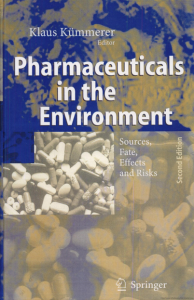
This book addresses the most important issues in the field of pharmaceuticals in the environment for the near future. Typical examples and abundant data are presented.
KUEMMERER, K. (2004): Pharmaceutcals in the Environment: Sources, Fate, Effects and Risks - second Edition. Springer Berlin Heidelberg URL [Accessed: 02.08.2018]When people take drugs, they end up in the water, either unchanged or broken down into specific metabolites. Increasingly, water can be tested to gauge how much drug use is going on in an area, and a new study shows that the level of illegal drugs being used in a community can be tested in real time, and potentially applied to help police narcotic use.
MAIN, D. (2014): Real-time Wastewater Analysis shows what drugs are being used where. Popular Science URL [Accessed: 02.08.2018]