The main purpose of this paper is to apply a water balance concept with two models in the Ching–Shui watershed to describe the groundwater recharge.
HSIN-FU YEH, H. LEE, C. CHEN, J. CHEN, W. (2007): Estimation of Groundwater Recharge Using Water Balance Model. Tainan: National Cheng Kung University. Kaohsiung Kao Yuan Institute of Technology URL [Accessed: 10.04.2019]Library
Devolution, or the delegation of power by central government to local or regional administration, is by far the most significant initiative in governance that Kenya has undertaken since independence. Effective implementation of the new devolved framework now requires the water sector to focus on the emerging opportunities and to address a number of challenges. This note analyses the pertinent issues and options for national government and county leadership to achieve sustainable delivery of improved water services under the new dispensation.
WSP (2013): Devolution in Kenya. Opportunities and Challenges for the Water Sector. Washington: The World Bank, Water and Sanitation Program (WSP) URL [Accessed: 10.04.2019]This training manual focuses of specific water resources management functions carried out by River Basin Organisations. There is a specific module on water allocation with PowerPoint a presentation.
CAP-NET (2008): Training Manual on Integrated Water Resources Management for River Basin organisations. Pretoria: Cap-Net URL [Accessed: 10.04.2019]This article argues that policy making is an interactive and ongoing process that transcends the spatio-temporal boundaries drawn by a linear, rational or instrumental model of policy. This argument is constructed by analysing the making of the Irrigation Management Transfer (IMT) policy in Mexico in the early 1990s, focusing on different episodes of its re-emergence, standardisation, and acceleration.
RAP, E. ; WESTER, P. (2013): The Practices and Politics of Making Policy. Irrigation Management Transfer in Mexico. In: Water Alternatives: Volume 6 , 506-531. URL [Accessed: 10.04.2019]The AQUASTAT online database is a collection of information and analyses on water resources, water uses, and agricultural water management with an emphasis on countries in Africa, Asia, Latin America and the Caribbean.
The National Sanitation Draft White Paper includes a chapter about institutional and organisational framework for sanitation. On this site, you can find detailed information on how to build such a framework, including stakeholders and responsibilities, financial and economic approaches etc. Only available online.
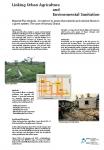
The poster presents material flow analysis as a method to assess the material and nutrient flows in a given system and thus to link urban agriculture and environmental sanitation: The case of Kumasi, Ghana.
FORSTER, D. SCHERTENLEIB, R. BELEVI, H. (2003): Linking Urban Agriculture and Environmental Sanitation. Duebendorf: Swiss Federal Institute for Environmental Science (EAWAG) URL [Accessed: 10.04.2019]This document has its focus on the importance of the link between water supply, sanitation and Integrated Water Resources Management.
BUTTERWORTH, J. SOUSSAN, J. (2001): Water Supply and Sanitation and Integrated Water Resources Management: why seek better integration?. Andhra Pradesh: Water, Households and Rural Livelihoods Project URL [Accessed: 10.04.2019]A short overview about irrigation needs of crops, their water demand and different growth stages. This three page overview is very comprehensibly written and easy to read. It is an introduction to crop selection.
AL-KAISI BRONER (2009): Crop Water Use and Growth Stages. Colorado State University Extensions: Fort Collins URL [Accessed: 09.04.2019]The Ontario Ministries website offers a lot of information about different needs of crops. This includes soil types, crop types, nutrient management, water management and general agriculture tips.
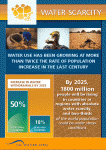
Thematic Factsheet on Water Scarcity. The world contains an estimated 1 400 million cubic km of water. Only 0.003% of this vast amount, about 45 000 cubic km, are what is called "fresh water resources", i.e. water that can be used for drinking, hygiene, agriculture and industry.
UN Water (2013): Water Scarcity Factsheet. United Nations Water URL [Accessed: 09.04.2019]This online article describes the crop rotation system, what it is, its effects and practices.
This chapter of Infonet Biovision provides additional information about intercropping and crop rotation. The reader gets to know about difficulties, means and practices.
INFONET BIOVISION (2012): Intercropping and Push-Pull. Zurich: URL [Accessed: 09.04.2019]Read more about the importance of soil moisture.
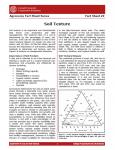
BERRY, W. KETTERINGS, Q. ANTES, S. PAGE, S. RUSSEL-ANELLI, J. RAO, R. DeGLORIA, S. (2007): Soil Texture. Ithaca: Cornell University Cooperative Extension URL [Accessed: 09.04.2019]Infonet-biovision.org is a web-based information platform offering trainers, extension workers and farmers in East Africa a quick access to up-to-date and locally relevant information in order to optimise their livelihoods in a safe, effective, sustainable and ecologically sound way.
INFONET-BIOVISION (2010): Water for Irrigation. Zürich: Biovision URL [Accessed: 09.04.2019]