Library
The dominant paradigm in rural water provision in Bolivia has focused on the provision of infrastructure, whether by government agencies or international cooperation groups. However, the investment in infrastructure has led neither to universal access for all Bolivians nor to consistently high levels of services for those who do have access to a water system. This paper will describe the transition of one international non-profit organisation, Water For People, from supporting dispersed water projects throughout the country towards targeted support of water services at the municipal level, aiming to support permanent universal services.
FOGELBERG, K. (2013): From Adopt-a-Project to Permanent Services. The evolution of Water For People’s Approach to Rural Water Supply in Bolivia. In: Water Alternatives: Volume 6 , 367-383. URL [Accessed: 11.04.2019]This factsheet is good to get an idea on PPPs. It offers a list of further reading material, and includes tips for the preparation of a PPP.
KHAN, S. COTTON, A. (2003): Public Private Partnerships and the poor in water supply projects. Leicestershire: Water, Engineering and Development Centre (WEDC) URL [Accessed: 11.04.2019]This webpage from the UNDP and the UNODC provides a lot of information about corruption and the fight against it.
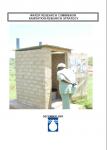
The Sanitation Research Strategy includes a part about institutional and management aspects of sanitation service delivery, helping to identify short-term and long-term objectives.
WRC (2003): Sanitation Research Strategy. Water Research Commission (WRC) URL [Accessed: 11.04.2019]This document is on sanitation and the challenges of improving it. It includes some case studies and ideas about building an institutional framework for its cause.
SCOTT, R. COTTON, A. GOVINDAN, B. (2003): Sanitation and the Poor. Leicestershire/London/Delft: Resource Centre for Water, Sanitation and Environmental Health (WELL) URL [Accessed: 11.04.2019]This paper on institutional frameworks is very helpful for getting more information about the topic. It is offering both detailed information and links to further reading material in each of its sections.
IEES (2006): Challenges in Developing an Institutional Framework. Wolhusen: International Ecological Engineering Society (IEES) URL [Accessed: 11.04.2019]The DWAF offers information about the institutional structure for service provision, which is very helpful for getting an overview of the topic. Chapter summary available online.
DWAF (2003): Strategic Framework for Water Services. Republic of South Africa: Department of Water Affairs and Forestry (DWAF) URL [Accessed: 11.04.2019]This paper describes a sensitivity analysis of a simple water balance model to determine the parameters having the greatest influence on estimates of recharge.
FINCH, J.W. (1998): Estimating direct groundwater recharge using a simple water balance model – sensitivity to land surface parameters. Wallingford: Institute of Hydrology URL [Accessed: 10.04.2019]The main purpose of this paper is to apply a water balance concept with two models in the Ching–Shui watershed to describe the groundwater recharge.
HSIN-FU YEH, H. LEE, C. CHEN, J. CHEN, W. (2007): Estimation of Groundwater Recharge Using Water Balance Model. Tainan: National Cheng Kung University. Kaohsiung Kao Yuan Institute of Technology URL [Accessed: 10.04.2019]Devolution, or the delegation of power by central government to local or regional administration, is by far the most significant initiative in governance that Kenya has undertaken since independence. Effective implementation of the new devolved framework now requires the water sector to focus on the emerging opportunities and to address a number of challenges. This note analyses the pertinent issues and options for national government and county leadership to achieve sustainable delivery of improved water services under the new dispensation.
WSP (2013): Devolution in Kenya. Opportunities and Challenges for the Water Sector. Washington: The World Bank, Water and Sanitation Program (WSP) URL [Accessed: 10.04.2019]This training manual focuses of specific water resources management functions carried out by River Basin Organisations. There is a specific module on water allocation with PowerPoint a presentation.
CAP-NET (2008): Training Manual on Integrated Water Resources Management for River Basin organisations. Pretoria: Cap-Net URL [Accessed: 10.04.2019]This article argues that policy making is an interactive and ongoing process that transcends the spatio-temporal boundaries drawn by a linear, rational or instrumental model of policy. This argument is constructed by analysing the making of the Irrigation Management Transfer (IMT) policy in Mexico in the early 1990s, focusing on different episodes of its re-emergence, standardisation, and acceleration.
RAP, E. ; WESTER, P. (2013): The Practices and Politics of Making Policy. Irrigation Management Transfer in Mexico. In: Water Alternatives: Volume 6 , 506-531. URL [Accessed: 10.04.2019]The AQUASTAT online database is a collection of information and analyses on water resources, water uses, and agricultural water management with an emphasis on countries in Africa, Asia, Latin America and the Caribbean.
The National Sanitation Draft White Paper includes a chapter about institutional and organisational framework for sanitation. On this site, you can find detailed information on how to build such a framework, including stakeholders and responsibilities, financial and economic approaches etc. Only available online.
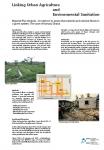
The poster presents material flow analysis as a method to assess the material and nutrient flows in a given system and thus to link urban agriculture and environmental sanitation: The case of Kumasi, Ghana.
FORSTER, D. SCHERTENLEIB, R. BELEVI, H. (2003): Linking Urban Agriculture and Environmental Sanitation. Duebendorf: Swiss Federal Institute for Environmental Science (EAWAG) URL [Accessed: 10.04.2019]This document has its focus on the importance of the link between water supply, sanitation and Integrated Water Resources Management.
BUTTERWORTH, J. SOUSSAN, J. (2001): Water Supply and Sanitation and Integrated Water Resources Management: why seek better integration?. Andhra Pradesh: Water, Households and Rural Livelihoods Project URL [Accessed: 10.04.2019]