Hygiene, Sanitation, and Water in Schools projects can create an enabling learning environment that contributes children's improved health, welfare, and learning performance. This Toolkit makes available information, resources, and tools that provide support to the preparation and implementation of hygiene, sanitation, and water in schools policies and projects.
WORLD BANK ; UNICEF ; WSP (2001): Toolkit on Hygiene, Sanitation and Water in Schools. Washington, D.C.: The World Bank URL [Accessed: 22.04.2019]Library
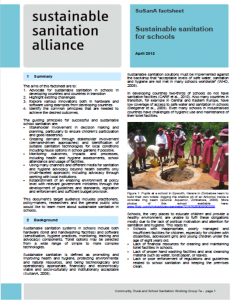
The aim of this Factsheet is to advocate for sustainable school sanitation by highlighting existing challenges, exploring the various innovations both in hardware and software from examples in Africa, Asia, and South America identifying the common principles that are needed for successful implementation.
SUSANA (2012): Sustainable Sanitation for Schools. (= SuSanA Factsheet ). Sustainable Sanitation Alliance (SuSanA) URL [Accessed: 22.04.2019]This manual deals with school water, sanitation and hygiene education. It describes many of the elements needed for scaling up programmes for water, sanitation and hygiene in schools while ensuring quality and sustainability. It contains many examples, most of which are drawn from a UNICEF-IRC pilot study for School Sanitation and Hygiene Education (SSHE) carried out in six countries (Burkina Faso, Colombia, Nepal, Nicaragua, Vietnam, and Zambia).
IRC (2007): Towards Effective Programming for WASH in Schools: A manual on scaling up programmes for water, sanitation and hygiene in schools . (= Technical Paper Series No. 48 ). Delft: IRC International Water and Sanitation Centre URL [Accessed: 22.04.2019]This paper focuses on sanitation and hygiene education at the school level. It may be of relevance to practitioners and to academics who are working directly or indirectly on School Sanitation and Hygiene Education, for example managers and trainers involved in school programmes operating at the state, district or community level may find the paper useful and it may also assist teachers at the community level who are focusing on certain aspects.
SNEL (2003): School Sanitation and Hygiene Education. (= Thematic Overview Paper ). Delft: IRC International Water and Sanitation Centre URL [Accessed: 22.04.2019]Training guide, which delivers an overview on possible economic and financial tools for water management. The application ranges from water resources, through water supply and sanitation. Further training material as well as supporting PowerPoint’s are available on the website (in English, French, Spanish, and Portuguese).
CAP-NET (2008): Economics in Sustainable Water Management. Training Manual and Facilitator's Guide. URL [Accessed: 22.04.2019]The paper shows how School Led Total Sanitation (SLTS) has had very promising results to date and paves the way to speed up the process of intensive latrine coverage in school catchment areas.
ADHIKARI, S. SHRESTHA, N.L. (n.y): School Led Total Sanitation: A Successful Model to Promote School and Community Sanitation and Hygiene in Nepal. Nepal: UNICEF URL [Accessed: 22.04.2019]This is a good website which gives a comprehensive understanding about social marketing.
SCOTT, B. (2005): Social Marketing: A Consumer-based Approach to Promoting Safe Hygiene Behaviours. (= WELL factsheet ). Leicestershire: WELL URL [Accessed: 22.04.2019]Taking urban sanitation to scale requires ‘scaling out’ models that work for poorer communities, and at the same time ‘scaling up’ sustainable management processes. This short note reports scale-out and scale-up experience from Maputo and Antananarivo.
WSUP (2013): Get to Scale in Urban Sanitation!. (= Practice Note , 10 ). London: Water and Sanitation for the Urban Poor (WSUP) URL [Accessed: 22.04.2019]This guidebook targets the water and sanitation service sector, such as public or private utilities in urban centres who wish to engage in water and sanitation education activities through dedicated classrooms. It also focuses on encouraging schools to cooperate with the water and sanitation sector on joint education initiatives.
UN-HABITAT (2006): Facilitators & Trainers guideBook. Human Values-based Water, Sanitation and Hygiene Classrooms. Nairobi: United Nations Human Settlements Programme (UN-HABITAT) URL [Accessed: 22.04.2019]What are water markets and tradable permits and how can they be achieved? This page gives a short overview related to these questions. It further contains a list of documented related cases.
This document is about creating a video for development in rural areas. Besides different possible forms of producing video material, it includes case studies to each one topic. Even though it is not specialized on water and/or sanitation, it is helpful for getting general information on video and video production for rural areas.
LIE, R. MANDLER, A. (2009): Video in Development. Filming for Rural Change. London: Food and Agriculture Organization of the United Nations (FAO) and URL [Accessed: 21.04.2019]This document guides you through all steps of writing a radio serial drama. It offers some theoretical background information, but the main part focuses on practical methods. It is useful for both novices and experienced scriptwriters who have not yet written a serial drama that educates as well as it entertains.
FOSSARD, E. de (1996): How To Write a Radio Serial Drama for Social Development. A Script Writer’s Manual. John Hopkins University Population Communication Services URL [Accessed: 21.04.2019]This guide for the Water, Sanitation and Hygiene for all (WASH) campaign offers practical guidance on advocacy work related to water and sanitation. It aims to explain the different advocacy tools, provide practical examples of advocacy work, and provide information on key policy actors and processes and how to influence them at local, national and international levels.
WATERAID & WSSCC (2003): Advocacy Sourcebook. A Guide to Advocacy for WSSCC co-ordinators working on the WASH campaign. WATERAID & WSSCC URL [Accessed: 21.04.2019]“A Rights-Based Approach to Participatory Video: Toolkit” is helpful for providing the first few steps for practitioners of participatory video to begin introducing a rights-based approach into their practice.
BENEST, G. (2010): A Rights-Based Approach to Participatory Video: toolkit. InsightShare URL [Accessed: 21.04.2019]This book provides detailed information about drawing up advocacy action plans that aim to improve the water supply and sanitation situation. The document presents concrete examples of advocacy work in practice and it provides many tools, tables and diagrams, which advocacy workers may like to reproduce, adapt or distribute for their own advocacy campaign.
WATERAID (2007): The Advocacy Sourcebook. London: WaterAid URL [Accessed: 21.04.2019]