Library
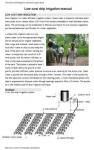
This two-page paper manual describes the low-cost drip irrigation.
RCSD (Editor) (2008): Low Cost Drip Irrigation Manual. Assam: Resources Centre for Sustainable Development (RCSD) URL
This presentation is designed to equip people with the knowledge and tools to design innovative and sustainable business models. It covers the essential components of a business model, including customer segments, value propositions, revenue streams, channels, key activities, resources, and partnerships.
WAFLER, M. and JONCOURT, S. (2023): Business Model Development. Training Program on Sustainable Natural and Advance Technologies and Business Partnerships for Water & Wastewater Treatment, Monitoring and Safe Water Reuse in India.. PDF
En este documento se evalúa el proyecto PRAGUAS que se dio en Ecuador, el cual tenía la finalidad de lograr una reforma a nivel institucional lograr, invertir en proyectos de agua y saneamiento e impulsar modelos de gestión; se evidencia la problemática y se plantean recomendaciones.
CARE (2008): Análisis del proyecto a pequeños municipios en agua y saneamiento – Programa PRAGUAS. Programa de alianzas multisectoriales en gestión del recurso hídrico LAC PPA. Honduras: CareLanguage: Spanish
This case study outlines the activities of an engineering consulting firm that has been contracted to submit a preliminary design for a new water treatment plant for a rural community in Nova Scotia, Canada.
WALSH, M.E. ; GAGNON, G.A. (2006): Evaluating Membrane Processes for Drinking Water Treatment Design. In: Association of Environmental Engineering & Science Professors: , 08.03.2012.
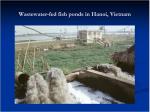
This presentation gives a detailed overview on the 3. volume of the WHO guidelines on the safe use of wastewater and excreta in aquaculture including many pictures of existing wastewater-fed aquaculture and fish pond technologies all over the world. Apart from the health risk and appropriate health protection measures, a lot of information on socio-cultural, environmental and economic aspects is given as well as supporting information on planning and implementation of sewage-fed fish ponds.
EDWARDS, P. (2008): Volume III: Wastewater and excreta use in aquaculture.. (pdf presentation). Bangkok, Thailand: Asian Institute of Technology
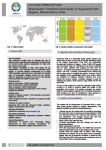
This document present a detailed description of the case study implemented at Dayanand Park, including history of the project, design information, materials and project components, costs and economics, and details about operation and maintenance, practical information and lessons learnt.
GARFI, M. (2015): Wastewater Treatment and Reuse in Dayanand Park, Nagpur, Maharashtra, India. Case Study. In: NaWaTech Project:
Training Session Plan on Treatment of Sewage using Improved MBBR and SAFF and Treatment of Faecal Sludge using Mechanical Dewatering and Drying System (MDDS).
POPHALI, G. (2023): Training Session Plan - Treatment of Sewage using Improved MBBR and SAFF and Treatment of Faecal Sludge using Mechanical Dewatering and Drying System (MDDS). Training Program on Sustainable Natural and Advance Technologies and Business Partnerships for Water & Wastewater Treatment, Monitoring and Safe Water Reuse in India . PDF
This thesis establishes that the inadequate consideration of cultural characteristics interactions between and within project stakeholders is a major reason for variations between intended and actual outcomes of rural water, sanitation and hygiene promotion projects. A conceptual framework of cultural dimensions is being developed and applied to a variety of stakeholder groups. Exhaustive and scientific approach.
WEBSTER, J. (2006): Culture’s Influence. Towards Understanding Stakeholder Interactions in Rural Water, Sanitation and Hygiene Promotion Projects. (= PhD Thesis ). Institute of Water and Environment, Cranfield University