
CHALINDER, A.
(1994):
Water and Sanitation in Emergencies. Good Practice .
(= Review 1
).
London:
Overseas Development Institute
URL
[Accessed: 21.05.2019]
Library
LEA, M.
(2010):
Bioremediation of Turbid Surface Water Using Seed Extract from Moringa Oleifera Lam. (Drumstick) Tree.
URL
[Accessed: 21.05.2019]
REED, B. SHAW, R.
(1999):
Emergency Water Supply.
Leicestershire (UK):
Water, Engineering and Development Centre (WEDC), Loughborough University. Technical Brief No. 44
URL
[Accessed: 21.05.2019]
Factsheet on the principles, construction, operation and maintenance of kanchan filters (for arsenic and pathogen removal) for drinking water treatment at household level.
CAWST (2009): Kanchan Filter. Fact Sheet - Academic. (= Household Water Treatment and Safe Storage Fact Sheet - Academic ). Centre for Affordable Water and Sanitation Technology (CAWST) URL [Accessed: 21.05.2019]
These equipment packages have been devised by the Oxfam Public Health Engineering Team and others to help provide a reliable water supply, primarily for emergency situations such as in refugee camps and disaster-relief operations. The equipment is designed to be readily available, easily transported, simple to use, rapidly assembled, and fully self-contained, to provide an adequate water supply at moderate cost.
OXFAM (2000): Water, Sanitation, and Shelter Equipment. For Emergencies and Longer Term Use. Oxford: OXFAM URL [Accessed: 21.05.2019]
This document presents the results of a pilot study aiming at removing water micropollutants at the Lausanne (Switzerland) wastewater treatment plant.
MARGOT, J. ; MAGNET, A. ; THONNEY, D. ; CHEVRE, N. ; ALENCASTRO, F. de ; ROSSI, L. (2011): Traitement des Micropolluants dans les Eaux Uses-Rapport Final sur les Essais Pilotes a la STEP de Vidy (Lausanne). المُدخلات: Ed. Ville de Lausanne : URL [Accessed: 21.05.2019]
KOMMINENI, S.
; ZOECKLER, J.
; STOCKING, A.
; LIANG, S.
; FLORES, A.
; KAVANAUGH, M.
(2008):
Advanced Oxidation Processes.
المُدخلات: National Water Research Institute:
URL
[Accessed: 21.05.2019]
Factsheet on the principles, construction, operation and maintenance of arsenic removal via complexation for drinking water treatment at household level.
CAWST (2009): Arsenic Removal. Complexation. (= Household Water Treatment and Safe Storage Fact Sheet - Academic ). Centre for Affordable Water and Sanitation Technology (CAWST) URL [Accessed: 21.05.2019]
A three-page factsheet containing introduction, operation procedure, treatment efficiency, operating criteria and other information related to settling.
CAWST (2009): Settling. (= Household Water Treatment and Safe Storage Fact Sheets ). Calgary: Centre for Affordable Water and Sanitation Technology (CAWST) URL [Accessed: 21.05.2019]
https://www.trunzwatersystems.com/products
[Accessed: 21.05.2019]
This is the webpage of a producer of mobile compact water purification and desalination units from Switzerland.
COMNINELLIS, C.
; KAPALKA, A.
; MALATO, S.
; PARSON, S.A.
; POULIOS, L.
; MANTZAVINOS, D.
(2008):
Perspective Advanced Oxidation Processes for Water Treatment: Advanced and Trends for R&D.
المُدخلات: Journal of Chemical Technology and Biotechnology:
Volume 83
, 769-776.
URL
[Accessed: 21.05.2019]
EPA
(n.y):
Water Treatment Cycle.
Washington D.C.:
US Environmental Protection Agency (EPA)
URL
[Accessed: 21.05.2019]
This review article focuses on the treatment of textile wastewaters by means of different AOPs.
ADEL, A. K. ; AZNI, I. ; KATAYON, S. ; CHUAH, T.G. (2004): Treatment of Textile Wastewater by Advanced Oxidation Processes – A Review. المُدخلات: Global Nest: the International Journal – General Information: Volume 6 , 222-230. URL [Accessed: 21.05.2019]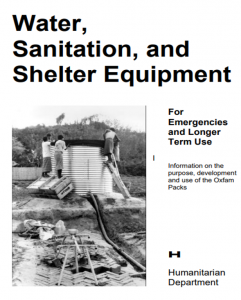
This short manual describes purpose, development and use of standard water and sanitation equipment packages of OXFAM, as well as individual packages for water storage, water pumping, borehole drilling, but also excreta disposal and shelter equipment. These measures can serve urgent but also longer term needs.
OXFAM (2000): Water, Sanitation, and Shelter Equipment. For Emergencies and Longer Term. Oxford: Humanitarian Department Oxfam URL [Accessed: 21.05.2019]
This publication discusses the effects of pH, temperature, flow rate, contaminant nature, activated carbon type etc. on adsorption.
DESILVA, F. (2000): Activated Carbon Filtration. المُدخلات: Water Quality Products Magazine : URL [Accessed: 21.05.2019]
This Technical Brief is the second of two which examine the treatment of water at household level. It considers treatment by coagulation, flocculation, filtration and solar distillation and covers aspects of the reduction of some chemical concentrations.
SKINNER, B. SHAW, R. (1999): Household water treatment 2. London & Loughborough: Water And Environmental Health at London and Loughborough (Well). Technical brief 59 URL [Accessed: 20.05.2019]
PUREPRO
(2012):
PurePro Drinking Water System.
Illinois:
PurePro USA Corporation
URL
[Accessed: 20.05.2019]

Case study from Nicaragua on the dissemination of locally constructed enhanced ceramic filters (colloidal silver filters)
IDEASS (n.y): FILTRON. Ceramic Filters for Drinking Water. United Nations Development Programme (UNDP), United Nations Office for Project Services (UNOPS) and ILO/Universitas URL [Accessed: 20.05.2019]
http://rdic.org/ceramic-water-filters/
[Accessed: 20.05.2019]
Website of RDI Cambodia to learn more about Ceramic Filtration.

This paper elaborates on the performance of two indigenous arsenic (As) removal techniques, theSafi filter and home-based filters (Chari/Pitcher filter). The filters were developed to serve household drinking water requirementsand were evaluated at field conditions and compared with those reported in literature.
RAHMAN, I.M.M. ; HOSSAIN, M.M. ; HELAL UDDIN, M. ; NAZIMUDDIN, M. ; MAJD, M.A. (2005): Appraisal of Two Indigenous Household Groundwater Arsenic Removal Technologies for Bangladesh under Field Conditions. المُدخلات: Journal of Agriculture and Social Sciences: Volume 4 , 361-365. URL [Accessed: 20.05.2019]