
VILLINGEN-SCHWENNINGEN
(2010):
Kanalplanung/Kanalbau.
URL
[Accessed: 04.01.2011]
Library
http://www.un-habitat.org/categories.asp?catid=548
[Accessed: 04.01.2011]
After studying the situation in slums around the world, UN-HABITAT sought to devise a system that would replace manual pit latrine and septic tank emptying. It commissioned a mechanical system that would be capable of being manufactured locally using readily available components, that would be affordable, easily serviceable, able to operate in narrow passageways where other conventional exhauster vehicles cannot pass, and capable of sucking out dense waste sludge for transportation to a larger tanker vehicle. At the same time it was imperative that excrement be removed as safely as possible without posing further health hazards in slums. Thus in 1995 Manus Coffey and Associates Ltd (MCA) and UN-HABITAT designed and built the first prototype in Ireland: the MK I UN-HABITAT Vacutug.
This paper provides a framework within which a process engineer can design an anaerobic baffled reactor for the treatment of a specific domestic wastewater.
FOXON, K.M. BUCKLEY, C.A. (2006): Guidelines For The Implementation of Anaerobic Baffled Reactors for On-Site Or Decentralised Saniation. Durban: University of KwaZulu-Natal URL [Accessed: 03.01.2011]
The objective of this research study was to compare the treatment performance of the conventional septic tank system with upgraded septic tank systems, and to try to define the optimal operation conditions.
SRI-ANANT, W. (2003): Upgrading conventional Septic Tanks by integrating in tank Baffles. Klong Luang: School of Environment, Resources and Development (SERD)/Asian Institute of Technology (AIT) URL [Accessed: 03.01.2011]
The anaerobic baffled reactor (ABR) could be a valuable alternative to conventional septic tanks. In this study, 3 lab-scale experimental ABR (2 baffles with and without anaerobic filter, respectively, and 3 baffles) were studied and compared to a conventional 2 chambers septic tank. The experimental units were fed with a mixture of septage and sewage in order to imitate the characteristics of toilet wastewater from households.
KOOTTATEP, T. SRI-ANANT, W. ANTOINE, M. SCHERTENLEIB, R. (2004): Potential of the Anaerobic Baffled Reactor as decentralized Wastewater Treatment System in the Tropics. Klong Luang and Duebendorf: School of Environment, Resources and Development (SERD)/Asian Institute of Technology (AIT) and Water and Sanitation in Developing Countries (SANDEC) at the Swiss Federal Institute for Environmental Science (EAWAG) URL [Accessed: 03.01.2011]
Giving ideas of steering up group discussions.
PENN, A. (2005): Creative Group Discussions. University of Arkansas Division of Agriculture publications URL [Accessed: 23.12.2010]
http://www.successcds.net/MBA-Admission/Group-discussion-GD-Tips.html
[Accessed: 23.12.2010]
Gives ideas on how to prepare for group discussions
http://712educators.about.com/od/lessonplans/p/discussions.htm
[Accessed: 23.12.2010]
Deals with training plans and training methods
Provides the detailed description of Group discussions methods in training.
USERFIT TOOLS (n.y): Group Discussions. Tools and Techniques. New York: Userfit URL [Accessed: 23.12.2010]
http://www.teachingenglish.org.uk/think/articles/group-discussion-skills
[Accessed: 23.12.2010]
Gives ideas on how to prepare for group discussions
http://www.exforsys.com/career-center/group-discussions.html
[Accessed: 23.12.2010]
Gives ideas on how to prepare for group discussions
http://sydney.edu.au/education_social_work/groupwork/evaluate/sharing.shtml
[Accessed: 22.12.2010]
This website shares sample sheets with which an evaluation for a finished group work can be done. This includes also a group feedback to estimate the performance and well-doing of the group.
http://teaching.berkeley.edu/bgd/collaborative.html
[Accessed: 22.12.2010]
This website gives a short summary about how to conduct a group work in general. The site gives advice on how a group work can be improved further.
http://www.guidance-research.org/EG/impprac/ImpP4/ImpP4iii/view?searchterm=group work
[Accessed: 22.12.2010]
The material presented on this website emphasises on developing and supporting group works. Skills and a basic understanding which are necessary to perform a good group work are also described.
This article is written for trainers and aims to improve practical skills. Since group works is not free of problems, the focus lies on dealing with problem incidents.
MORTENSON, R. (2004): Group work – training the trainers. NGRF URL [Accessed: 20.12.2010]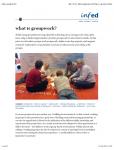
The author of this article gives an elaborate summary about how to do group works. He elaborates some definitions of key aspects and suggests areas which are held open for exploration.
SMITH, M.K. (2008): What is group work? . INFED URL [Accessed: 20.12.2010]
This article looks at the basics of group work and suggests ways to accelerate development. Normally, in a group, there are two main issues involved. The first issue includes the task. The second one concerns the process of the group work itself the mechanisms by which the group acts as a unit. This process is rarely addressed and is often forgotten, which can impede the success of group works.
BLAIR, G.M. (n.y): Groups that work. URL [Accessed: 20.12.2010]
Scenario building was used for identifying the main issues for water management in Lima. It includes a comparison how the future could be with a vision, e.g. with goals to achieve and without any vision. It gives an outlook of scenarios how the future of Lima in terms of water management might be in 2040.
SCHUETZE, M. (2010): Water and wastewater management in megacities – the Lima example. (= =Proceedings of Future Megacities in Balance, 11th to 13th October 2010; Session B2 ). Essen: [Accessed: 16.12.2010] PDF
More than two billion urban dwellers in developing countries use on-site sanitation facilities such as pit latrines, septic tanks and aqua privies for excreta and wastewater disposal. Since on-site sanitation installations will serve the growing urban populations in developing countries for decades to come, increasing faecal sludge quantities will have to be managed. Proper faecal sludge management (FSM) is the important link missing in integrated urban sanitation upgrading efforts.
KONE, D. STRAUSS, M. SAYWELL, D. (2007): Towards an Improved Faecal Sludge Management (FSM). Duebendorf: EAWAG/SANDEC URL [Accessed: 15.12.2010]