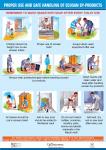
This poster illustrates how to use Ecosan toilets and handle faecal compost in a safe way.
NETWAS (n.y): Proper Use and Safe Handling of Ecosan By-Products. Kampala: Network for Water and Sanitation (NETWAS) URL [Accessed: 11.05.2019]Perspectives are different frameworks from which to explore the knowledge around sustainable sanitation and water management. Perspectives are like filters: they compile and structure the information that relate to a given focus theme, region or context. This allows you to quickly navigate to the content of your particular interest while promoting the holistic understanding of sustainable sanitation and water management.

This poster illustrates how to use Ecosan toilets and handle faecal compost in a safe way.
NETWAS (n.y): Proper Use and Safe Handling of Ecosan By-Products. Kampala: Network for Water and Sanitation (NETWAS) URL [Accessed: 11.05.2019]
This article provides detailed information on terra preta, the historical background and the latest ideas and theories of creating a synthetic terra preta.
BALLIETT, A. (2007): Terra Preta. Magic Soil of the Lost Amazon. In: Acres U.S.A. The Voice of Eco-Agriculture: Volume 37 , 16-18. URL [Accessed: 11.05.2019]
The paper provides information on the discoveries of terra preta at various regions within the Amazonas area. The different soils are explained and historical background is given. Besides characteristics of the different soil types a classification is done. Results of different studies concerning the application of the pre-Columbian Indigenous techniques for sustainable land use and field and laboratory research are provided.
SOMBROEK, W. KERN D. RODRIGUEZ, T. CRAVO, M. S. da JARBAS, T. C. WOODS, W. GLASER, B. (2002): Terra Preta and Terra Mulata: pre-Columbian Amazon kitchen middens and agriculture fields, their sustainability and their replication. Thailand: Presentation of 17th WCSS URL [Accessed: 11.05.2019]
The publication explains the purposes of urine diversion, its benefits and challenges, urine precipitation, urine treatment and reuse in agriculture. Further, it provides an overview on design and operational aspects for equipment needed, such as waterless urinals and urine diversion toilets including supplier information and indicative costs. Overall, it pulls together scattered knowledge around the topic of urine diversion in a concise manner.
MUENCH, E. von WINKER, M. (2011): Technology Review of Urine Diversion Components. Overview of Urine Diversion Components such as Waterless Urinals, Urine Diversion Toilets, Urine Storage and Reuse Systems. Eschborn: Deutsche Gesellschaft für Internationale Zusammenarbeit (GIZ) GmbH URL [Accessed: 11.05.2019]
The objective of this study was to investigate the suitability of terra preta sanitation (TPS) systems as an alternative sanitation option. The effects of lactic-aid conditions in urine-separation dry toilets and a subsequent treatment by vermicomposting are assessed. Research focused on analysing standard chemical and biochemical properties of the toilet products to evaluate their stability and maturity, and establish nutrient status.
FACTURA, H. ; BETTENDORF, T. ; BUZIE, C. ; PIEPLOW, H. ; RECKIN, J. ; OTTERPOHL, R. (2010): Terra Preta Sanitation: re-discovered from an ancient Amazonian civilisation - integrating sanitation, bio-waste management and agriculture. In: Water Science and Technology, accepted for publication: URL [Accessed: 10.05.2019]
This document is a broad research study of the environmental effects of Tucuruı ́ Dam in Brazilian Amazonia.
FEARNSIDE, P. (2001): Environmental Impacts of Brazil’s Tucurui Dam: Unlearned Lessons for Hydroelectric Development in Amazonia. In: Environmental Management : Volume 27 , 377–396. URL [Accessed: 09.05.2019]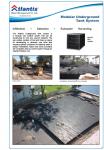
The Atlantis underground tank system is a modular sub surface system that can be constructed to hold any volume required. The sub surface location of the tank frees up space for landscaping or driveway use while also ensuring optimal conditions for retaining water is always maintained. Macro and micro pollutants are completely kept out of the system through an Atlantis Filtration Unit. It is used for infiltration, detention and to store roof top harvested rainwater.
ATLANTIS (n.y): Modular Underground Tanks System. Sidney: Atlantis URL [Accessed: 09.05.2019]
This document presents the general overview of small hydropower development and how it can contribute to meet the electricity needs of the national grid as well as the isolated rural areas. It presents a case study from Nepal that shows how a country that relied on external assistance for its hydropower development has now developed its local capability and utilised the internal resources available to develop it hydropower resources, especially the small hydro projects.
BASNYAT, D. (2006): Fundamentals of Small Hydro Power Technologies. Nairobi. Kenya: African Development Bank FINESSE training course on Renewable Energy and Energy Efficiency for Poverty Reduction URL [Accessed: 09.05.2019]
This book describes how to construct Arborloo toilets and how it can be upgraded to VIPs at a later stage.
MORGAN, P. EcoSanRes (2009): Ecological Toilets. (pdf presentation). Stockholm: Stockholm Environment Institute URL [Accessed: 09.05.2019]
These guidelines are intended to help municipalities, local authorities, consulting engineers, and developers in the planning and design of stormwater management systems in Alberta. They outline the objectives of stormwater management and the available methodologies and concepts for the planning, design, and operation of stormwater drainage systems. In addition to the water quantity aspects of stormwater management, the publication also describes some of the techniques that can be applied for quality management of stormwater.
ALBERTA ENVIRONMENT (1999): Stormwater Management Guidelines for the Province of Alberta. Edmonton: Alberta Environmental Protection URL [Accessed: 09.05.2019]
This is one of a series of fact sheets on potential income generating activities.
WHIRISKEY, J. and MC CARTHY, P. (2006): Small-Scale Hydroelectricity. Galway: Teagasc, Mellows Development Centre URL [Accessed: 09.05.2019]
With the move to a risk based approach to dam safety there has been a concomitant focus on estimating the probability of failure of dams. The majority of risk guidelines relate to the total probability of failure and therefore the individual probabilities estimated for different components and loading conditions need to be combined.
HILL, P. ; BOWLES, D. ; JORDAN, P. ; JORDAN, P. (2003): Estimating overall Risk of Dam Failure: Practical Considerations in Combining Failure Probabilities. In: ANCOLD Bulletin : Volume 127 , 63-72. URL [Accessed: 09.05.2019]
Volume IV of the Guidelines for the Safe Use of Wastewater, Excreta and Greywater recognizes the reuse potential of wastewater and excreta (including urine) in agriculture and describes the present state of knowledge as regards potential health risks associated with the reuse as well as measures to manage these health risks following a multi-barrier approach.
WHO (2006): Guidelines for the safe use of wastewater excreta and greywater. Volume IV. Excreta and Greywater Use in Agriculture. Geneva: World Health Organisation (WHO) URL [Accessed: 09.05.2019] PDF
A case study about “green infrastructure” to allow storm water soaking into the ground.
U.S. EPA (2008): Case Studies for Stormwater Management on Compacted, Contaminated Soils in Dense Urban Areas. Washington, DC: United States Environmental Protection Agency (U.S. EPA) URL [Accessed: 09.05.2019]
Greywater towers were selected as one of the methods that can be adopted to treat and safely reuse greywater for Arba Minch town and eight such units were constructed. Awareness about the unit has been raised in the community of Arba Minch and promising demand has been created.
SHEWA, W.A. GELETA, B.G. (2009): Greywater Tower, Arba Minch, Ethiopia. Draft. (= SuSanA - Case Studies ). Eschborn: Sustainable Sanitation Alliance (SuSanA) URL [Accessed: 09.05.2019]
One of the most exciting new trends in water quality management today is the movement by many cities, counties, states, and private-sector developers toward the increased use of Low Impact Development (LID) to help protect and restore water quality. LID comprises a set of approaches and practices that are designed to reduce runoff of water and pollutants from the site at which they are generated. By means of infiltration, evapotranspiration, and reuse of rainwater, LID techniques manage water and water pollutants at the source and thereby prevent or reduce the impact of development on rivers, streams, lakes, coastal waters, and ground water.
U.S. EPA (2007): Reducing Stormwater Costs through Low Impact Development (LID) Strategies and Practices. Washington, DC: United States Environmental Protection Agency (U.S. EPA) URL [Accessed: 09.05.2019]