Library
This document outlines the social and economical relevance of photocatalysis, provides background information on the technology, and highlights further challenges to be addressed.
MULLER, N. ; NOWACK, B. ; OY, S. ; SAARI, J. (2010): Photocatalysis for Water Treatment. In: ObservatoryNANO Briefings: URL [Accessed: 21.05.2019]The most common technologies for arsenic removal utilise conventional processes like oxidation, co-precipitation, adsorption, ion exchange and membrane techniques. The paper gives a short review of all these technologies, which are used in Bangladesh and India.
AHMED, M. F. (2001): An Overview of Arsenic Removal Technologies in Bangladesh and India. In: BANGLADESH UNIVERSITY OF ENGINEERING AND TECHNOLOGY ; UNITED NATIONS UNIVERSITY (2001): Technologies for Arsenic Removal from Drinking Water. Dhaka: 251-269. URL [Accessed: 21.05.2019]This presentation given in a course at the New Jersey Institute of Technology gives a theoretical and technical overview of adsorption on granular activated carbon.
ARMENANTE, P.M. (n.y): Adsorption with Granular Activated Carbon (GAC) . URL [Accessed: 21.05.2019]This publication describes the combination of ozone and ultrasounds for the disinfection and discoloration of domestic wastewater treatment plant effluents for reuse purposes.
SELCUK, H. ; NADDEO, V. ; BELGIONO, V. (2007): Advanced Treatment by Ozonation and Sonolysis for Domestic Wastewater Reuse. In: Proceedings of the 10th International Conference on Environmental Science and Technology: URL [Accessed: 21.05.2019]Factsheet on the principles, construction, operation and maintenance of kanchan filters (for arsenic and pathogen removal) for drinking water treatment at household level.
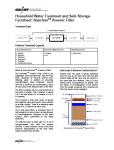
CAWST (2009): Kanchan Filter. Fact Sheet - Academic. (= Household Water Treatment and Safe Storage Fact Sheet - Academic ). Centre for Affordable Water and Sanitation Technology (CAWST) URL [Accessed: 21.05.2019]These equipment packages have been devised by the Oxfam Public Health Engineering Team and others to help provide a reliable water supply, primarily for emergency situations such as in refugee camps and disaster-relief operations. The equipment is designed to be readily available, easily transported, simple to use, rapidly assembled, and fully self-contained, to provide an adequate water supply at moderate cost.
OXFAM (2000): Water, Sanitation, and Shelter Equipment. For Emergencies and Longer Term Use. Oxford: OXFAM URL [Accessed: 21.05.2019]A three-page factsheet containing introduction, operation procedure, treatment efficiency, operating criteria and other information related to settling.
CAWST (2009): Settling. (= Household Water Treatment and Safe Storage Fact Sheets ). Calgary: Centre for Affordable Water and Sanitation Technology (CAWST) URL [Accessed: 21.05.2019]This document presents the results of a pilot study aiming at removing water micropollutants at the Lausanne (Switzerland) wastewater treatment plant.
MARGOT, J. ; MAGNET, A. ; THONNEY, D. ; CHEVRE, N. ; ALENCASTRO, F. de ; ROSSI, L. (2011): Traitement des Micropolluants dans les Eaux Uses-Rapport Final sur les Essais Pilotes a la STEP de Vidy (Lausanne). In: Ed. Ville de Lausanne : URL [Accessed: 21.05.2019]Factsheet on the principles, construction, operation and maintenance of arsenic removal via complexation for drinking water treatment at household level.
CAWST (2009): Arsenic Removal. Complexation. (= Household Water Treatment and Safe Storage Fact Sheet - Academic ). Centre for Affordable Water and Sanitation Technology (CAWST) URL [Accessed: 21.05.2019]Simplified factsheet on the principles, construction, operation and maintenance of ceramic pot filters for drinking water treatment ion developing countries.
CAWST (2009): Ceramic Pot Filter. Fact Sheet - Simplified. (= Household Water Treatment and Safe Storage Fact Sheet - Simplified ). Center for Affordable Water and Sanitation Technology (CAWST) URL [Accessed: 20.05.2019]Water, Hygiene and Sanitation Posters - The presentation includes 30 posters with key messages and questions on water, hygiene and sanitation. They are adapted for different regions including: Africa, Latin America, South Asia, Southeast Asia; and are available in multiple languages.
CAWST (2008): Water Hygiene Sanitation Poster Presentation. Alberta: Center for Affordable Water and Sanitation Technology (CAWST) URL [Accessed: 20.05.2019]Factsheet compilation on the principles, construction, operation and maintenance of HWTS options.
CAWST (2009): Household Water Treatment and Safe Storage Fact Sheets - Academic. Alberta: Center for Affordable Water and Sanitation Technology (CAWST) URL [Accessed: 20.05.2019]This study examines the microbiological effectiveness of locally produced ceramic filters in laboratory and field level at Cambodia.
BROWN, J.M. (2007): Effectiveness of ceramic filtration for drinking water treatment in Cambodia. (= PhD Dissertation ). Chapel Hill: University of North Carolina URL [Accessed: 20.05.2019]