Library

Se evalúan 6 casos de estudio a nivel de Latinoamérica respecto a experiencias de desarrollo de capacidades y su contribución a la implementación de la gestión integrada del agua en Argentina, Brasil, México y Perú incluyendo dos maestrías sobre GIRH en Argentina y México. En cada uno de los casos se analiza su impacto en el desarrollo de la GIRH, sus fortalezas y debilidades.
BARBAZZA, C. COMELLAS, E. FASCIOLO, G. LLOP, A. MENDOZA, V. DÍAZ, C. ESTELLAR, V. MACHADO, N. CARESTIATO, P. PROYECTO MASAL PARIS, M. SCHREIDER, M. SAINZ, A. (2010): Desarrollo de Capacidades para la GIRH en América Latina: Impactos y Avances. Argentina: LA WETnet Red Latinoamericana de Desarrollo de Capacidades para la Gestión de los Recursos HídricosLanguage: Spanish
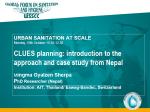
This presentation summarises the CLUES planning process in Nala, a peri-urban settlement near Kathmandu, Nepal. In Nala, there has been a strong demand from community to improve sanitation conditions. The document provides conclusions about the strengths and weaknesses of the CLUES approach, based on the case study in Nala.
SHERPA, M. (2011): CLUES planning: introduction to the approach and case study from Nepal. Conference presentation. Mumbai: WSSCC Global Forum on Sanitation and Hygiene
This document is part of a set of three resource documents included in the Integrity Management toolbox for Water service Providers (WsPs):
- Facilitator’s Guide
- Description of WsP Integrity risks
- Description of WsP Integrity Instruments (this document)
This document (description of WsP Integrity Instruments) provides elaborate descriptions of different types of integrity instruments that can help mitigating integrity risks within water utilities. As many such instruments do not only serve the purpose of enhancing integrity, this link is explicitly specified for each instrument. Further examples and ways how the different instruments could be implemented are provided together with a list of further reading.
Hermann-Friede, J. Kropac, M. Achermann, S. Heeb, J. Feuerstein, L. (2014): Integrity Management Toolbox for Water Service Providers - Description of WSP Integrity Instruments. Berlin, Germany: cewas, WIN, GIZ PDF
This paper tries to assess improvement of microbiological quality in drinking water by boiling and cost analysis of boiling in Boc Bo commune in Vietnam.
CLASEN, T.F. ; THAO, D.H. ; BOISSON, S. ; SHIPIN, O. (2007): Microbiological Effectiveness and Cost of Boiling to Disinfect Drinking Water In Rural Vietnam. In: Environmental Science and Technology: Volume 42 , 4255-4260. PDF
Powerpoint presentation of the water purification system implied by AUTARCON. This system uses solar energy to realise mechanical filtration and chlorification of water.
AUTARCON (2012): AUTARCON SuMeWa System. SolarPV Driven-Drinking Water Treatment. Munich: AUTARCON, Sun Meets Water (SuMeWa) System. [Accessed: 18.07.2017] PDF
This paper aims to present a basic conceptual framework for understanding the main practical issues and challenges relating to tariffs and subsidies in the water sector in developing countries
BLANC, D. le (2008): Providing Water to the Urban Poor in Developing Countries: the Role of Tariffs and Subsidies. New York: DESA Working Paper n°63
Riverbank filtration (RBF) has been used for many decades in Europe and the United States to provide drinking water to communities located on riverbanks. In India, the development of RBF has the potential to provide drinking water to many cities located on the Ganga Plains currently using surface water as a source for their public water supply. Water diversion for irrigation and discharge of wastewater to rivers with extremely low flows has aggravated the water supply situation for many Indian cities using surface water. A number of Indian cities, with source waters of significantly varying quality, are already using RBF. In most of these cities no significant additional treatment is provided to the filtrate for their water supply. The objective of this article is to examine selected operating bank filtration sites in India (that have been investigated since 2005) and to elucidate additional potential RBF sites based on water problems and hydrogeologic suitability. A summary of selected operational RBF systems in Ahmedabad, Delhi, Haridwar, Mathura, Medinipur and Kharagpur, Nainital, Patna and Srinagar and their ability to produce potable water is provided. Analysis of the suitability of RBF for Allahabad, Bhubaneswar, Guwahati, and Vijayawada, based on hydrogeology and land use, is also provided.
SANDHU, C. ; GRISCHEK, T. ; KUMAR, P. ; RAY, C. (2011): Potential for Riverbank Filtration in India. In: Clean Technologies Environmental Policy: Volume 13 , 295-316.