
Library
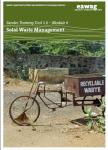
This document provides an overview of the present state-of-the-art of solid waste production and management. It contains the characteristics of municipal solid waste and describes current waste treatment systems and technologies, as well as non-technical aspects like private sector involvement and financial arrangements.
EAWAG ; SANDEC (2008): Solid Waste Management. Lecture notes. (= Sandec Training Tool 1.0, Module 6 ). Duebendorf: Swiss Federal Institute of Aquatic Science (EAWAG), Department of Water and Sanitation in Developing Countries (SANDEC) URL [Accessed: 08.04.2010]
This paper describes the World Bank DM2003 award, and the plan to implement the KAF (Kanchan Arsenic Filter) project throughout the Terai region in Nepal. The objectives of this project include the establishment of local entrepreneurs for a financially sustainable distribution mechanism, the capacity-building of local people towards long-term, user-participatory safe water provision, the dissemination of KAF information from a central technology centre, as well as networking with other water supply implementers.
NGAI, T. MURCOTT, S. SHRESTHA, R. (2004): Kanchan Arsenic Filter (KAF) - Research and Implementation of an Appropriate Drinking Water Solution for Rural Nepal. Cambridge, MA and Kathmandu: Massachusetts Institute of Technology and ENPHO, Nepal URL [Accessed: 07.04.2010]This is the website Dr. David Manz, who has developed of the small scale humanitarian models of biosand filters.
The homepage of the centre for affordable water and sanitation technology (CAWST) provides general description of sustainable drinking water treatment technologies and water, sanitation and hygiene issues. The publications section can provide you with important information. The profound HWTS knowledge base (https://www.hwts.info/) on Point-of-use water treatment solutions includes technology options to the implementation of best practices.
The factsheet about the OPPS-approach published by EcoSanRes gives a clear overview about the framework and the used planning tools.
KVARNSTROEM, E. AF PETERSENS, E. (2005): Open Planning of Sanitation Systems. EcoSanRes Factsheet 7. Stockholm: Stockholm Environmental Institute URL [Accessed: 06.04.2010]
Summary and brief evaluation of main household water treatment and safe storage (HWTS) options for developing countries. Options described are: chlorination, biosand filtration, ceramic filtration, solar disinfection, filtration and chlorination, flocculation and chlorination.
LANTAGNE, D. S. ; QUICK, R. ; MINTZ, E.D. (2006): Household Water Treatment and Safe Storage Options in Developing Countries. Review of Current Implementation Practices. In: Woodrow Wilson International Center for Scholars: Volume 54 , 17-38. URL [Accessed: 06.04.2010]
Evaluation of existing ceramic water filter technologies and their performance, production processes and methods for bringing a low-cost ceramic water filter to market in Nepal.
DIES, W. (2003): Development of a Ceramic Water Filter for Nepal. Master Thesis. Cambridge (USA): Massachusetts Institute of Technology URL [Accessed: 06.04.2010]
This document presents the GTZ ecosan project steps in more detail. Though the source book is only available in a draft version it contains important information on the project steps.
WERNER, C. PANESAR, A. BRACKEN, P. MANG, H. P. HUBA-MANG, E. GEROLD, A. (2003): An Ecosan Source Book for the Preparation and Implementation of Ecological Sanitation Projects. Eschborn: German Agency for Technical Cooperation (GTZ) GmbH. [Accessed: 05.04.2010] PDF
This scientific article describes how solar light and oxygen lead to damage of faecal coliforms in waste stabilization ponds. Humic substances absorb the energy of the sunlight and react with surrounding oxygen, leading to the formation of toxic reactive oxygen species (ROS).
CURTIS, T.P. ; MARA, D.D. ; SILVA, S.A. (1992): Influence of pH, Oxygen, and Humic Substances on Ability of Sunlight to Damage Faecal Coliforms in Waste Stabilization Pond Water. In: Applied and Environmental Microbiology : Volume 58 , 1335-1343. URL [Accessed: 02.04.2010]
Introduction to filtration and chlorination systems at the household level.
CDC/USAID (2009): Filtration & Chlorination Systems . (= CDC Household Water Treatment Options in Developing Countries Factsheets ). New York: Center for Disease Control and Prevention (CDC) and United States Agency for International Development (USAID). [Accessed: 01.04.2010] PDF
A simplified and easily understandable factsheet on UV tubes.
CAWST (2009): Ultraviolet (UV) Disinfection. Household Water Treatment and Safe Storage Fact Sheets - Simplified. Alberta: Center for Affordable Water and Sanitation Technology (CAWST). [Accessed: 04.04.2010] PDF
Factsheet on the implementation of ceramic filters.
CDC (2008): Ceramic Filtration. Household Water Treatment Options in Developing Countries Factsheets. Centers for Diseases Control and Prevention (CDC) URL [Accessed: 01.04.2010]The homepage of the Centre for Affordable Water and Sanitation Technology (CAWST) provides general descriptions of sustainable drinking water treatment technologies and water, sanitation and hygiene issues. The publications section in particular can provide you with important information.
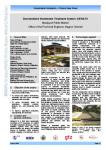
The wastewater from Manjuyod’s public market is treated in a decentralized system (DEWATS) composed of four different components: a settling tank; an anaerobic baffled reactor; an anaerobic filter; a planted gravel filter; and finally a polishing pond.
BORDA (2008): Wastewater Treatment System - DEWATS. Manjuyod Public Market.. (= Sustainable Sanitation Project Data Sheet. ). Bremen: Bremen Overseas Research and Development Association URL [Accessed: 31.03.2010]
This volume of the WHO guidelines for drinking-water quality explains how guideline values for drinking-water contaminants are to be used, defines the criteria used to select the various chemical, physical, microbiological, and radiological contaminants included in the report, describes the approaches used in deriving guideline values, and presents, in the form of brief monographs, critical reviews and evaluations of the effects on human health of the substances or contaminants examined.
WHO (1996): Guidelines for Drinking-Water Quality, Second Edition. (= Health Criteria and Other Supporting Information - Second Edition , 2 ). Geneva: World Health Organization (WHO) URL [Accessed: 31.03.2010]
This booklet should support households to prepare them for emergency situation by storing emergency food and water supplies.
FEMA (2004): Food and Water in an Emergency. Federal Emergency Management Agency (FEMA), U.S. Department of Homeland Security and American Red Cross URL [Accessed: 30.03.2010]
This paper documents WAN and its partners’ work on community-based approaches to water resource management, and attempts to distil important lessons from their experience to inform continued refinement of WAN’s institutional approach to CWRM and inform sector learning.
WAN (2008): Nepal’s Experiences in Community-Based Water Resource Management. (= Fieldwork paper ). Water Aid Nepal (WAN) and End Water Poverty URL [Accessed: 30.03.2010] PDF