Short factsheet on the design, operation, maintenance and costs of facultative ponds in the United States.
EPA (2002): Facultative Lagoons. (= Wastewater Technology Fact Sheet ). United States Environment Protection Agency URL [Accessed: 12.04.2010]Perspectives are different frameworks from which to explore the knowledge around sustainable sanitation and water management. Perspectives are like filters: they compile and structure the information that relate to a given focus theme, region or context. This allows you to quickly navigate to the content of your particular interest while promoting the holistic understanding of sustainable sanitation and water management.

Short factsheet on the design, operation, maintenance and costs of facultative ponds in the United States.
EPA (2002): Facultative Lagoons. (= Wastewater Technology Fact Sheet ). United States Environment Protection Agency URL [Accessed: 12.04.2010]
Journal article on a biogas digester, which was designed, constructed and its performance evaluated using a 3m3 continuous flow Indian type biogas plant at the Teaching and Research Farm, University of Agriculture, Makurdi, Nigeria. Various technical drafts and mathematical and chemical formulas are shown.
ITODO, I. N. ; AGYO, G. E. ; YUSUF, P. (2007): Performance evaluation of a biogas stove for cooking in Nigeria. In: Journal of Energy in Southern Africa: Volume 18 , 14-18. URL [Accessed: 09.04.2010]The sanitation portal of Akvopedia offers state of the art information on several sanitation technologies. It also mentions background knowledge on “Biogas as a source of energy”.
This website contains publications and resources developed under USAID-funded Hygiene Improvement Project (HIP). Various case studies, publications and training material are available.

This report examines the evidence to date regarding the scalability of HWTS. It seeks to consolidate existing knowledge and experience and distil the lessons learnt. Its primary aims are to 1) review the development and evolution of leading household water treatment technologies in their efforts to achieve scale, 2) identify the main constraints that they have encountered and 3) recommend ways forward.
CLASEN, T.D. (2009): Scaling Up Household Water Treatment. PhD Thesis. Geneva: World Health Organization (WHO) URL [Accessed: 09.04.2010]This website provides useful information and factsheets on HWTS.
The webpage of Sustainable Sanitation Alliance working group 03 provides up to date information on the use of biogas and anaerobic biogas reactors. Technical drafts and links are also available.
This webpage of the Appropriate Rural Technology Institute (ARTI) contains a report on an implemented biogas plant project in Maharashtra, India. The biogas is used for cooking.
This report presents the findings of a study conducted by Ministry of Agriculture (MININFRA) and SNV to assess the feasibility to set-up and implement a national programme on domestic biogas in Rwanda.
DEKELVER, G. RUZIGANA, S. LAM, J. (2005): Report on the Feasibility Study for a Biogas Support Programme in the Republic of Rwanda. Netherlands Development Organisation (SNV) URL [Accessed: 09.04.2010]
This factsheet provides information on point-of-use product trials conducted for four HWT options (boiling, chlorination, colloidal silver filter, and SODIS) in Nepal.
USAID (2006): Bringing the Consumer to the Table: Perceptions and Practice of Household Water Treatment Methods in Nepal . (= Research Brief ). Washington: United States Agency for International Development (USAID) URL [Accessed: 09.04.2010]
This report is a basic assessment of the feasibility and potential for using animal wastes in anaerobic methane digesters to create electricity in Minnesota. Anaerobic methane digesters use bacteria to partially break down animal wastes, creating methane, which can be used for making electricity.
MDCSEO (2003): Minnesota\'92s Potential for Electricity Production Using Manure Biogas Resources. Minnesota, USA: Minnesota Department of Commerce State Energy Office (MDCSEO) URL [Accessed: 09.04.2010]
This manual aims to help program planners, managers, and evaluators to design, implement, and evaluate WASH interventions. It is intended for use either in programmes and projects with a principal focus on WASH or with a broad child health agenda.
USAID (2010): Access and Behavioural Outcome Indicators for Water, Sanitation and Hygiene. New York: United States Agency for International Development (USAID), Hygiene Improvement Project URL [Accessed: 09.04.2010]
This report examines the evidence to date regarding the scalability of HWTS. It seeks to consolidate existing knowledge and experience and distil the lessons learnt. Its primary aims are to 1) review the development and evolution of leading household water treatment technologies in their efforts to achieve scale, 2) identify the main constraints that they have encountered and 3) recommend ways forward.
CLASEN, T.D. (2009): Scaling Up Household Water Treatment Among Low-Income Populations. (PhD Thesis). Geneva: World Health Organization (WHO) URL [Accessed: 09.04.2010]This webpage provides information of the application of biogas for cooking in Santa Fe de Guatuso. The e report explains the economic, social and technical background of the project.
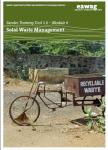
This document provides an overview of the present state-of-the-art of solid waste production and management. It contains the characteristics of municipal solid waste and describes current waste treatment systems and technologies, as well as non-technical aspects like private sector involvement and financial arrangements.
EAWAG ; SANDEC (2008): Solid Waste Management. Lecture notes. (= Sandec Training Tool 1.0, Module 6 ). Duebendorf: Swiss Federal Institute of Aquatic Science (EAWAG), Department of Water and Sanitation in Developing Countries (SANDEC) URL [Accessed: 08.04.2010]
This document provides technical information to TMDL practitioners who are familiar with the relevant technical approaches and legal requirements pertaining to developing TMDLs and refers to statutory and regulatory provisions that contain legally binding requirements.
US EPA (2008): Handbook for Developing Watershed Total Maximum Daily Loads (TMDLs). Washington, DC: Environmental Protection Agency (EPA) URL [Accessed: 08.04.2010]This website is a focal point for providing access to information about water, sanitation and environmental health and related issues in developing and transitional countries.