The national biogas extension programme in Nepal has been carried out successfully by the biogas support partnership (BSP). Their homepage reflects and capitalizes their experience in small-scale anaerobic biogas digester dissemination and construction.
Library
The main aim of the project was to avoid manual scavenging of excreta and to improve the sanitation situation at the Navsarjan Vocational Training Institute. The technical solution proposed was source separation (grey-/blackwater) and reuse. Greywater is separately treated and reused in the garden while the urine and faeces (blackwater) are directly introduced into a biogas plant. Digested sludge is dried on basic drying beds and used as compost for the garden. UDDT were also installed. The concept was implemented and evaluated for its social and cultural acceptability, sustainable and hygienic safety.
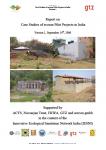
WAFLER, M. (2006): Chapter 3. Pilot Project "Navsarjan Vocational Training Institute Dalit Shakti Kendra". In: WAFLER, M. ; HEEB, J. ; (2006): Report on Case Studies of ecosan Pilot Projects in India. Eschborn: . URL [Accessed: 26.04.2010]This is the homepage of the Bremen Overseas Research and Development Association (BORDA), which has contributed strongly to the development of decentralized wastewater treatment (i.e. DEWATS) the past decades.
This link to Wikipedia provides information on cogeneration. There are many existing further links explaining the technologies of engine or generator types.
The Salem is a hilly surrounded District in Tamil Nadu State with a tropical climate and temperatures within 35 to 40°C (thus perfectly suited for biogas plant). Ramu owns a toilet linked biogas plant and the improvement of his family’s socio-economic circumstances has had an enormous impact on local thinking. Now the local inhabitants of that area realise the importance of hygiene and the ecological and environmental values, and the demand for toilet-linked biogas plants is increasing steeply.
RAJAM, G. (n.y): Individual Household Toilet Linked Biogas Plants. A Success Story in Salem District. New Delhi: Ministry of Rural Development URL [Accessed: 25.04.2010]This case study reports the development of an ecologically sound sanitation concept at the Adarsh Bidyaprasarak Sanstha's College of Arts & Commerce. In comprises separate urine collection and a DEWATS system for the treatment of black- and greywater consisting of a biogas settler, an anaerobic baffled reactor and an anaerobic filter, a horizontal flow constructed wetland and a polishing pond.
ZIMMERMANN, N. WAFLER, M. (2009): Decentralized Wastewater Management at Adarsh College, Badalapur, Maharashtra, India. (= SuSanA - Case Studies ). Eschborn: Sanitation Alliance (SuSanA) URL [Accessed: 25.04.2010]This report provides information on UV tube design, concept and presents research on different dimensions of UV tubes, such as effectiveness, tracer studies, bulb studies, and performance. It also contains experiences from different countries.
NELSON, K COHN, A. CONNELLY, L.G. KAMMEN, D. LARSEN, W. (2005): Final Report: UV tube Design Concept for Sustainable, Point-of-Use Water Disinfection. (=EPA SU831825) . United States Environmental Protection Agency and Office of Water Research and Development URL [Accessed: 25.04.2010]The project described aimed at avoiding manual scavenging of faecal products and at improving the sanitation situation at the Navsarjan Vocational Training Institute. Now greywater is separately treated and reused in the garden while the urine and faeces (blackwater) are directly introduced into a biogas plant. Digested sludge is dried on basic drying beds and used as compost for the garden. UDDTs were also installed. The concept was implemented and evaluated for its social and cultural acceptability, sustainable and hygienic safety.
WAFLER, M. HEEB, J. STAUB, A. OLT, C. (2009): Pour-flush toilets with biogas plant at DSK Training Institute. Gujarat, India - Draft. (= SuSanA - Case Studies ). Eschborn: Sustainable Sanitation Alliance (SuSanA) URL [Accessed: 25.04.2010]This article shows how biogas technology could improve the life of rural habitants in Nepal by preserving the nature.
GURUNG, T. (2007): Biogas, Saving Nature Naturally. In: EcoCircular: Volume 42 , 1-3. URL [Accessed: 25.04.2010]Biogas technology is already working extremely well on a large scale in several Asian countries. This article reports on some of these successes and recent up-scaling initiatives, and makes a plea for a global conference on biogas.
NES, W.J., van (2006): Asia hits the gas. In: Renewable Energy World: Volume 1 , 102-111. URL [Accessed: 24.04.2010]Article on pros and cons of lecturing can be found here
This document provides brief overlook on setting up ground rules. It includes ideas or even a list of suggestions for maintaining a safe and productive learning climate.
HARPER-WHALEN, S. MORRIS, S. (2007): Setting Ground Rules for Training Sessions. Montana Early Childhood Project URL [Accessed: 23.04.2010]Report data from ten years of teaching with Peer Instruction PI! In the calculus- and algebra-based introductory physics courses for no majors.
CROUCH, C.H. MAZUR, E. (2001): Peer Instruction: Ten years of experience and results. Cambridge: Harvard University URL [Accessed: 23.04.2010]Various aspects on establishing group rules are posted in this link.
Guidelines for trainers explaining how to create condition for trainings and what trainers should do to get the good atmosphere for the training.
This report presents the findings of a study conducted by the Netherlands Development Organisation (SNV) to assess the feasibility of setting up and implementing a national programme on domestic biogas in Bangladesh.
NES, W.J. van BOERS, W. UL-ISLAM, K. (2005): Feasibility of a national programme on domestic biogas in Bangladesh. (= Final report ). Netherlands Development Organisation (SNV) URL [Accessed: 23.04.2010]