
FRESNO
(2006):
Fresno Area Regional Groundwater Management Plan.
Fresno, California (USA):
City of Fresno homepage
URL
[Accessed: 21.03.2019]
Library


This paper investigates the potential for fog harvesting of the West Coast of South Africa.
OLIVER, J. (2002): Fog-water harvesting along the West Coast of South Africa: A feasibility study. In: Water SA: Volume 28 , 4. URL [Accessed: 21.03.2019]
This book provides a general introduction to a wide range of technologies. Among the topics covered are: planning and management of small water supplies, community water supplies in Central and Eastern European countries, water quality and quantity, integrated water resources management, artificial recharge, rainwater harvesting, spring water tapping, groundwater withdrawal, water lifting, surface water intake, water treatment, aeration, coagulation and flocculation, sedimentation, multi-stage filtration, desalination technology, disinfection, household level water treatment, technologies for arsenic and iron removal from ground water, and emergency and disaster water supply. Chapter 6: Artificial Recharge
SMET, J. ; WIJK, C. van (2002): Small Community Water Supplies: Technology, People and Partnership: Artificial Recharge - Chapter 6. The Hague: International Water and Sanitation Centre (IRC) URL [Accessed: 21.03.2019]
COOK, R., SANSA, G. and BROWN, L.
(2006):
Drainage Water Management. A Practice for Reducing Nitrate Loads from Subsurface Drainage Systems.
Washington D.C.:
United States Environmental Protection Agency (EPA)
URL
[Accessed: 21.03.2019]
This document provides guidance on artificial recharge techniques and designs and the planning and monitoring of artificial recharge projects.
MINISTRY OF WATER RESOURCES (2000): Guide on Artificial Recharge to Groundwater. New Delhi: Central Ground Water Board URL [Accessed: 21.03.2019]
KUMAR, N.K. AIYAGARI, N.
(1997):
Artificial Recharge of Groundwater.
Virginia:
Civil Engineering Department
URL
[Accessed: 21.03.2019]
This paper provides a scientific background on fog, including the definition of fog, the types of fog, and the relevance of fog in research.
EUGSTER, W. (2008): Fog Research. In: Die Erde : Volume 139 , 1-2. URL [Accessed: 21.03.2019]
CAP
(2002):
Typical spreading basin.
Phoenix:
Central Arizona Project
URL
[Accessed: 21.03.2019]
USGS
(2011):
The Water Cycle – Infiltration.
Washington D.C.:
U.S. Geological Survey. U.S. Department of the Interior
URL
[Accessed: 21.03.2019]
UIEXTENSION
(n.y):
Drainage Water Management.
Illinois (USA):
University of Illionis Extension (UIEXTENSION)
URL
[Accessed: 21.03.2019]
https://www.youtube.com/watch?v=M-BAVYzh1ZY
[Accessed: 14.03.2019]
In this interview with TheWaterChannel Erik Nissen-Peter explains four different water harvesting techniques in a river bed which should be considered before the actual development: hand dug wells, subsurface dams, weirs and sand dams. Erik Nissen-Petersen tells about the advantages of subsurface dams compared to sand dams.
http://stormwaterbook.safl.umn.edu/case-studies/case-study-11-stormwater-retention-ponds-maintenance-vs-efficiency
[Accessed: 14.03.2019]
This case study was done in Minneapolis (USA). It compares maintenance frequency with cost efficiency of retention ponds, taking at hand data of several retention ponds of the region.
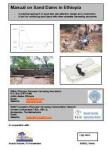
A practical approach on sand dam site selection, design and construction. A tool for combining sand dams with other rainwater harvesting structures.
ERHA ; RAIN (n.y): Manual on Sand Dams in Ethiopia. Addis Ababa and Amsterdam: Ethiopian Rainwater Harvesting Association (ERHA) and Rainwater Harvesting Implementation Network (RAIN) URL [Accessed: 14.03.2019] PDF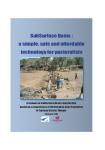
This manual builds on the experience of VSF with subsurface dams in Kenya, explaining all phases from the initial assessment to the design of the dams based on the own lessons learned with this specific technique.
VSF (2006): SubSurface Dams: a simple, safe and affordable Technology for Pastoralists. A manual on SubSurface Dams Construction based on an Experience of Vétérinaires sans Frontières in Turkana District (Kenya). Brussels: Vétérinaires sans Frontières (VSF) URL [Accessed: 14.03.2019] PDF