

WATERUN Toolbox

Funded by the
European Union
The WATERUN Toolbox was developed as a dissemination activity of the WATERUN project, funded by the European Union under the Horizon Europe research and innovation programme (Grant Agreement No. 101060922, project duration: June 2022 – May 2026). Views and opinions expressed are however those of the author(s) only and do not necessarily reflect those of the European Union or the granting authority. Neither the European Union nor the granting authority can be held responsible for them.
This work has received funding from the Swiss State Secretariat for Education, Research and Innovation (SERI).
Welcome to the WATERUN Toolbox for Urban Water Runoff Management!
Are you a municipality, water utility, urban drainage operator or similar that is struggling with diffuse water pollution in your city?
EU Directive 2024/3019 requires cities to manage pollution from stormwater overflows and urban runoff. This toolbox helps you do it — from understanding your system to selecting and monitoring measures.
The Toolbox is built around two entry axes. Pick the one that matches what you are working on:
- A) The IUWMP Journey. Here you can create your Integrated Urban Wastewater Management Plan. A practical, step-by-step guide for municipalities and water utilities preparing an IUWMP as required by Directive (EU) 2024/3019, Annex V. It covers the full process: mapping your drainage system, setting measurable objectives, selecting and sizing measures (with priority given to nature-based solutions), and designing a monitoring programme that feeds into the next planning cycle.
- B) WATERUN Tools for Diffuse Pollution Control. This is where you will find four tools developed in the WATERUN project to support IUWMP preparation: Tool 1 – Portable Monitoring System developed by DCU, Tool 2 – CleanCityCover developed by TU Berlin, Tool 3 – MUST-B Planning Toolkit by UFZ, and Tool 4 – Risk-based Decision Support System developed by UNIVPM. Each tool is presented through a factsheet and at times sub-factsheets providing further details on specific steps. Three contrasting catchments with different climates, land uses and degrees of existing infrastructure were used to develop and validate the WATERUN methodology: Santiago de Compostela (Spain), Aarhus (Denmark), and Amman (Jordan).
The three sections are interconnected. The IUWMP Journey guides users through the planning process step by step, while the WATERUN Tools support specific stages with monitoring, modelling and decision support solutions. The Case Studies show how the Journey and Tools were applied in three real urban catchments, offering practical reference points for users developing their own approach.
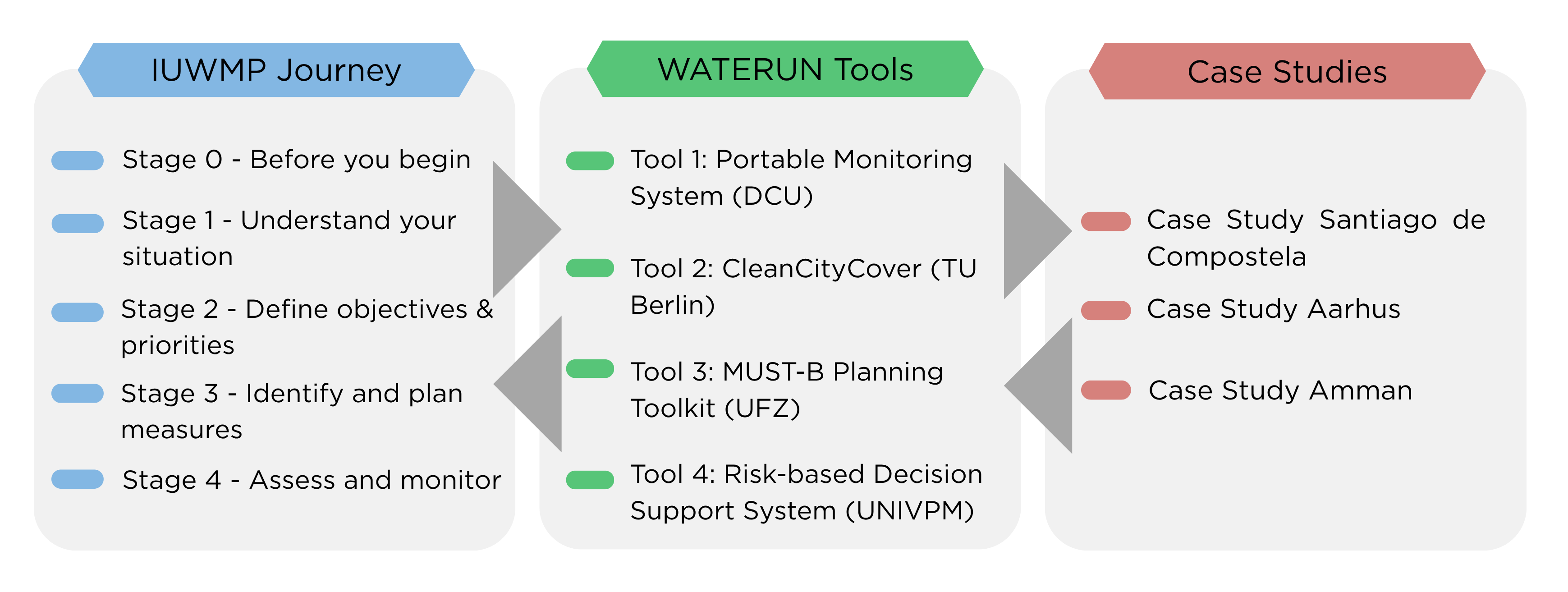
Figure 1: Entry points and structure of the WATERUN Toolbox. Source: OWN ELABORATION (2026)
Why Do We Need This Toolbox?
Urban runoff and stormwater overflows are a source of pollution that is expected to increase due to urbanization and climate-driven rainfall pattern changes. Directive (EU) 2024/3019 requires cities to address this through Integrated Urban Wastewater Management Plans but the EU implementing guidance is expected by 2028. This toolbox does not anticipate or replace the official EU implementing guidance on IUWMPs. It offers one practical interpretation of the Directive’s requirements, grounded in published research and established planning practices from across Europe and beyond. Its purpose is to help municipalities begin preparing now, and to show where the WATERUN tools can support a process that every affected city will need to go through.
Integrated Urban Wastewater Management Plans (IUWMPs) are a central instrument to address this challenge. They provide the strategic framework for preventing and reducing pollution from storm water overflows, separately collected urban runoff and rainfall-driven pollution events.
According to Annex V of Directive (EU) 2024/3019, IUWMPs must consider preventive and mitigation measures such as avoiding the entry of unpolluted rainwater into sewer systems (source control), promoting natural water retention and rainwater harvesting, increasing green and blue spaces, limiting impermeable surfaces, and giving priority to green and blue (nature-based) solutions in the case of new infrastructure.
The IUWMP Journey is not official EU guidance. The IUWMP Journey set out here was developed by seecon as a practitioner framework, drawing on the Directive itself, established urban drainage practice, and existing planning frameworks from comparable jurisdictions. For the wider WATERUN project context, partners and funding, see the About tab.
Who Is This Toolbox For?
If you are a municipal engineer, urban planner, drainage manager, or part of a water utility team working on overflow reduction, pollution control, or nature-based solutions, this platform is for you! Regulators, environmental agencies, consultants, and researchers can also use the toolbox to review plans, assess risk, or support strategic decisions. Its primary focus is on helping cities and utilities turn requirements into workable solutions.