
The objective of this extensive report is to provide a comprehensive, long-term and regional framework for thinking about water in the Middle East (Israel, the Palestinian Territories, Jordan, Lebanon, Syria, Iraq and Turkey), in order to engage political leaders, media and the public in harnessing and managing collaborative solutions for sustainable regional water management.
STRATEGIC FORESIGHT GROUP (2011): Blue Peace. Rethink Middle East Water. Mumbai: Strategic Foresight Group URL [Visita: 24.07.2011]Library
Saline industrial wastewater containing non-biodegradable compounds (a-methylphenylglycine) can be treated by a photo-Fenton process. However, in order to reduce the treatment costs, the AOP can be coupled with a biologic treatment as soon as water is biodegradable.
MALATO, S. (2007): Waste Water Treatment by Advanced Oxidation Processes (Solar Photocatalysis in Degradation of Industrial Contaminants). Plataforma Solar de Almeria-CIEMAT. [Acccessed: 20.07.2011] PDFThis document gives a brief technical overview over fog harvesting.
UNEP (1997): Chapter 1.3 Fog harvesting. Entradas: UNEP (1998): Source Book of Alternative Technologies for Freshwater Augmentation in Latin America and the Caribbean. Nairobi: . URL [Visita: 20.07.2011]This document presents illustrative an implemented fog harvesting project in Peru.
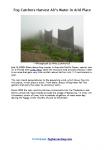
FOGHARVESTING (n.y): Fog Catchers Harvest Air’s Water in Arid Place. FOGHARVESTING. [Accessed: 20.07.2011] PDFSince the 1980s, the Pacific Institute tracks and categorizes any events related to water and conflict. The open website presents the water conflict chronology in form of a list, a map and a timeline.
This article is about one of the first fog harvesting projects, which started in 1990 in El Tofo, Chile.
This website of the charity FogQuest provides a broad overview over fog harvesting as well as several videos on fog collection.
This document specifies the success factors for fog collection projects.
MUNICH RE FOUNDATION (2010): Results from the Workshop on Success Factors for Fog Collection Projects. 5th International Fog Conference 25-30 July 2010. Munich: MUNICH RE FOUNDATION. [Accessed: 14.07.2011] PDFThis is a general description about fog collection.
SCHEMENAUER, R. CERECEDA, P. (1997): Fog Collection. Norwich: Tiempo. [Accessed: 13.07.2011] PDFThis document contains information about standard fog collectors and their construction.
SCHEMENAUER, R. ; CERECEDA, P. (1994): A Proposed Standard Fog Collector for Use in High-Elevation Regions. Entradas: Journal of Applied Meteorology : Volume 33 , 1313-1322. URL [Visita: 13.07.2011]The main objective of this publication is therefore to assist planners and practitioners in designing and managing spate irrigation projects. It covers hydrology, engineering, agronomy, local organisations and rules, wadi basin management and the economics. It is designed to be both a practical guidance document and a source of information and examples based extensively on experience from around the world in areas where spate irrigation is practised.
FAO (2010): Guidelines on Spate Irrigation. Rome: Food and Agriculture Organization (FAO) URL [Visita: 28.06.2011]The purpose of the study was to evaluate the potential and technical aspects of improving irrigation performance and reducing poverty simultaneously through applying a market creation approach to development.
KELLER, J. (2001): Gardening with Low-Cost Drip Irrigation in Kenya:. URL [Visita: 27.06.2011]