The focus of the study is on the impact of the programmes at the level of the end beneficiaries. Main effect variables taken up in the impact analysis are quality and quantity of the drinking water that is supplied and consumed, the actual use of improved water sources and sanitation facilities, hygiene behaviour, the time burden of water collection, the use of time savings for schooling and/or economic activities, the health effects and costs, and the financial viability of the investment and fee structure. The study also addresses differences in benefits across socio-economic groups, and differences between the dry and rainy season. The study has been designed with the explicit aim of providing quantitative evidence on the effects that can be attributed to the interventions by comparing changes over time and between households with (treatment) and without (control) programme interventions. The interventions studied are water supply infrastructure (manual pumps and small piped systems), public latrine buildings and hygiene promotion.
MINISTRY OF FOREIGN AFFAIRS (2012): Impact Evaluation of Drinking Water Supply and Sanitation Programmes in Rural Benin. The Risk of Vanishing Effects . The Hague: Ministry Of Foreign Affairs URL [Visita: 26.03.2012]Library
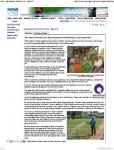
IWMI research in Ghana suggests that poor access to irrigation may discourage some women from taking up urban farming, but men also feel disadvantaged by female domination of the marketing sector.
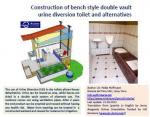
HOPE, L. COFIE, O. KERAITA, B. DRECHSEL, P. (2009): Gender and Urban Agriculture: The Case of Accra, Ghana. Warwickshire, UK: Practical Action Publishing URL [Visita: 26.03.2012]The use of Urine Diversion (UD) in dry toilets allows faeces dehydration. Urine can be reused as urea, while faeces are dried in a double vault system of alternate use. The moisture comes out using ventilation pipes. After 2 years the end product can be emptied and reused without having any health risk. Water from washing can be treated in a constructed wetland and reused for instance for irrigation.
HOFFMANN, H. (2012): Construction of Bench Style Double Vault Urine Diversion Toilet and Alternatives. Lima: Rotaria del Peru SAC URL [Visita: 26.03.2012]This website is about basic ion exchange processes in water treatment with an emphasis on applications such as softening, demineralisation, and nitrates removal.
This is an article on how to remove radioactive iodine-131 from drinking water, talking about different technologies including ion exchange.
This web link describes the use of ion exchangers and their use in wastewater treatment, including theoretical and practical information.
The aim of this manual is to describe the variety of work as well as to provide a survey of the types of materials used in rural water supply construction.
MEULI, C. WEHRLE, K. MUELLER, H. PFIFFNER, H. (2000): Building Construction. (= Series of Manuals on Drinking Water Supply , 3 ). St. Gallen: Swiss Centre for Development Cooperation in Technology and Management (SKAT) URL [Visita: 22.03.2012]The purpose of this manual is to assist UNICEF Country Offices and others interested in promoting the emergence of a professional manual drilling sector in their country of operation. The manual provides a step-by step methodology, based on experiences in Niger, Chad and Senegal, for the promotion of a local professional manual drilling sector.
UNICEF (2010): Professionalizing the Manual Drilling Sector in Africa. A Guide to Building Capacity to Increase Access to Safe Water in Rural Areas. New York: UNICEF URL [Visita: 21.03.2012] PDFThis case study examines the impact of professional manual drilling operations on the problem of increasing the rate of delivery of improved water supply in Chad.
UNICEF (2009): The Impact of Manual drilling for the Construction of Sustainable Water-Points in Chad. Case Study. New York: UNICEF URL [Visita: 21.03.2012] PDFThe purpose of this manual is to provide straightforward financing guidance to “low cost well drilling enterprises” involved in water well drilling operations, as well as to village and community groups, individual, and NGOs (“community customers”) intending to borrow the necessary capital to hire services from such well drilling enterprises.
UNICEF (2010): Financing Options for Low-cost Well Drillers & Communities for Rural Water Supply. New York: UNICEF URL [Visita: 21.03.2012] PDFThis handbook describes the various jetting techniques in detail that can be used to drill wells in loose and soft soil formations. With this technique, wells are drilled in a few hours rather than days.
VUIK, R. (2010): Manual Drilling Series: Jetting. Technical Training Handbook on Affordable Manual Well Drilling. Papendrecht: PRACTICA Foundation URL [Visita: 21.03.2012] PDFThe practical guidelines for test pumping presented in this publication reflect years of hands-on experience in borehole exploitation in both rural and urban settings, from Africa to the Middle East and Asia.
ICRC (2011): Technical Review. Practical Guidelines for Test Pumping in Water Wells. Geneva: International Committee of the Red Cross (ICRC) URL [Visita: 21.03.2012] PDFThe manual ‘Understanding Groundwater & Wells in manual drilling’ complements the 4 technical training handbooks and highlights those essential subjects which are relevant to manual drilling, geo-hydrology, hygiene, well installation and well development in practice, in simple and understandable language.
WAL, A. van der (2010): Understanding Groundwater & Wells in Manual Drilling. Instruction Handbook for Manual Drilling Teams on Hydro-geology for Well Drilling, Well Installation and Well Development. Papendrecht: PRACTICA Foundation URL [Visita: 21.03.2012] PDFThe Rural Water Supply Network (RWSN), in collaboration with UNICEF, recently published a Code of Practice for Cost Effective Boreholes. This document outlines principles that provide a basis for the realisation of economical and sustainable access to safe water through the construction of boreholes in Sub-Saharan Africa. Evaluation of these principles in specific countries underlined the importance of improved contractual procedures and technical specifications for significant reductions in drilling costs.
UNICEF (2011): Improving Cost Effectiveness of Drilling Programmes in Mozambique and Zambia. New York: UNICEF PDF