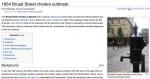
The Broad Street cholera outbreak was a severe outbreak of cholera that occurred near Broad Street in Soho district of London, England in 1854. This outbreak is best known for the discovery that cholera is spread by contaminated water. This discovery came to influence public health and the construction of improved sanitation facilities beginning in the 19th century.
WIKIPEDIA (n.y): 1854 Broad Street cholera outbreak. San Francisco: Wikimedia Foundation Inc URL [Visita: 05.02.2013]Library
This manual is part B of the updated manuals on sewerage and sewage treatment, prepared by the Central Public Health and Environmental Engineering Organisation (CPHEEO), a department under the Ministry of Urban Development, India. These manuals aim at meeting the professional needs of practising engineers dealing with the sanitation sector in the country that focuses on achieving the goal of 'sanitation for all' within a reasonable timeframe. Part B of the manual is on Operation and Maintenance aspects related to sewerage system.
CPHEEO (2012): Manual on Sewerage and Sewage Treatment. Part B: Operation and Maintenance. New Delhi: The Central Public Health and Environmental Engineering Organisation (CPHEEO), Ministry of Urban Development, Government of India URL [Visita: 04.02.2013]This videos show how traditional diversion-based phad irrigation systems are being revived and promoted in Vidarbha, Maharashtra. Phads are a community-based and managed diversion irrigation management system.
This manual is part C of the updated manuals on sewerage and sewage treatment, prepared by the Central Public Health and Environmental Engineering Organisation (CPHEEO), a department under the Ministry of Urban Development, India. These manuals aim at meeting the professional needs of practising engineers dealing with the sanitation sector in the country that focuses on achieving the goal of 'sanitation for all' within a reasonable timeframe. Part C of the manual is on Management aspects related to sewerage system.
CPHEEO (2012): Manual on Sewerage and Sewage Treatment. Part C: Management. New Delhi: The Central Public Health and Environmental Engineering Organisation (CPHEEO), Ministry of Urban Development, Government of India URL [Visita: 04.02.2013]This manual is part A of the updated manuals on sewerage and sewage treatment, prepared by the Central Public Health and Environmental Engineering Organisation (CPHEEO), a department under the Ministry of Urban Development, India. These manuals aim at meeting the professional needs of practising engineers dealing with the sanitation sector in the country that focuses on achieving the goal of 'sanitation for all' within a reasonable timeframe. Part A of the manual is on Engineering aspects related to sewerage system.
CPHEEO (2012): Manual on Sewerage and Sewage Treatment. Part A: Engineering. New Delhi: The Central Public Health and Environmental Engineering Organisation (CPHEEO), Ministry of Urban Development, Government of India URL [Visita: 04.02.2013]The aim of this page is to help people in getting familiar with a variety of methods and tools for planning and reflection of their own activities, for drawing lessons and for sharing insights and applying them. It features a selection of more than 20 methods and tools for knowledge sharing and learning, from basic to more advanced tools, applicable at personal, team and organisational level.
This issue publishes selected contributions from the 1st WATERBIOTECH conference. WATERBIOTECH („Biotechnology for Africa‘s sustainable water supply“) is a coordination and support action funded within the Africa call of the EU 7th Framework Programme.
ECOSAN CLUB (2013): Selected contributions from the 1st WATERBIOTECH conference, 9-11 October 2012, Cairo, Egypt. (= Sustainable Sanitation Pratice , 14 ). Vienna: Ecosan Club URL [Visita: 29.01.2013]This video presents the larger context of the region within which phads, or diversion based-irrigation systems are practised in western Maharashtra, India.
This little video sums up "The History of Climate Change Negotiations in 83 seconds". It is put together by CICERO and the Research Council of Norway.
To meet the food and nutrition needs of a richer, more urbanised world with a growing population, it is essential to popularise sustainable eating habits. The Food and Environment Double Pyramid model, which has undergone its third update since 2010, reinforces this theory by confirming the close connection between healthy eating and sustainable eating.
BARILLA (2012): Double Pyramid 2012: enabling sustainable food choices. Parma: Barilla URL [Visita: 29.01.2013]Menstrual hygiene matters is an essential resource for improving menstrual hygiene for women and girls in lower and middle-income countries. Nine modules and toolkits cover key aspects of menstrual hygiene in different settings, including communities, schools and emergencies.
HOUSE, S. MAHON, T. CAVILL, S. (2012): Menstrual hygiene matters. A resource for improving menstrual hygiene around the world. London: WaterAid URL [Visita: 29.01.2013]In order to manage the groundwater resources better, the Ministry of Drinking Water and Sanitation of India in collaboration with the National Remote Sensing Centre, has prepared groundwater prospects maps for 14 states in the country, so far. These 1:50000 scale maps organised toposheet-wise, possess comprehensive spatial data on groundwater and can help identify locations for open wells or borewells, as well as locations of groundwater recharge structures.
This website contains a wealth of information about the blue ocean strategy, as well as many tips and downloads available for using the blue ocean strategy to improve your business.
The Plain Language Guide offers a set of standardised, easy-to-understand definitions, providing readers with concrete examples in practice of how TI approaches these issues. Relevant links are also provided for further background information or research.
TRANSPARENCY INTERNATIONAL (2009): The Anti-Corruption Plain Language Guide. Berlin: Transparency International URL [Visita: 16.01.2013]The Water Integrity Network (WIN) was formed to respond to increasing concerns among water and anti-corruption stakeholders over corruption in the water sector. It combines global advocacy, regional networks and local action, to promote increased transparency and integrity, bringing together partners and members from the public and private sectors, civil society and academia, to drive change that will improve the lives of people who need it most.
This website provides articles, academic articles, course materials and other resources for making use of the Blue Ocean Strategy.