The Report aims to illustrate progress made on meeting the target to develop integrated water resources management and water efficiency plans by 2005, with support to developing countries, through actions at all levels agreed at the World Summit on Sustainable Development (WSSD) in Johannesburg in 2002, through the Johannesburg Plan of Implementation (JPoI). The Report is based on a survey covering 104 countries. The survey brings together the results of questionnaires by UN-DESA DSD and UNEP carried out in 2007.
UN Water (2008): Status Report on IWRM and Water Efficiency Plans for CSD16. . URL [Visita: 07.05.2013]Library
In this document, case studies from a variety of both developed and developing countries are described and subdivided into the following ecosystem management categories: Habitat rehabilitation, pollution control, environmental flows, enhancing stakeholder involvement, and integrated watershed management.
UNEP (2009): Ecosystem Management Case Studies. Nairobi: United Nations Environmental Programme (UNEP) URL [Visita: 07.05.2013]This publication gives a short and comprehensive summary of the United Nation’s Millennium Ecoystem Assessment. It treats the questions: How have ecosystems and their services and uses changed? How does ecosystem change affect human well-being and poverty alleviation? What are the critical factors that cause ecosystem change? What are future scenarios of ecosystem change?
GREENFACTS (2013): Scientific Facts on Ecosystem Change. Brussels: Greenfacts URL [Visita: 07.05.2013]This Wikipedia article is about irrigation in agriculture.
Wikipedia article containing a description and the environmental impacts of pollination.
Website describing the natural purification of water.
Wikipedia article describing the process of photosynthesis.
Water is one of the most important elements involved in the creation and development of healthy life. Haphazard disposal of untreated wastewater from households as well as institutions and industry is causing severe deterioration of water bodies in many urban areas in the developing world. There are several methods to treat the municipal wastewater for intended use. One of the methods of the treatment is constructed wetland. Constructed wetland system for wastewater treatment has been proven to be effective and sustainable alternative for conventional wastewater treatment technologies. In the present study performance of the fabricated model on which the local Amba Nala effluent characteristics like pH, DO, TS, BOD, COD with and without plant species were studied.
BORKAR, R.P. ; MAHATME, P.S. (2011): Wastewater Treatment with Vertical Flow Constructed Wetland. Entradas: International Journal of Environmental Sciences: Volume 2 , 590-603. URL [Visita: 04.05.2013]Constructed wetlands are considered as low cost treatment option for domestic and industrial wastewater in the recent decades. The presence of toxic heavy metals in wastewater is a problematic issue, since these heavy metals have potential to accumulate in the treatment systems. Thus heavy metals greatly influence the efficiency of constructed wetlands. Therefore a feasibility study was proposed for long term usage of constructed wetlands as treatment systems.
SIVARAMAN, C. ; ARULAZHAGAN, P. ; WALTHER, D. ; VASUDEVAN, N. (2011): Feasibility Studies for Reuse of Constructed Wetlands Treating Simulated Nickel Containing Groundwater. Entradas: Universal Journal of Environmental Research and Technology: Volume 1 , 293-300. URL [Visita: 04.05.2013]An introduction to process documentation presents lessons learned from a range of projects over the past ten years and describes IRC's emerging understanding of how process documentation can promote learning and action through joint reflection and analysis. It also offers tools for collecting and presenting observations that stimulate reflection, learning and sharing.
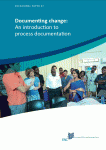
Da Silva Wells, C. Le Borgne, E. Dickinson, N. Jong, D. de IRC International Water and Sanitation Centre (2011): Documenting change : an introduction to process documentation. (= Occasional paper series / IRC , 47 ). The Hague: IRC International Water and Sanitation Centre URL [Visita: 24.04.2013]En este documento se habla sobre el marco legal de la gestión del Agua en Chile, las instituciones relacionadas al sector, finalmente se proponen ajustes que se deberían realizar para una apropiada gestión.
LARRAÍN, S. AEDO, M. NAVARRETE, K. VILLARROEL, C. (2010): Marco Jurídico para la Gestión del Agua en Chile. Diagnóstico y Desafíos. Chile: Programa Chile Sustentable URL [Visita: 18.04.2013]Language: Spanish
Language: Spanish
Se realiza el análisis del Marco Jurídico e Institucional actual para la prestación de los servicios de agua y saneamiento y se realizan recomendaciones para cada ley y organismo con la finalidad de mejorar su gestión.
AMILPA, E. (2012): Marco Jurídico e Institucional para la Prestación de los Servicios de Agua y Saneamiento en el Estado de Chiapas, México. México: Naciones Unidas URL [Visita: 18.04.2013]Language: Spanish
En el proyecto de “Análisis del marco legal e institucional para caudales ecológicos en el Ecuador”, primeramente se realiza un análisis del marco legal completo, de las normas vigentes, posteriormente se determinan las competencias institucionales sobre la rectoría del agua y caudales ecológicos.
ARIAS, V. TERNEUS, E. (2012): Análisis del Marco Legal e Institucional para Caudales Ecológicos en el Ecuador. Quito: Unión Internacional para la Conservación de la Naturaleza y de los Recursos Naturales URL [Visita: 18.04.2013]Language: Spanish
En esta página se encuentra una descripción de los mapas participativos, con sus objetivos, beneficios y pasos a seguir para su elaboración.
RODRIGUEZ MARTINEZ, E. (2011): Los Mapas Participativos-Comunitarios en la Planificación del Desarrollo Local. Maracay: Universidad Pedagógica Libertador URL [Visita: 17.04.2013]Language: Spanish
This report is produced every two years by the World Health Organization (WHO) on behalf of UN-Water. It provides a global update on the policy frameworks, institutional arrangements, human resource base, and international and national finance streams in support of sanitation and drinking-water. It is a substantive input into the activities of Sanitation and Water for All (SWA).
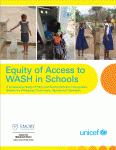
WHO (2012): UN-Water Global Annual Assessment of Sanitation and Drinking-Water (GLAAS). The Challenge of Extending and Sustaining Services. Geneva: World Health Organization (WHO) URL [Visita: 17.04.2013]This study presents findings from a six-country study conducted by UNICEF and the Center for Global Safe Water at Emory University in collaboration with UNICEF country offices in Kyrgyzstan, Malawi, the Philippines, Timor-Leste, Uganda and Uzbekistan and their partners. The six case studies presented together contribute to the broader understanding of inequities in WASH in Schools access by describing various dimensions that contribute to equitable or inequitable access across regions, cultures, gender and communities.
UNICEF (2013): Equity of Access to WASH in Schools: A Comparative Study of Policy and Service Delivery. New York: UNICEF URL [Visita: 17.04.2013]Language: Spanish
This paper discusses the origin and fate of macro pollutants in river bank filtrate, based on extensive full-scale measurements in well fields and treatment systems of the Drinking Water Company Oasen in the Netherlands.
DE VET, W.W.J.M. ; VAN GENUCHTEN, C.C.A. ; VAN LOOSDRECHT, M.C.M. ; VAN DIJK, J.C. (2009): Water Quality and Treatment of Riverbank Filtrate. Entradas: Drinking Water Engineering and Science Discussions: Volume 2 , 127-159. URL [Visita: 15.04.2013]Decentralised wastewater treatment plant is a site-specific system. The different components of the system settler , anaerobic baffled reactor , planted filter and polishing pond are planned and designed according to the treatment requirement of the wastewater generated. Average water consumption for domestic usage in India is 135 Lpcd. 80% of the water which is used or consumed for domestic purposes comes out as a wastewater. An on-site wastewater treatment plant like DWWT can be installed to treat and recycle this wastewater in order to close the loop. The capacity of the system may vary from 1KLD to 100 KLD . For instance, DWWT system at CSE is designed for the capacity of 8 KLD to treat and reuse wastewater which is generated by the staff population of 150-200.
CSE (n.y): Cost Estimation for Planning and Designing of Decentralised Wastewater Treatment System. New Delhi: Centre for Science and Environment (CSE) URL [Visita: 15.04.2013]CDD Society aims to address the challenges posed by increasing quantities of wastewater produced in urban and peri-urban areas in South Asia through the provision of Decentralised Basic Needs Services (DBNS).
CDD (2013): Consortium for DEWATS Dissemination Society. Bangalore: CDD (Consortium for DEWATS Dissemination) Society URL [Visita: 14.04.2013]