
NWC
(2005):
Australian Water Resources 2005 - Water Balance Assessment.
Canberra:
Australian Government, National Water Commission (NWC)
URL
[Visita: 10.04.2019]
Library
Phosphorus (P) resources globally are considered limited. P originates from a mined non-renewable rock, therefore its presence in the urban-shed demonstrates the impact of urbanisation and the anthropogenic influences on natural cycles of material flow. Any recycling of P is therefore becoming increasingly important. In passing through the linear urban system P is mobilised from particulate to soluble forms. With the present level of nutrient losses from urban water management into the aquatic environment (leading to adverse health and ecological impacts) commitment to urban or peri-urban ecological agriculture (without synthetic fertilisers) offers an attractive solution to the management of urban organic “wastes”.
GUMBO, B. (1999): Establishing Phosphorus Fluxes Through Material Flow Accounting and Systems Thinking in an Urban Shed in Harare, Zimbabwe. Harare: SSRZ Seminar II URL [Visita: 10.04.2019]
This document explains how a model-based on material flow analysis (MFA) and life cycle assessment (LCA) was constructed to evaluate the environmental performance of the scenarios. The variables were nitrogen, phosphorus and organic carbon. The evaluation focused on eutrophication and potential reuse of nutrients in agriculture.
DAHLMAN. K (2009): Modelling sanitation scenarios in developing countries: a case study in Kumassi, Ghana. Sweden: Uppsala University URL [Visita: 10.04.2019]
This is a short paper about the estimation of annual water balance in the Anthemountas river basin.
FIKOS, I. ZIANKAS, G. RIZOPOULOU, A. FAMELLOS, S. (2005): Water balance estimation in Anthemountas river basin and correlation with underground water level. Thessaloniki: Development Agency of Eastern Thessaloniki URL [Visita: 10.04.2019]
Volume I of the Guidelines for the Safe Use of Wastewater, Excreta and Greywater focuses on policy, regulation and institutional arrangements. Accordingly, its intended readership is made up of policy-makers and those with regulatory responsibilities. It provides guidance on policy formulation, harmonisation and mainstreaming, on regulatory mechanisms and on establishing institutional links between the various interested sectors and parties. It also presents a synthesis of the key issues from Volumes II, III, and IV and the index for all four volumes as well as a glossary of terms used in all four volumes is presented in Annex 1.
WHO (2006): Guidelines for the safe use of wastewater excreta and greywater. Volume I. Policy and Regulatory Aspects. Geneva: World Health Organisation URL [Visita: 10.04.2019]
http://projects.nri.org/wss-iwrm/index.htm
[Visita: 10.04.2019]
This is a website of a project called “Water, Households and Rural Livelihoods Project (WHiRL), which promotes access of the poor to sustainable water supplies for domestic and productive uses in areas of water scarcity. Many of the case studies are from India and South Africa
This briefing note summarises the importance of good sector resource allocation and sets out some mechanisms for achieving this in theory and in practice. It has useful examples for allocating water to sanitation.
FISHER, J. (2005): Allocating National Resources in the Water and Sanitation Sector. (= Well Briefing Note 11 ). Leicestershire: Loughborough University URL [Visita: 10.04.2019]
YIOUGO, L.S.A., KOANDA, H., WETHE, J., LUTHI, C., YAPO, O. and DAPOLA, E.D.
(2011):
The method of material flow analysis, a tool for selecting sustainable sanitation technology options: The case of Pouytenga (Burkina Faso).
Water Resources Management VI, Conference Paper, pp. 671-680
URL
[Visita: 10.04.2019]
UNITED NATIONS
(2000):
Principles and Practices of Water Allocation among Water-Use Sectors .
New York:
United Nations
URL
[Visita: 10.04.2019]
Read more about the importance of soil moisture.
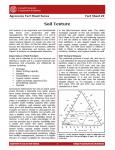
BERRY, W. KETTERINGS, Q. ANTES, S. PAGE, S. RUSSEL-ANELLI, J. RAO, R. DeGLORIA, S. (2007): Soil Texture. Ithaca: Cornell University Cooperative Extension URL [Visita: 09.04.2019]
Infonet-biovision.org is a web-based information platform offering trainers, extension workers and farmers in East Africa a quick access to up-to-date and locally relevant information in order to optimise their livelihoods in a safe, effective, sustainable and ecologically sound way.
INFONET-BIOVISION (2010): Water for Irrigation. Zürich: Biovision URL [Visita: 09.04.2019]
The Guide to efficient plant nutrition management addresses some major issues related to the agronomic management of plant nutrients in an attempt to ensure both enhanced and sustainable agricultural production and to safeguard the environment.
FAO (1998): Guide to Efficient Plant Nutrition Management. Rome: Food and Agriculture Organization of the United Nations (FAO) URL [Visita: 09.04.2019]
This document is an example of a water resources assessment in Haiti.
US ARMY CORPS OF ENGINEERS (1999): Water Resources Assessment Of Haiti. Washington, DC: US Army Corps of Engineers URL [Visita: 09.04.2019]
A short overview about irrigation needs of crops, their water demand and different growth stages. This three page overview is very comprehensibly written and easy to read. It is an introduction to crop selection.
AL-KAISI BRONER (2009): Crop Water Use and Growth Stages. Colorado State University Extensions: Fort Collins URL [Visita: 09.04.2019]
http://www.omafra.gov.on.ca/english/crops/index.html
[Visita: 09.04.2019]
The Ontario Ministries website offers a lot of information about different needs of crops. This includes soil types, crop types, nutrient management, water management and general agriculture tips.
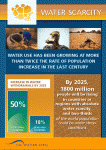
Thematic Factsheet on Water Scarcity. The world contains an estimated 1 400 million cubic km of water. Only 0.003% of this vast amount, about 45 000 cubic km, are what is called "fresh water resources", i.e. water that can be used for drinking, hygiene, agriculture and industry.
UN Water (2013): Water Scarcity Factsheet. United Nations Water URL [Visita: 09.04.2019]
https://www.infonet-biovision.org/PlantHealth/Crop-rotation
[Visita: 09.04.2019]
This online article describes the crop rotation system, what it is, its effects and practices.
This chapter of Infonet Biovision provides additional information about intercropping and crop rotation. The reader gets to know about difficulties, means and practices.
INFONET BIOVISION (2012): Intercropping and Push-Pull. Zurich: URL [Visita: 09.04.2019]