The conflict sensitivity website aims to understand what “conflict sensitivity” means in practice, in terms of organisational systems as well as during the design, implementation, monitoring and evaluation of specific interventions. It provides information on understanding conflict risk through a series of practical documents, including: Introduction to conflict-sensitive business practice, screening tool for early identification of conflict risk, macro-level conflict risk and impact assessment tool, and project-level conflict risk and impact assessment tool.
Library
The „Community Organisers Toolbox“ by the Education and Training Unit (ETU) in Johannesburg contains simple guides on a wide range of skills that are useful for community organisers. The section on conflict management in organisations presents topics like: How to identify signs and stages of conflict; how to build teamwork and co-operation and to thus minimise the possibility of conflicts; how to manage and resolve conflict situations.
This paper presents groundwater flow simulations, which according to the author could be useful for planning and design of groundwater dams.
ONDER, H. ; YILMAZ, M. (2005): Underground Dams. A Tool of Sustainable Development and Management of Groundwater Resources. Entradas: European Water : Volume 11 , 35-45. URL [Visita: 10.05.2011] PDFINCORE (International Conflict Research Institute) promotes conflict resolution management strategies. It aims at influencing policymakers and practitioners involved in peace, conflict and reconciliation issues while enhancing the nature of international conflict research. Issue sheets, publications and other resources can be downloaded.
Water quality testing is necessary in many emergency situations. This WELL factsheet describes some of the key options available to undertake rapid assessment (microbiological quality test and alternative methods) of water sources to determine their suitability for the supply of drinking water to affected communities.
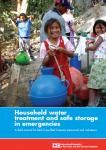
This well-illustrated manual can be used for the promotion of household water treatment and the safe storage of drinking water in emergencies. The easy-to-understand chapters on the three household water treatment methods disinfection, sedimentation and filtration (including factsheets which can be used as posters) are followed by instructions of safe storage and handling of drinking water. It also includes information on how to promote such methods.
IFRC (2008): Household Water Treatment and Safe Storage in Emergencies. A Field Manual for Red Cross/Red Crescent personnel and volunteers. Geneva: International Federation of Red Cross and Red Crescent Societies URL [Visita: 04.05.2011]Experiences and best practices that have been learnt in this case study in Ghana are shared and recommendations made to enhance sustainable operation and maintenance of small towns water supply systems.
OBUOBISA-DARKO, A. ASIMAH, S. E. WEDC (2005): Maximizing the Benefits from Water and Environmental Sanitation. Sustainable Operation and Maintenance of Small Towns Water Supply Systems in Ghana. (= WEDC Conference , 31 ). Kampala: Water, Engineering and Development Centre (WEDC). [Accessed: 03.05.2011] PDFThis essay is about the human right to water and sanitation that has been established in 2010. The author shows the development of the right and discusses possibilities how it could be realised.
WINKLER, I. DIM (2011): Lebenselixier und Letztes Tabu. Die Menschenrechte auf Wasser und Sanitärversorgung. (= Essay , 11 ). Berlin: Deutsches Institut fuer Menschnerechte (DIM) URL [Visita: 02.05.2011]Language: German
This document contains a worldwide list of suppliers for urine diversion squatting pans. The tables of suppliers provided here are not complete listings but give only an indication of available products. If you spot errors or omissions, please contact the authors at ecosan@giz.de. In the brackets below each listing the date for provision of the information/last update of information is given. Please be aware that not all information is from 2011. An entry in this list does not imply a recommendation by GIZ. Costs are indicative only.
MUENCH, E., v. WINKER, M. GIZ (2011): Appendix 2 of technology review of urine diversion components. Worldwide listing of suppliers for urine diversion squatting pans (for UDDTs or for urine diversion flush toilets). (= Technology Review ). Eschborn: Deutsche Gesellschaft für Internationale Zusammenarbeit (GIZ) GmbH URL [Visita: 29.04.2011]This document contains a worldwide list of suppliers for urine diversion pedestals/seats (for UDDTs or for UD flush toilets). The tables of suppliers provided here are not complete listings but give only an indication of available products. If you spot errors or omissions, please contact the authors at ecosan@giz.de. In the brackets below each listing the date for provision of the information/last update of information is given. Please be aware that not all information is from 2011. An entry in this list does not imply a recommendation by GIZ. Costs are indicative only.
MUENCH, E., v. WINKER, M. GIZ (2011): Appendix 3 of technology review of urine diversion components. Worldwide listing of suppliers for urine diversion pedestals/seats (for UDDTs or for UD flush toilets). (= Technology Review ). Eschborn: Deutsche Gesellschaft für Internationale Zusammenarbeit (GIZ) GmbH URL [Visita: 29.04.2011]A short movie by the Ford Foundation about the live of human scavengers in India. The film was prepared around the year 2002 and shows quite stark images. It starts with an interview with the former director of Navsarjan, Martin Macwan, an India-based human rights organization, which works to "eliminate discrimination based on caste and untouchability practices, to assure equality of status and opportunities for all, and ensure the rule of law".
The training manual on conflict management is meant for leaders of different categories as a tool to assist them in managing potential conflicts likely to emerge. The main parts constituting this manual are the following: the concept of conflict, conflict analysis, causes of conflict, the way people respond to conflict or styles of behaviour, conflict prevention and resolution mechanisms. In addition, the document provides practical exercise.
NURC (2006): Training Manual on Conflict Management. Kigali: The National Unity and Reconciliation Commission (Republic of Rwanda). [Accessed: 26.04.2011] PDFThis Waterwiki-page gives an overview of approaches to prevent, minimise or manage conflicts in local water management projects. The article discusses ways to prevent or minimise such conflicts that can be incorporated into the design of a project and methodologies for resolving conflicts when communities are faced with such situations.