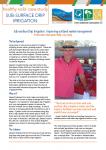
This is an article about the efforts of an Australian pioneer of sub-surface drip irrigation and his ideas and solutions.
CRC (n.y): Healthy Soil Case Study. Sub-Surface Drip Irrigation. Narrabri: Cotton Catchment Communities. [Accessed: 24.06.2011] PDFLibrary
This paper helps to understand that the relationship between soil, water and plants is the first and most critical step in knowing how to design a water efficient irrigation system.
NETAFIM (2009): Subsurface Irrigation. Fact vs. Fiction. Fresno: NETAFIM URL [Visita: 24.06.2011]This website contains a short description of drip irrigations systems.
The objectives of this project were to develop crop-specific guidelines for Best Management Practices of subsurface irrigation systems for alfalfa, including system design criteria, identifying optimal irrigation and fertigation practices, crop water use and soil salinity patterns under SDI systems and developing crop coefficients for use with standard state-provided reference evapotranspiration.
PHENE, C.J. (2004): Subsurface Irrigation. Increased Yield, Quality and Water Use Efficiency of Alfalfa. Fresno: NETAFIM URL [Visita: 24.06.2011]This paper analyses solar-powered drip irrigation as a strategy for enhancing food security in the rural Sudano–Sahel region of West Africa.
BURNEY, J. WOLTERING, L. BURKE, M. NAYLOR, R. PASTERNAK, D. (2009): Solar-powered Drip Irrigation Enhances Food Security in the Sudano–Sahel. Washington, DC: Proceedings of the National Acedemy of Sciences of the United States (PNAS) URL [Visita: 23.06.2011]Small-scale rural farmers’ perceptions, attitudes and preferences of low-cost drip irrigation systems were investigated through a series of interviews conducted before, during and following their use of such systems. Responses were analysed to determine the technological, socioeconomic and cultural suitability of the systems.
ANDERSSON, L. (2005): Low-Cost Drip Irrigation. On Farm Implantation in South Africa. Lulea: Lulea University of Technology URL [Visita: 23.06.2011]This publication is an attempt to distil current information on irrigation methods that might be appropriate, and to offer some ideas on the possible adoption and adaptation of such methods by small-scale farmers in the semi-arid areas of sub-Saharan Africa.
FAO (1997): Small-scale Irrigation for Arid Zones. Principles and Options. Rom: Food and Agriculture Organisation of the United Nations (FAO) URL [Visita: 23.06.2011]This website is an attempt to distil current information on irrigation methods that might be appropriate, and to offer some ideas on the possible adoption and adaptation of such methods by small-scale farmers in the semi-arid areas of sub-Saharan Africa.
This document is about Ecosan, as a solution to sanitation problems concerning health and contaminated water.
SATISH, S. THAKUR, P. PATANGE, P. ESF (n.y): Sustainable Sanitation Practises Integrating Water and Health. Pune: Ecosan Services Foundation (ESF). [Accessed: 22.06.2011] PDFFour billion low-income people, a majority of the world’s population, constitute the base of the economic pyramid. New empirical measures of their behavior as consumers and their aggregate purchasing power suggest significant opportunities for market-based approaches to better meet their needs, increase their productivity and incomes, and empower their entry into the formal economy.
HAMMOND, A. KRAMER, W. KATZ, R. TRAN, J. WALKER, C. WRI (2007): The Next 4 Billion. Market Size and Business Strategy at the Base of the Pyramid. Washington DC: World Resources Institute (WRI) URL [Visita: 22.06.2011]ESF is working in the diversified sectors in rural, peri-urban and urban areas focusing on the agricultural sector, schools, communities, the Eco-village project, sanitation plans for pilgrimage towns and upcoming projects in local government bodies with a participatory approach and cost effective sustainable sanitation solutions. This document shows some examples.
THAKUR, P. PANSE, D. ESF (n.y): Success Stories of Sustainable Sanitation Initiatives in India by ESF. Pune: Ecosan Services Foundation (ESF). [Accessed: 22.06.2011] PDFIn this paper, a large scale Ecosan capacity building project for introducing the Ecosan approach to several target groups in India is described.
PANSE, D. HEEB, J. SATISH, S. ESF (2007): Large Scale Ecosan Capacity Building Project in India. (= UNESCO-IHP Symposium ). Pune: Ecosan Services Foundation (ESF). [Accessed: 22.06.2011] PDFThe report highlights that overall benefits from investing in water and sanitation are likely to be large, but that there are wide variations depending on the type of investments made along the water and sanitation services “value chain” and the local conditions.
OECD (2011): Benefits of Investing in Water and Sanitation. An OECD Perspective. Paris: Organisation for Economic Co-Operation and Development (OECD) Publishing URL [Visita: 22.06.2011]This report contains an analysis of the economic incentive to adopt more water efficient sprinkler systems using lettuce as a case study. The economic model draws on several Department of Agriculture studies on the performance of sprinkler systems and yield-water relationships for lettuces on the Swan Coastal Plain.
BRENNAN, D. CALDER, T. (2006): The Economics of Sprinkler Irrigation Uniformity: A Case Study of Lettuce on the Swan Coastal plain. Clayton South: Commonwealth Scientific and Industrial Research Organisation (CSIRO) URL [Visita: 21.06.2011]This very short paper accurately describes different sprinkler and identifies important aspects for choosing the correct system.
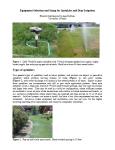
SCHERER, T. (2010): Selecting a Sprinkler Irrigation System. Fargo: North Dakota State University (NDSU) URL [Visita: 21.06.2011]This document describes small-scaled sprinkler and drip systems and also discusses the technical aspects.
NEIBLING, H. ROBBINS, J.A. (n.y): Equipment Selection and Sizing for Sprinkler and Drip Irrigation. Idaho: University of Idaho URL [Visita: 21.06.2011]