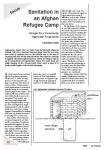
This brief paper describes project design for the delivery of 6’000 family pit latrines in an Afghan refugee camp within a few months. For the superstructure a small hut made of mud blocks was chosen due to the climate conditions with extremely hot summers and winter frosts.
HEINZ, C. (1996): Sanitation in an Afghan Refugee Camp. Design for a Community Approach Programme. Entradas: AT Forum 7, p.96. [Accessed: 02.08.2011]: PDFLibrary
These guidelines give technical managers of excreta disposal in emergencies practical assistance in planning and implementing such programmes. The document includes a standard logical framework, and many technical details.
OXFAM (2000): Guidelines for Excreta Disposal in Emergencies. An Oxfam Technical Manual. Oxford: OXFAM URL [Visita: 02.08.2011]In this manual existing, innovative and new technologies and approaches for excreta disposal in emergency situations are investigated. It provides practical guidance on how to select, design, construct and maintain appropriate excreta disposal systems to reduce faecal transmission risks and protect public health in emergency situations.
HARVEY, P.A. (2007): Excreta Disposal in Emergencies. A Field Manual. Leicestershire: WEDC Loughborough University URL [Visita: 29.07.2011]The UNEP Resource Centre for Mainstreaming Environment into Humanitarian Responses provides an overview of various sources related to WASH emergency responses – trying to emphasise the role of environment in WASH emergency responses.
This extensive technical paper addresses the observed and projected changes in climate as they relate to water, discusses impacts of climate change and water resources on sectors and systems, analyses regional aspects of climate change and water resources, discusses climate change mitigation measures and water, and policy implications. It is the sixth paper in the IPCC Technical Paper series.
BATES, B.C. ; KUNDZEWICZ, Z.W. ; WU, S. ; PALUTIKOF, J.P. (2008): Climate Change and Water. Technical Paper of the Intergovernmental Panel on Climate Change. Geneva: IPCC Secretariat URL [Visita: 24.07.2011]The research papers presented in the Environment and Conflict Transformation series stem from the ECONILE and "NCCR North South, Research Partnerships for Mitigating Syndromes of Global Change" projects. The various papers available online focus on conflicts over the use of renewable resources and the environment, and how such conflicts can be prevented, or transformed into cooperative relations.
This dissertation contributes to the concept of a common management scheme to avert excessive prices for water and deterioration of the resource on the whole in the North-West Sahara Aquifer System (NWSAS) which is one of the largest groundwater systems of the world and providing water in Algeria, Tunisia and Libya. It warns on increasing costs of deteriorating ground water level and attraction of saline waters.
SIEGFRIED, T.U. (2004): Optimal utilization of a non-renewable transboundary groundwater resource. Methodology, case study and policy implications. Dissertation. Zurich: ETH URL [Visita: 24.07.2011]The objective of this extensive report is to provide a comprehensive, long-term and regional framework for thinking about water in the Middle East (Israel, the Palestinian Territories, Jordan, Lebanon, Syria, Iraq and Turkey), in order to engage political leaders, media and the public in harnessing and managing collaborative solutions for sustainable regional water management.
STRATEGIC FORESIGHT GROUP (2011): Blue Peace. Rethink Middle East Water. Mumbai: Strategic Foresight Group URL [Visita: 24.07.2011]This informative site from the Climate Institute provides practical information about the impact of climate change on water and various further references.
This short paper elaborates on characteristics of water-related violence, where and how it occurs but also underlines how common water interests can stimulate cooperation. The policy brief is aiming at the UN system by concluding that it should establish a program of preventive diplomacy focused on water.
CARIUS, A. DABELKO, G.D. WOLF, A.T. (2004): Water, Conflict, and Cooperation. Policy Brief – The United Nations and Environmental Security. (= ECSP Report , 10 ). Nairobi: UNEP URL [Visita: 24.07.2011]