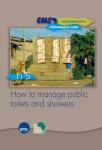
The purpose of this decision-making aid is to provide practical advice and recommendations for managing toilet blocks situated in public places. It is primarily aimed at local decision-makers in developing countries and at their partners (project planners and managers).
TOUBKISS, J. (2010): How to Manage Public Toilets and Showers. (= Six Methodological Guides for a Water and Sanitation Services' Development Strategy , 5 ). Cotonou and Paris: Partenariat pour le Développement Municipal (PDM) and Programme Solidarité Eau (pS-Eau) URL [Visita: 19.10.2011]Library
This short factsheet informs about how sanitation is connected with questions of dignity, equality and safety, including questions of gender, disabilities, etc.
UN WATER (n.y): Sanitation Brings Dignity, Equality and Safety. (= Factsheet , 3 ). United Nations Water (UN WATER) URL [Visita: 17.10.2011]This short factsheet is a good overview on the right to water and sanitation, including latest achievements as well as ideas for taking action.
UN WATER (n.y): Sanitation for All: Making the Right a Reality. (= Factsheet , 1 ). United Nations Water (UN WATER) URL [Visita: 17.10.2011]The guidance document is a booklet prepared by the UNHCR water and sanitation division. It introduces water and sanitation and the UNHCR`s guiding principles and goals. It lays out the guiding principles of water and sanitation provision and then detailed guidance for emergency and stable phases. The documents also address durable solution the issues of advocacy and provide guidance on access to technical support. It provides information on operations and maintenance considerations throughout the document.
UNHCR (2008): A Guidance for UNHCR Field Operations on Water and Sanitation Services. Geneva: UNHCR Water and Sanitation Unit URL [Visita: 17.10.2011]This article shows the link between improved sanitation, sexual (gender) discrimination and health issues.
This study aims to analyse climate related disasters risk reduction governance in the European context. There is a particular focus on the flow of information from researchers to policy makers and the way in which the decision-making process in climate adaptation and risk reduction is commonly managed. The study confines itself to Europe and looks into practical cases of European regional and national adaptation strategies.
EUR-OPA ; UNISDR (2011): Climate Change Adaptation and Disaster Risk Reduction in Europe. A Review of Risk Governance. Strasbourg: Council of Europe (EUR-OPA) and United Nations International Strategy for Desaster Reduction (UNISDR) URL [Visita: 17.10.2011]Irrigation water reallocations are playing an increasingly important role both in developed and developing countries. With growing urban and environmental water demands, rising cost for the development of new water supplies, and irrigated agriculture usually including the least economically valuable use of water, transfers of irrigation water to alternative uses are increasing. However, such reallocations are often controversial, and it is often questioned whether the benefits resulting from these transactions are large enough to outweigh the associated costs. The study, which is based on Economic and Sector Work (ESW) in the Water Anchor, reviews the experience with irrigation water transfers, including the involvement of the World Bank.
THE WORLD BANK (2011): Assessing Direct Economic Effects of Reallocating Irrigation Water to Alternative Uses. Concepts and an Application. URL [Visita: 17.10.2011]A micro-irrigation system design based on a control volume method using the back step procedure is presented in this study. The proposed numerical method is simple and consists of delimiting an elementary volume of the lateral equipped with an emitter, called “control volume” on which the conservation equations of the fluid hydrodynamics are applied.
ZELLA, L. ; KETTAB, A. ; CHASSERIAUX, G. (2006): Design of a Micro-Irrigation System Based on the Control Volume Method. Entradas: Biotechnology, Agronomy, Society and Environment : Volume 10 , 163 – 171. URL [Visita: 17.10.2011]This impact assessment identifies how the water and sanitation initiatives implemented under the Water Sanitation and Infrastructure Branch of UN-HABITAT, have strategically mainstreamed gender aspects in its various initiatives. It shows achievements and impact, challenges, lessons learned and provides recommendations.
UN HABITAT (2011): Gender Mainstreaming Impact Study. (= Water and Sanitation Trust Fund Impact Study Series , 4 ). Nairobi: United Nations Human Settlements Programme (UN-HABITAT) URL [Visita: 17.10.2011]Irrigation water supply can significantly improve the lives of poor households in developing countries. However, the reliable supply of irrigation is often hindered by corrupt practices at different levels of the irrigation sector. The main corruption risks identified in this study result from poor irrigation governance. Canal irrigation, tubewell irrigation and wastewater irrigation are identified as three types of irrigation systems with specific governance and corruption risks. In public canal irrigation, the largest risk is related to capital intensive investments, and operation and maintenance by irrigation officials. In tubewell irrigation, corruption risks are mainly related to the regulation of groundwater overdraft. Wastewater irrigation is an informal practice with few corruption risks. However, the lack of formal governance increases health risks related to wastewater use. As formalisation of the sector is on its way, vigilance is required to prevent corruption in the future. The identified corruption risks can be addressed by taking case-specific action to increase transparency, accountability and participation at different levels of the irrigation sector.
WIN (2011): Corruption Risks and Governance Challenges In the Irrigation Sector. Berlin: Water Integrity Network (WIN) URL [Visita: 17.10.2011]This factsheet briefly shows the connections between toilets and business.
UN WATER (n.y): Sanitation is a Good Economic Investment. (= Factsheet , 4 ). United Nations Water (UN WATER) URL [Visita: 17.10.2011]This factsheet shows the links between improved sanitation and health in a short overview.
UN WATER (n.y): Sanitation is Vital for Good Health. (= Factsheet , 2 ). United Nations Water (UN WATER) URL [Visita: 17.10.2011]The Latin American and Caribbean countries have seen growing pressure on water resources, with increasing demand and costs, for agricultural, domestic and industrial consumption. This has brought about the need to maximize and augment the use of existing or unexploited sources of freshwater. There are many modern and traditional alternative technologies for improving the utility and augmenting the supply of water being employed in various countries, but with limited application elsewhere due to the lack of information transfer among water resources managers and planners. This book was prepared to provide water resource managers and planners, especially in developing countries and in countries with economies in transition, with information on the range of technologies that have been developed and used in the various countries throughout the world.
UNEP (1998): Source Book of Alternative Technologies for Freshwater Augmentation in Latin America and the Caribbean. Nairobi: United Nations Environment Programme (UNEP) URL [Visita: 17.10.2011]The goal of the Global Scaling Up Handwashing project (HWWS) is to reduce the risk of diarrhea and therefore increase household productivity by stimulating and sustaining the behavior of handwashing with soap at critical times for 5.4 million people in Peru, Senegal, Tanzania, and Vietnam. This document summarises findings from the impact evaluation baseline survey in Senegal.
ORSOLA-VIDAL, A. YUSUF, A. (2011): Scaling Up Handwashing Behaviour. Findings from the Impact Evaluation Baseline Survey in Senegal. (= Technical Paper ). Washington DC: Water and Sanitation Program (WSP) URL [Visita: 17.10.2011]This document annually informs about the progresses concerning the Millennium Development Goals (MDG's) of the United Nations.
UN (2011): (The) Millennium Development Goals Report 2011. New York: United Nations (UN) URL [Visita: 17.10.2011]This factsheet shortly describes how sanitation can add to sustainability in an environmental way.
UN WATER (n.y): Sanitation Sustains Clean Environments. (= Factsheet , 5 ). United Nations Water (UN WATER) URL [Visita: 17.10.2011]This article explains what a high-efficiency urinal is and includes a list of water sense urinals.
KOELLER, J. GAULEY. B. (2009): High-Efficiency Urinals (HEUs) U.S. and CANADA. Yorba Linda and Mississauga: Koeller & Company and Veritec Consulting Inc. URL [Visita: 13.10.2011]