This presentation gives an overview on different ecosan technology components including source separated collection/treatment systems; treatment of blackwater fraction; treatment of greywater; rainwater harvesting; vermicomposting of organic waste.
WAFLER, M. (2007): Overview of Ecosan Technology Components. Basel: seecon international gmbhLibrary
This article addresses the potential of anaerobic technology in the treatment and management of toilet wastes at schools, camps and prisons. It is based on the pilot project that was set up at Cyangugu prison in October 2000, Kigali, Rwanda.
BUTARE, A. ; KIMARO, A. (2002): Anaerobic technology for toilet wastes management: the case study of the Cyangugu pilot project. In: World Transactions on Engineering and Technology Education: Volume 1 , 147-152.This document provides a good overview of the importance of improving water use efficiency in respect to irrigated agriculture. Furthermore, this paper contains many useful definitions, such as water use efficiency and deficit irrigation.
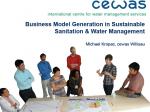
BOUTRAA, T. (2010): Improvement of Water Use Efficiency in Irrigated Agriculture: A Review. In: Journal of Agronomy: Volume 9 , 1-8.This PowerPoint explains the concept of a business model and how it is critical for the success of a business, particularly in the field of sustainable sanitation & water management.
KROPAC, M. (2013): Business Model Generation in Sustainable Sanitation & Water Management. Willisau: cewas – the international centre for water management servicesWhy are decentralised wastewater treatment systems (DEWATS) needed? This powerpoint presentation follows this question, arguing, that decentralisation as an approach is necessary to overcome problems related to wastewater treatment.
BORDA (2003): Design Principles for Decentralized Wastewater Treatment Systems (DEWATS). Bremen Overseas Research and Development Association (BORDA)This study reviews the potential health risks and current epidemiological evidence for actual risks from pathogen transmission through wastewater aquaculture.
STRAUSS, M. (n.y): Health (Pathogen) Considerations Regarding the Use of Human Waste in Aquaculture. (pdf presentation). Switzerland: Department of Water and Sanitation in Developing Countries at the Swiss Federal Institute of Aquatic Science and TechnologyAn excellent training is nothing without an excellent trainer. This publication covers basic guidelines and tips to help improve your training skills. The following areas are covered: Preparation, Establishing Confidence, Setting the Tone, Facilitating Discussion, and Ending.
ALAMEDA COUNTY PUBLIC HEALTH DEPARTMENT (2007): Train the Trainer: Basic Training Guidelines. Alameda: Alameda County Public Health DepartmentThis case study describes safety and O&M planning activities carried out for the NaWaTech project site at Ordnance Factory Ambajhari.
NICOLICS, S. ; HEWITT, D. ; POPHALI, G.R. ; MASI, F. ; NAGARNAIK, P. ; PANSE, D. ; LABHASETWAR, P.K. ; MEINHOLD, K. ; LANGERGRABER, G. (2015): Application of the NaWaTech safety and O&M planning approach re-use oriented wastewater treatment lines at the Ordnance Factory Ambajhari, Nagpur, India. In: Proceedings of the 9th International Workshop "Nutrient Cycling and Retention in Natural and Constructed Wetlands":